From the Archives: “Bestselling Author and the BIG Move to Self-Publishing”

Welcome back to our Tuesday segment, where we’ll be revisiting some of our most popular posts from the last few years.  What’s stayed the same?  And what’s changed?  We’ll be updating you on the facts, and taking a new (and hopefully refreshing) angle on a few timeless classics of Self Publishing Advisor.

∗∗∗∗∗

[ Originally posted: November 4th, 2010 ]

Ten years after the success of his debut novel, bestselling author of “Kidnapped,” AJ Davidson, has made the switch to independent self-publishing. With the availability of full-service publishing options on the rise and the high profile moves of established authors to independent publishing, AJ discusses the increasing appeal of this new model for traditionally published authors.

Q: What was the deciding factor for moving to independent publishing?

A: Initially I wasn’t entirely sure if Indie publishing was right for me. The deciding factor was how traditional publishers seem to be narrowing the range of their lists with each passing year. I recently compared 1970s best sellers with the 2010 best sellers and was staggered to realize how many of the chart-topping writers of yesteryear are still there four decades later. Kudos to the authors for consistency, but the dearth of new names is a sad indictment for the publishing world. The smaller presses are more adventurous, but more often than not the marketing will be left to the author, and if that’s the case, then Indie publishing is the way to go.

Q: Now that you manage the marketing independently as well as the publishing, do you find it difficult to switch back and forth between writing and marketing?

A: I have found the change in my writing to be a dramatic one. In the past I was the only one I had to please with a piece of prose. Now I’m much more aware of the readers’ attitudes. As I write I find that I ask myself constantly how the readers would react. This transformation is due largely to the immediacy of Indie publishing. With a traditionally published book there can be years between writing and publication. Your agent might suggest minor changes. It may then take time for the manuscript to be accepted. The publishers will nominate a slot, often a year or more in the future. Libel lawyers may have to cast an eye over it. Copy and proof editors will refine the work. Artwork will be done. By the time the book hit the shops, the writer will have moved on, often immersed in another project. I often felt a sense of detachment from a book by the time it was published.

Q: The list of well-known authors that are moving toward Independent publishing structures continues to grow. Do you think this is opening up possibilities for less established authors or monopolizing what was formerly their only option?

A: I’m optimistic about the future of Indie publishing and would buy shares in Smashwords faster than in Barnes & Noble. The fate of the traditional bookstore will be down to specialization. I doubt if they can continue being all things to all people. We already see some very successful stores concentrating in one or two genres. This genre specialization will develop, and no doubt the giants of the retail industry have a trick or two yet. I expect some form of stratification will enter Indie book publishing.

Perhaps a division between the one book author and the multiple author. Certainly we have seen a rise in the popularity of book series in the last decade and readers do enjoy embarking on journeys with writers they admire. It is anyone’s guess where will this leave the authors of a single text. Bad news for the Harper Lees and Margaret Mitchells.

Q: You give your work away for free. Can you explain your strategy on this?

A: Giving away the occasional free book is an established marketing tool. The first Walter Mosley book I read was a magazine freebie, and I became a huge fan. It’s a great way of increasing consumer awareness. I have had readers read my free e-books, then go buy the paperback. I still have the Mosley book, but I also bought another edition of it.

Q: How relevant is your success with traditional publishing to your reputation as an independent author?

A: Being a traditionally published author who switched to Indie does lend a degree of credibility. But reputations do not sell books. Positive word of mouth is the magic key to high number book sales and the only thing that will generate that is a damned good story. Admittedly the snowball rolling down a hill effect will be faster for a moderately well known author. It would be nice to be still amongst the best sellers in forty years time.

From the Huffington Post, October 29th 2010

So how did that work out, anyway?

Pretty good, actually.

When you visit AJ Davidson’s website now, it’s not a flashy page full of advertisements for his books––it’s a blog, a simple blog hosted by WordPress and packed with useful tidbits of information, including the latest gem from January 17th of 2017:

AJ Davidson has become the second Irish writer to join Radish, the serial fiction platform based on the incredibly successful model used in China and Korea. Paper Ghosts, Davidson’s most downloaded book (1,400,000) will be available in the near future, closely followed by a sequel released on a serial basis.

Can you imagine––almost one and a half million downloads of just one book? Yeah, Davidson may not be making the news the same way (after all, to do so, he’d have to self-advertise and aggressively) but he’s being productive in the way that counts most for an author: sales and distribution.

AJ Davidson
Author Photo

So why revisit this blog post?

It’s because we’re so used to stories of self-publishing authors “gone big,” gone over to traditional publishing after having been scouted by some enterprising soul within that industry. And don’t get us wrong, we love the stories about Andy Weir’s The Martian and Christopher Paolini’s The Inheritance Cycle as much as anybody––but they’re not the only Cinderella stories out there. We have people like AJ Davidson, too, who defected from traditional publishing to move into the world of indie books because he saw the value in shaking off old modes of thinking. (And yes, there are other authors who defect for other reasons, including neglect or downright mistreatment from their publishing houses and marketing teams.)

The story of self-publishing and who chooses to do it is more rich and varied than we ever could have imagined, in 2010. Some indie authors have risen up who never knew any other way of life and publishing, and some have crossed over in each direction from traditional to indie and vice versa, and some still perceive it as the last haven of the desperate. But the stigma is fading, both as the tools for self-publishing improve each year, and as people begin to realize what many of us have always known: Everyone has something to say worth hearing, and self-publishing is the most effective, affordable, and natural way of saying it.

The news may seem a bit bleak overall just now, with political upheaval across the globe and many people still mired in despair, but there is a ray of hope. It may not be able to touch everything––but maybe it can, at that. The future of self-publishing is secure in people like AJ Davidson and in you, and your stories have a home.

Thanks for reading.  If you have any other ideas, I’d love to hear them.  Drop me a line in the comments section below and I’ll respond as quickly as I can.  ♠


Kelly

ABOUT KELLY SCHUKNECHT: Kelly Schuknecht is the Executive Vice President of Outskirts Press. In addition to her contributions to the Outskirts Press blog at blog.outskirtspress.com, Kelly and a group of talented marketing experts offer book marketing services, support, and products to not only published Outskirts Press authors, but to all authors and professionals who are interested in marketing their books and/or careers. Learn more about Kelly on her blog, kellyschuknecht.com.

Self-Publishing News: 2.27.2017

And now for the news!

This week in the world of self-publishing:

Milo Yiannopoulos, who just resigned from Breitbart News on Tuesday after some highly condemned comments about pedophilia, is currently in an interesting position as far as being an author goes. When a lucrative book deal falls through due to this level of bad press, celebrity figures of Yiannopoulos’ status find themselves in the same position of aspiring authors of lesser status; no publishing company will touch their book.

In this article, James Hibbard points to other celebrity figures who’ve been in a similar situation to Yiannopoulos, such as O.J. with his title If I Did it with a hypothetical confession of the double murder and Bret Easton Ellis’ American Psycho with its graphic and violent  content that angered too many people. Seeing as how the O.J. book was picked up and sold over 100,000 copies through a small publishing house, there is speculation that something similar could happen for Yiannopoulos. Jason Pinter, a publisher with Polis Books says, “I think it’s going to be a situation like with the O.J. book, where even if somebody publishes it, a lot of bookstores will refuse to carry it.” The logic follows, if bookstores won’t carry it, publishers probably won’t want to touch it, no matter how many copies he pre-sold, especially if those pre-sold copies were to his previous supporters who have since abandoned him do to his lewd comments.

So I guess the moral of this story is…even if you’re a celebrity with a huge social media and right wing media platform, you could still very easily end up in the shoes of those of us who can’t get a publishing company to touch our work. Silver linings: at least ours isn’t ignored or pushed aside because of infamy.

If you’re looking for a fantastic, in-depth and honest article about self-publishing children’s books, look no further than this piece by Ashley Eneriz. Eneriz begins with the priciest part of children’s books: the illustrations.

Eneriz gives a rough estimate for what a quality illustrator might cost, so you can know if you’re being high or low balled right off the bat, which I found useful because a lot of people don’t know what a reasonable price is for a book with a color cover and 20-40 color illustrations inside.

As far a time as something that was “spent” by Eneriz, she says that she spent about an hour a week for 15 weeks, which when you break it down like that, doesn’t sound too shabby for writing an entire book (albeit one for children)! Another time commitment she had to invest was in-person marketing at craft fairs and other special events, as she said that almost none of the 2,000 copies she sold the first year were online sales.

So, her final questions was, “is it worth it?”. While admitting that she barely broke even and that she makes more money in a month at work than she did in a year of selling her books, it was a dream come true for her, which was ultimately priceless. Sometimes, profit is not the goal, but following our passion is. If you think writing is a get-rich-quick scheme, sure, you may be disappointed, but hopefully you write for the love of it and not the love of money.


spa-news

As a self-publishing author, you may find it helpful to stay up-to-date on the trends and news related to the self-publishing industry. This will help you make informed decisions before, during and after the self-publishing process, which will lead to a greater self-publishing experience. To help you stay current on self-publishing topics, simply visit our blog every Monday to find out the hottest news. If you have other big news to share, please comment below.


Kelly

ABOUT KELLY SCHUKNECHT: Kelly Schuknecht is the Executive Vice President of Outskirts Press. In addition to her contributions to the Outskirts Press blog at blog.outskirtspress.com, Kelly and a group of talented marketing experts offer book marketing services, support, and products to not only published Outskirts Press authors, but to all authors and professionals who are interested in marketing their books and/or careers. Learn more about Kelly on her blog, kellyschuknecht.com.

Decluttering … Clearing the Mental Clutter

Continuing the series Inspired by The Life-Changing Magic of Cleaning Up: The Japanese art of decluttering and organizing by Marie Kondo, let’s spend some time this week talking about the ways in which we can declutter our minds as writers.

mindful mindfulness

You know how it goes; you sit down to write and you start thinking about that item you need to add to the grocery list, you recall that really annoying thing a coworker said to you and you start analyzing why he or she said it in the first place, you remember that your child has a soccer practice tomorrow and you start mentally trying to figure out if you have time to pick her up afterward or if you should arrange a ride for her with another player’s parents…the list goes on. Now if you’re capable of simply “emptying your mind” of all of this useless information by a simple exercise of willpower…kudos. If you’re like me, and need some reminders for how to declutter your headspace, here are some things to consider:

  • Write down all of these bizarre and/or unproductive thoughts you’re having. Putting these things down on paper empties your mind of them, allows you to look at them, analyze them and then put them aside for a time when they become more relevant. Also, any writing gets the writing juices flowing. Who knows, maybe stream of conscious ranting about an interaction at work could create a meaningful dialogue in an upcoming chapter of yours!
  • Focus or meditate on nothing. ‘Now empty your mind of all of your worries and attachments,’ she says, calm as a cow in the downward dog position, her yoga pants screaming enlightenment as she hums a long ‘Ommmmmmmmmm,’ followed by Namaste–or something ridiculously cliché to that same effect. As silly as it sounds, trying to think of ‘nothing,’ or meditating is serious business, and something I would never call myself talented at. Trying to actually let go of the idea that you and all of your little problems and anxieties are at the center of the universe is like trying not to blink. Practicing this focus on nothing will help temporarily remove our focus on that giant ego we all have (and would never, if only begrudgingly admit to having), and help you become present in the task at hand: namely, writing.
  • Put on some music, and go out for a walk or run or a spin on the bike. Exercise (with or without music) is a fantastic way to help you process all of those nagging thoughts cluttering up your mind space. Exercising with music supposedly activates your frontal lobe (the area in your brain associating with higher mental function), and not only that, it gives you something else to meditate on–lyrics perhaps. Focus on the words in the song, seek inspiration in the creativity of music. Meditate on putting one foot in front of the other if the whole Namaste thing is too much for you. Moving meditation is my favorite form, and it always helps boost my creativity.
  • Take a nap. If you have way too much going on in your head to write, take a snooze. Let those things drift away into Never Never Land and wake up feeling refreshed. A nap is like a reset button later in the day. We only get more and more stressed out starting the minute we shut off the alarms anyway, so go back into that bliss-like state of nothingness that is slumber. Maybe you’ll even dream up an interesting scenario for your main character to overcome in the midst.
  • Listen to a podcast or call a friend. A one-sided conversation with a podcast is my favorite means for readjusting my focus. If I want to write about anxiety or loneliness and I’m unable to focus, I’ll search YouTube to see what some of my literary or philosophical love interests have said on the matter. Listening to someone I truly respect and whose opinion I long to have on any matter in my life always get my brain gears turning. Especially since I can’t talk back to them, but can only entertain the conversation in my mind. This makes me want to write to no avail; it makes me want to express my thoughts triggered by someone else’s ideas. This same effect can be achieved by calling a friend who you love discoursing with as well–just make sure to not get too carried away and forget to get back to work at all. 


Thank you for reading!  If you have any questions, comments, suggestions, or contributions, please use the comment field below or drop us a line at selfpublishingadvice@gmail.com.  And remember to check back each Wednesday for your weekly dose of marketing musings from one indie, hybrid, and self-published author to another. ♠


Kelly

ABOUT KELLY SCHUKNECHT: Kelly Schuknecht is the Executive Vice President of Outskirts Press. In addition to her contributions to the Outskirts Press blog at blog.outskirtspress.com, Kelly and a group of talented marketing experts offer book marketing services, support, and products to not only published Outskirts Press authors, but to all authors and professionals who are interested in marketing their books and/or careers. Learn more about Kelly on her blog, kellyschuknecht.com

From the Archives: “Back to Writing on the Road to Self-Publishing”

Welcome back to our Tuesday segment, where we’ll be revisiting some of our most popular posts from the last few years.  What’s stayed the same?  And what’s changed?  We’ll be updating you on the facts, and taking a new (and hopefully refreshing) angle on a few timeless classics of Self Publishing Advisor.

∗∗∗∗∗

[ Originally posted: May 18th, 2010 ]

Ezines – they are a fast and free opportunity to self publish. Moreover, publishing in ezines can help you get motivated to write your book, and even promote your book after publication.

We’ve discussed the idea of publishing excerpts of your book as individual articles or stories. You can simply locate a website and query that site’s webmaster about publishing your article. Make sure you include your biographical byline, which mentions your book as well.

This is more of the same, but concentrating on ezine publication.

There really are countless ezines in existence now, each with a specific niche or category. And all of them are voraciously hungry for content.

Rather than seeking them out individually, you can place your articles into databases that ezine editors frequent for content. They use your article free of charge, and in exchange, include your biographical byline, which, again, includes information about you and your book.

Here are some to check out:

http://www.ezinearticles.com

http://www.ebooksnbytes.com

http://www.connectionteam.com

http://www.netterweb.com

http://www.ideamarketers.com

http://www.goarticles.com

http://www.knowledge-finder.com

http://www.articlecity.com

Don’t send an article you’ve already published last week. Instead, write another chapter of your book first (since finishing your book the main goal, after all.)

Have fun. Keep writing.

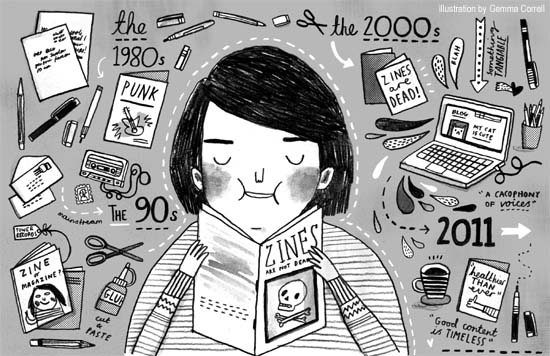
zines e-zines ezines

Well, it’s not 2010 anymore … and what is the state of the zine, much less the state of the e-zine? I haven’t heard as much about these lovely creatures of late as I used to, but that doesn’t mean there isn’t a thriving communiting of ziners floating around the interwebs where I can’t see them.

A quick foray around the news feeds I follow turns up, well, actually, quite a lot! This week alone, zines have been featured in local newspapers from coast to coast, as well as a handful of higher-profile national news magazines and online compendiums. The Hudson Valley One hosted an article just last week titled “Revolution in your hands: New Paltz hosts weekend of zine making & reading,” in which I learned a fabulous nugget of information: there is an actual job description called “Zine Librarian” at the Sojourner Truth Library. How cool is that?? (Very cool.) And two weeks ago, eCollege Times hosted an article titled “Print Isn’t Dead: Take a page from local zine queen Charissa Lucille,” and includes an interview with an ASU alum and zine shop owner from Phoenix, Arizona, who dishes on everything from putting together a team of writers to what the future of zines will look like. And late last month, the OC Weekly hosted an article titled “LibroMobile’s Zine Mission,” about a mobile truck (think of a food truck, just stocked with zines and zine-making materials!) powered by the dreams of one enterprising young woman determined to put the materials for creative self-expression into the hands of area teens. And an article from LA Weekly titled “A New Exhibit Traces the Influence of Zines and Books on L.A.’s Art Scene” hints at the long and ongoing legacy of zines on the West Coast as part of the culture-shaping punk aesthetic.

So zines haven’t gone anywhere. What about e-zines?

Well, there are fewer articles than there used to be. I don’t know if that’s a good thing or not, really. But if you spend much time on the E-Zine Directory (www.ezine-dir.com) you might just find yourself overwhelmed by how many e-zines there are these days. There are e-zines on wine-making and e-zines which are the official newsletters for towns and counties in Alabama. There are e-zines about alternative music and e-zines about spirituality and enlightenment. There are e-zines about feng shui and the paranormal, e-zines about parents of “difficult” children, e-zines about small businesses, and e-zines about voice talent and voice coaching.

In short, there seems to be an e-zine about everything. The content of most e-zines has shifted, however, away from what you might think of as typical “punk” content and the arts/music/literature scene which still dominates the physical zines. E-zines have broadened to become the territory of everyone with something to say ….

And that, as a self-publishing blog dedicated to the freedom of expression, we can get behind.


Thanks for reading.  If you have any other ideas, I’d love to hear them.  Drop me a line in the comments section below and I’ll respond as quickly as I can.  ♠


Kelly

ABOUT KELLY SCHUKNECHT: Kelly Schuknecht is the Executive Vice President of Outskirts Press. In addition to her contributions to the Outskirts Press blog at blog.outskirtspress.com, Kelly and a group of talented marketing experts offer book marketing services, support, and products to not only published Outskirts Press authors, but to all authors and professionals who are interested in marketing their books and/or careers. Learn more about Kelly on her blog, kellyschuknecht.com.

Self-Publishing News: 2.20.2017

And now for the news!

This week in the world of self-publishing:

In a fast-paced world, articles with bullet points (especially numbered ones) seem to rule as far as attention grabbers go. Consumers look and see a title like “8 tips for how to self-publish your novel” and think, ‘I’ll read the all of the emboldened points and skim the ones that interest me most, and then I can get back to my really interesting Facebook news feed.’

Ricardo Fayet, provides one such streamlined list for those thinking about taking the plunge into the self-publishing world. Fayet’s list is one worth going over because, while it is concise, it has some insightful tips that one might not consider off-hand.

  1. Know your audience
  2. Create a writing routine and be consistent with it
  3. Give your manuscript to readers and gather reactions before publishing
  4. “Know your budget and do your research”
  5. “Always hire a developmental editor”
  6. DO NOT design your own book cover
  7. “Don’t think of distribution as digital vs. print” — there’s a market for both!
  8. “Build your mailing list before you publish your book”

Within each of these tips, Fayet has pretty sound advice that is fleshed out succinctly, but with enough information to persuade you that he’s done his research. Click the link above and pluck what piece of writer wisdom you can from it!

For a more heart-warming piece, we’ll turn to the story of Dawn Reed, a woman who had the (quite achievable) dream of publishing a children’s book. Reed’s story had been rejected several times over, which would turn some dreamers into cynics or quitters. However, Reed had a more realistic (and optimistic) understanding of these rejections.

I think of Theodore Geisel (Dr. Seuss) who was rejected by over 20 publishers and Norman Bridwell, writer of the Clifford the Big Red Dog books, who was turned away by 15 publishing companies…and I keep going,” says Reed.

Rather than let the rejections stop her in her tracks, Reed simply chose another route–that of self-publishing. While working with a self-publishing company, a bizarre thing happened. Dawn received an email saying, “Hi. Your dream is over. Your book will never be published…” Reed was obviously crushed, but turned to things such as prayer as a way of coping with what seemed to be both terrible and impossible news.

Luckily, after probing and inquiring about the strange email, she received word “from the Vice President and Director of Production,” she said, “His email account had been hacked, and that’s why I received the harsh notice. I was so relieved!”

If you consider yourself a fellow dreamer, lover of writing and self-publishing, read this article to see how Dawn dealt with the possibility of her dreams being shattered time and time again, and how she turned out to still become a self–published author nonetheless. It’s an inspiring article that I’m sure many of us can empathize with.


spa-news

As a self-publishing author, you may find it helpful to stay up-to-date on the trends and news related to the self-publishing industry. This will help you make informed decisions before, during and after the self-publishing process, which will lead to a greater self-publishing experience. To help you stay current on self-publishing topics, simply visit our blog every Monday to find out the hottest news. If you have other big news to share, please comment below.


Kelly

ABOUT KELLY SCHUKNECHT: Kelly Schuknecht is the Executive Vice President of Outskirts Press. In addition to her contributions to the Outskirts Press blog at blog.outskirtspress.com, Kelly and a group of talented marketing experts offer book marketing services, support, and products to not only published Outskirts Press authors, but to all authors and professionals who are interested in marketing their books and/or careers. Learn more about Kelly on her blog, kellyschuknecht.com.