The Current State of E-Readers | An Author’s Guide (Part III )

Did you know that Barnes & Noble sells an e-reader?  If you haven’t stopped by one of their brick and mortar stores in the last few years, you might never have known.  This is because the tablet in question never quite got the sales momentum that its primary rivals, the Kindle and the iPad, had automatically built in.  (More on that in a moment.)  And the NOOK, as Barnes & Noble has dubbed their creation, already seems to be on the way out.  I stopped by a Barnes & Noble while driving through central Montana, and … gone are the enormous beautiful displays, the wide sweeps of banners and posters emblazened with larger-than-life-size images of the tablet, its logo, and cheery recommendations on what ebook to read next.  It looks as though we’re back to basics when it comes to our favorite (by default, since it’s our only) big brick and mortar bookstore!

But what about the NOOK?  Should you as an author care about the rise and fall of this non-gargantuan piece of technology?  The short answer is yes.  The reasons why can never quite be summarized as a “short answer,” but I’ll do my best to stick to the important bits.

William Lynch, Chief Executive Officer of Barnes & Noble, holds up the new Nook Tablet at the Union Square Barnes & Noble in New York

The first NOOK was launched in October 2009, almost exactly six years ago.  By 2011, the NOOK had captured approximately 13.4% of the total global market share for e-reading devices.  But as 

The NOOK store still does brisk business.  This is in part because readers still love a good physical book in hand, and B&N is now the only large remaining bookseller, and therefore it has both a solid built-in captive audience for its internal promotions.  It may also be attributable in part to the parent company’s deft hand at package deals and perqs.  (If you bring your NOOK into a B&N store, you have free access to their entire ebook collection while there!  Who knew?  Not me, until I started researching for this blog post!)  Here are the numbers according to number-crunching website Statista.com:

NOOK sales according to Statista

As you can see, NOOK sales are certainly, shall we say, “plunging.”  But Statista still reports approximately $263.8 million dollars in sales for 2015 to date, and that’s not an insignificant percentage of the total ebook market.  The real concern, for you as an indie or self-published author, is whether any of those sales translate into profits for authors outside of the traditional Big Five publishing houses.  And that data simply isn’t available, though anecdotal evidence seems to indicate that the NOOK store is not the most profitable place to publish your ebook.  Which is not to say that it’s not a worthwhile place … however, it’s far more likely you’ll connect with a greater number of new readers through the Amazon Kindle store or through Apple’s iTunes/iBooks interface.  This is because most search engines and indexing algorithms will promote results in these two digital stores over that of Barnes & Noble, for whatever reason (and there may be several reasons, some shady and some legitimate, and some mere rumors).  And although Kindle sales have fallen and tablet sales seem to have plateaued across the entire global market, Amazon and Apple have both proven innovative and flexible enough to roll with the punches, and their devices have held up better to changing market demands.

Half of your job as a self-published author is to tackle matters of self-promotion and marketing with the business acumen of an entire PR department and the ruthlessness of a CEO.  Is a strategy proving ineffective?  On the chopping block it goes.  Is one particular edition of your book not selling?  Out the window, sayonara.  Is a social media platform or blogging interface sucking up more of your time than seems worthwhile when balanced against outreach to new readers?  It may be time to refocus.  This is why it’s so vital that you know what’s going on with the NOOK before you decide whether or not you want to pay a hybrid publishing company to publish or spend hours of your own time agonizing over the creation of an ebook edition to sell on the NOOK Store.  If your book is already moderately successful, you may find that it helps round out your total bundle of offerings.  But if you’re just starting out and you don’t have much of a budget, you may want to stick with options that are guaranteed failsafes.

Don’t despair for the NOOK.  Just don’t be sucked into thinking that, just because Barnes & Noble has been around a long time (and now enjoys a certain kind of monopoly over the physical bookstore market), readers will pay back your investment in the NOOK store with any kind of enthusiasm.  As the ebook and ereader markets mature, one thing is becoming increasingly clear: more iterations of the same device will not equate to more ebooks sold and read.  In fact, readers are turning back in droves to the physical book … and that’s not such a bad thing, in the long run.

Thank you for reading!  If you have any questions, comments, suggestions, or contributions, please use the comment field below or drop us a line at selfpublishingadvice@gmail.com.  And remember to check back each Wednesday for your weekly dose of marketing musings from one indie, hybrid, and self-published author to another. ♠

KellyABOUT KELLY SCHUKNECHT: Kelly Schuknecht is the Executive Vice President of Outskirts Press. In addition to her contributions to the Outskirts Press blog at blog.outskirtspress.com, Kelly and a group of talented marketing experts offer book marketing services, support, and products to not only published Outskirts Press authors, but to all authors and professionals who are interested in marketing their books and/or careers. Learn more about Kelly on her blog, kellyschuknecht.com.

The Current State of E-Readers | An Author’s Guide (Part II)

Last week, I launched us into a new series about e-readers, and the pros and cons of using each different e-device (don’t worry, this won’t be quite the epic saga that the Beginner’s Guide to Social Media primer turned out to be!).  This week, I’ll be taking a closer look at perhaps one of the most talked-about e-readers of all time, the Kindle.  No doubt you’ve heard a lot about Amazon’s entry into the e-book sphere before, and elsewhere, in part because it was launched by a massive company still on the upswing in popularity, with the built-in infrastructure to ensure a strong debut––and in part because it remains a solid performer, especially in its newer incarnation, the Kindle Fire.

jeff bezos with the kindle
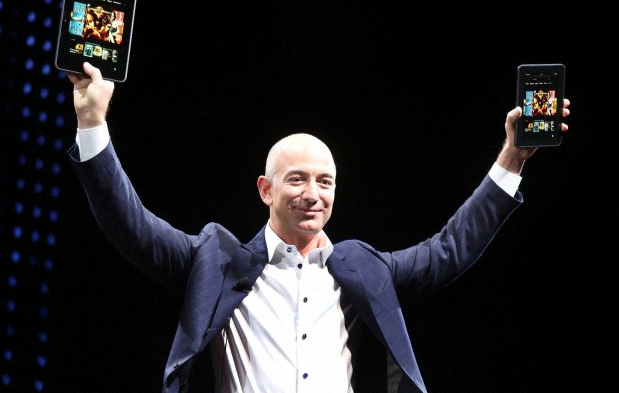
Amazon CEO Jeff Bezos with the new Kindle Fire HD

Just how many people own a Kindle?  A 2014 Forbes article reported that “roughly 43.7 million Kindle devices had been cumulatively sold till the end of 2013,” but, well, Amazon isn’t really talking, except when it’s super proud of itself, so the data Forbes was using may or may not be representative.  Even though in 2014 the Pew Research Center was marking an uptick in e-reader (specifically, Kindle) and everyone seemed, for the most part, highly optimistic about e-readers and therefore e-book distribution, some more recent data seems to indicate a plateauing of that trend … if not a slight reversal.  According to an article by Business Insider contributor James Cook, “for the first time ever the number of tablets shipped has decreased”––and Amazon’s Kindle line has been the hardest hit, with a decrease of some 69.9% in respect to shipments.  That’s a lot.  And the numbers are still so new that few tablet users are speculating yet as to why the Kindle has taken the brunt of the market change.  Is it because users have grown bored, or because Amazon hasn’t reinvented the wheel since the Kindle Fire was released two years (or two lifetimes, in today’s rapid-fire technology-hungry universe)?  But wait––what about the Kindle Paperwhite (the “Kindle 3”)?  Why does nobody seem to be getting on the Paperwhite train?  Is it because people are actively migrating away from Amazon, or from tablet computers, or from e-books?  The numbers seem to be holding mostly steady for e-books downloaded and read, so what’s the deal?

I’ll let you know as soon as I know.

Still, in the meantime, here’s what you need to know about the Kindle (Fire and Paperwhite):

They’re beautiful devices, designed and manufactured specifically to make thumbing through your digital library as tactile and responsive a practice as running a hand across a physical bookshelf––or at least, these e-readers are about as close as you can get without engaging your sense of smell.  (They do, however, make use of your fingertips and your ears as well as your eyes.  There’s some benefit to a multimodal interface, in terms of absorption of information, or so I’ve been told.)

And don’t forget that while sales may have dropped this last year (and significantly), the Kindle and Kindle Fire have out-sold almost every other dedicated e-reading device out there.  There are millions––dozens of millions––of Kindles out there already in use.  So yes, it still remains completely and absolutely worthwhile to sell your book as an e-book edition through the Kindle Store.  The total number of units sold alone should indicate this, but as the aforementioned Pew Research Center report also says, 3 in 10 American adults read an e-book last year, most of them on a tablet or dedicated e-reading device.  That’s a lot of e-books, my friends.  And Jim Tierney over at Loyalty360 reports that Amazon Prime Membership jumped by 53% in 2014––to around 40,000,000 (that’s 40 million) total adults.  And what with the advent of the Kindle Lending Library––a controversial offering, to be sure––Prime subscribers can opt to read certain select e-books for free.  That’s a lot of potential future readers.

Not much has changed when it’s come to the disadvantages of owning a Kindle, except for the fact that Amazon has taken away any grounds for complaint about the graphics, display quality, and user interface.  Their customer support system is pretty nifty, too, and users seem to like it.  No, you still can’t take the Kindle into the bathtub with you, and you probably don’t want to hurl it off the edge of a parking garage unless you actually want to watch it break, but these tablets do qualify as robust, insofar as tablets are allowed to.  Lending books to friends is possible, but still not quite intuitive.  Universities are starting to get on board with letting students use e-book editions for courses, but this still remains an underutilized possibility.  And no, it’s not an actual book you can hold in your hand and sniff for that “old-book” smell.  (But that’s what perfume is for, right?!)

I’m not about to try and sell you on buying a Kindle––or any e-reader, for that matter––but I do think it’s worth oohing and aaahing a little over the modern creature comforts technology has provided us.  An interlinked dictionary that I can access while reading?  Handy.  Highlighting and bookmarking?  Essential.  And much more difficult to “lose” when we’re speaking of a digital item.  And it’s nice, too, to have the option of reading multiple file formats on the same dedicated e-device without having to switch between apps.  PDFs?  No problem.  TXT?  DOC?  The Kindle’s got you covered.  And for now, people aren’t quite tossing them in a blender just to watch sparks fly, so I wouldn’t quite put up the crime scene tape just yet––if Amazon has proven anything, it’s proven just how much it loves to be on top!

Thank you for reading!  If you have any questions, comments, suggestions, or contributions, please use the comment field below or drop us a line at selfpublishingadvice@gmail.com.  And remember to check back each Wednesday for your weekly dose of marketing musings from one indie, hybrid, and self-published author to another. ♠

KellyABOUT KELLY SCHUKNECHT: Kelly Schuknecht is the Executive Vice President of Outskirts Press. In addition to her contributions to the Outskirts Press blog at blog.outskirtspress.com, Kelly and a group of talented marketing experts offer book marketing services, support, and products to not only published Outskirts Press authors, but to all authors and professionals who are interested in marketing their books and/or careers. Learn more about Kelly on her blog, kellyschuknecht.com.

Spooky Self-Publishing Statistics and Trends 2014

Happy October, everyone! In honor of this month, I’ll be sharing Halloween-themed posts each week. Today, I’ll start with some self-publishing and industry statistics and trends from the most recent data available. The information may shock you, but don’t be afraid; just keep reading.

  • The Big Five traditional publishers now account for only 16% of the e-books on Amazon’s bestseller lists.
  • Self-published books now represent 31% of e-book sales on Amazon’s Kindle Store.
  • Indie authors are earning nearly 40% of the e-book dollars going to authors.
  • Readers prefer longer e-books. The bestselling books tend to be over 100,000 words.
  • Series books outsell standalone books.
  • Pre-orders give authors a sales advantage.
  • Non-fiction earns more at higher prices.
  • The number of self-published titles in 2012 jumped to more than 391,000, up 59 percent over 2011 and 422 percent over 2007.
  • Ebooks continue to gain on print, comprising 40 percent of the ISBNs that were self-published in 2012, up from just 11 percent in 2007.
  • Self-published books’ share of the UK market grew by 79% in 2013.
  • In the UK, print sales fell by 10% last year and book purchasing as a whole was down 4%,  but ebook sales continue to grow.

Being knowledgable of book industry and self-publishing trends and statistics can help you make important decisions as a self-publishing author.

I’d love to know, how do these statistics impact your plans as a self-publishing author?

ABOUT JODEE THAYER: With over 20 years of experience in sales and management, Jodee Thayer works as the Manager of Author Services for Outskirts Press. The Author Services Department is composed of knowledgeable customer service reps and publishing consultants; together, they all focus on educating authors on the self-publishing process in order to help them publish the book of their dreams. Whether you are a professional looking to take your career to the next level with platform-driven non-fiction or a novelist seeking fame, fortune, and/or personal fulfillment, Jodee Thayer can put you on the right path.

How Self-Publishing Authors Can Celebrate Earth Day

In honor of Earth Day next week, many of you may be looking for ways to reduce your carbon footprint. Self-publishing authors can help keep our planet clean, beautiful, and healthy by offering their readers an ebook version of their book. Here are a few reasons why self-publishing an ebook is a great idea.

  • Obviously, ebooks equal paperless, and less paper equals more trees. More trees equal a healthier, more beautiful environment.
  • E-readers, such as the Kindle and Nook, are becoming increasingly popular, so more and more readers are looking for ebooks.
  • Offering an ebook increases the chance that your book will appear in search results, which increases the chance that readers will purchase your book.
  • Ebooks offer your readers a quick and convenient way to purchase your book. Today’s market wants to be able to make purchases by simply clicking a button, and unlike ordering a paperback book, readers don’t have to wait for the book to arrive in the mail.

While there are many benefits to ebooks, I also recommend offering readers a paperback version. Despite the growing ebook trend, some readers still prefer paper books. You don’t want to limit your audience by only offering one format. Paperback books are also ideal for gifts and selling at conferences or other public speaking events.

ABOUT JODEE THAYER: With over 20 years of experience in sales and management, Jodee Thayer works as the Manager of Author Services for Outskirts Press. The Author Services Department is composed of knowledgeable customer service reps and publishing consultants; together, they all focus on educating authors on the self-publishing process in order to help them publish the book of their dreams. Whether you are a professional looking to take your career to the next level with platform-driven non-fiction or a novelist seeking fame, fortune, and/or personal fulfillment, Jodee Thayer can put you on the right path.

Self-Publishing Week in Review: 4/08/14

As a self-publishing author, you may find it helpful to stay up-to-date on the trends and news related to the self-publishing industry. This will help you make informed decisions before, during and after the self-publishing process, which will lead to a greater self-publishing experience. To help you stay current on self-publishing topics, simply visit our blog every Tuesday to find out the hottest news.

How to Hire the Right Editor for Your Self-Published Book

This article discusses the importance of hiring a good editor. It also explains the difference between developmental editing, copyediting, and proofreading and offers tips on hiring the right editor for your self-published book.

4 Questions to Ask Before Self-Publishing

This article recommends four questions authors should ask themselves about their book before self-publishing. These four questions will improve your story. This article is a must read for fiction writers.

Complimentary Standard iPad Edition Offered to Authors Beginning to Publish with Outskirts Press in April

Leading self-publishing services provider Outskirts Press offers the new Standard iPad edition complimentary to authors publishing a book with either the Diamond or Pearl book publishing services in April. The Standard iPad/iPhone Edition offers many benefits to self-publishing authors.

If you have other big news to share, please comment below.

ABOUT KELLY SCHUKNECHT: Kelly Schuknecht is the Vice President of Outskirts Press. In addition to her contributions to the Outskirts Press blog at blog.outskirtspress.com, Kelly and a group of talented marketing experts offer book marketing services, support, and products to not only published Outskirts Press authors, but to all authors and professionals who are interested in marketing their books and/or careers. Learn more about Kelly on her blog at http://kellyschuknecht.com.