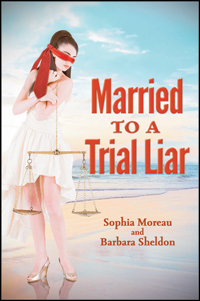
Weekly Self Published Book Review: Married to a Trial Liar

Book reviews are a great way for self-publishing authors to gain exposure. After all, how can someone buy your book if he or she doesn’t know it exists? Paired with other elements of your book promotion strategy, requesting reviews is a great way to get people talking about what you’ve written.

When we read good reviews, we definitely like to share them. It gives the author a few (permanent) moments of fame and allows us to let the community know about a great book. Here’s this week’s book review by Midwest Book Review:

married to a trial liar

Married to a Trial Liar

Sophia Moreau & Barbara Sheldon

Publisher: Outskirts Press

ISBN: 9781432772352

Love can turn to loathing so quickly. “Married to a Trial Liar” follows the struggle of Mia Pecarde, a business woman whose marriage has turned to imprisonment. With a sociopathic lawyer of a husband whose knowledge keeps her trapped in the marriage, she struggles to find a way out, as it seems all too hopeless. “Married to a Trial Liar” is a riveting read with plenty to consider, very much recommended for community library general fiction collections.

October Writing Challenge #5 NaNoWriMo

Over the past month I’ve challenged you to complete a weekly Halloween inspired writing challenge. These challenges were designed to spark creative ideas, help you stick to your writing routine, and provide a little fun in your hectic week. (After all, writing is supposed to be fun, right?)

Now that October is almost over, I have an even bigger and more exciting challenge for you — NaNoWriMo. If you’ve followed my blog posts in the past, you know I not only encourage authors to try NaNoWriMo, but I have also done the challenge myself.

NaNoWriMo stands for National Novel Writing Month. It is an annual, Internet-based creative writing project that challenges writers to pen a whopping 50,000 words in the month of November. Hundreds of thousands of writers participate in the challenge each year.

NaNoWriMo is great for new writers looking for a creative jumpstart or experienced writers looking for a new challenge. It begins November 1st and ends on November 30th.

To sign up or learn more about NaNoWriMo, visit www.nanowrimo.org. The website helps you track your progress, gives you access to pep talks and inspirational stories, and provides a place to meet other writers.

Also, if you missed any of the October challenges, be sure to go back and check out them out: Spiritual Poetry Challenge, 15 Minute Challenge, Short Story Challenge, and Children’s Halloween Story Challenge. (You never know, they might inspire your NaNoWriMo project.)

I’d love to know, are you going to participate in NaNoWriMo this year?

ABOUT KELLY SCHUKNECHT: Kelly Schuknecht is the Vice President of Outskirts Press. In addition to her contributions to the Outskirts Press blog at blog.outskirtspress.com, Kelly and a group of talented marketing experts offer book marketing services, support, and products to not only published Outskirts Press authors, but to all authors and professionals who are interested in marketing their books and/or careers. Learn more about Kelly on her blog at http://kellyschuknecht.com.

Self-Publishing Week in Review: 10/29/13

As a self-publishing author, you may find it helpful to stay up-to-date on the trends and news related to the self-publishing industry. This will help you make informed decisions before, during and after the self-publishing process, which will lead to a greater self-publishing experience. To help you stay current on self-publishing topics, simply visit our blog every Tuesday to find out the hottest news.

10 Tips For Self-Publishing A Multi-Author Anthology

If you are planning to self-publish a collection of short stories or non-fiction essays by multiple authors, this is a great article to check out. It offers 10 tips for self-publishing a multi-author anthology that will make your project easier and more successful.

Disruption 101 For Self-Publishers

If you’ve been following these weekly reviews, you know there has been a lot in the news about the self-published erotic books scandal. Here is a recent article on the how this disruption could affect book sellers.

Self-published e-books rife with illicit erotica, survey finds

A new survey shows that self-published e-books contain more extreme sexual content than their traditionally published counterparts. This article talks about self-published erotica and the current issues faced by book sellers such as Amazon.

6 Inspiring Self-Publishing Success Stories (That Aren’t ‘Fifty Shades of Grey’)

For everyone getting tired of all the erotic scandal coverage, here is a more upbeat post. It covers six inspiring self-publishing success stories, and one of them isn’t Fifty Shades of Grey.

If you have other big news to share, please comment below.

ABOUT KELLY SCHUKNECHT: Kelly Schuknecht is the Vice President of Outskirts Press. In addition to her contributions to the Outskirts Press blog at blog.outskirtspress.com, Kelly and a group of talented marketing experts offer book marketing services, support, and products to not only published Outskirts Press authors, but to all authors and professionals who are interested in marketing their books and/or careers. Learn more about Kelly on her blog at http://kellyschuknecht.com.

Top 6 Self-Publishing Copyright Questions

One of the most confusing topics for new authors is copyrights. I am constantly asked questions by new authors who want to avoid copyright infringements. Here are the top six copyright questions I am frequently asked by self-publishing authors.

1) Is my manuscript copyrighted when self-publishing?

Yes, the copyright for your material was secured as soon as you created it, or when it became fixed in a manuscript for the first time. No publication, registration or any other official act is required to secure copyright.

2) If copyright is automatic, why should I register for a copyright?

Filing with the U.S. Copyright Office creates a public record of the basic information of your book, which gives you the ability to sue for infringement and statutory damages. Doing this creates a legal presumption that your copyright is valid and allows you to recoup up to thousands of dollars, and possibly attorney fees, without having to prove actual monetary harm.

3)  How do you know if something in your book is copyright protected?

 In most cases, any picture, material, text, information, quote, map, song, image or illustration that you personally did not create is copyright protected by the person(s) who created and/or published the material.  Any text or pictures found in a book, magazine or newspaper is copyright protected by the publisher, artist photographer or some other entity.  And yes, most information found on the internet is copyright protected.  For example, if you pull material from Wikipedia, it’s copyrighted by somebody. 

4) What is Fair Use?

Under “Fair Use,” some copyright protected material can be used without permission; however, there are no clear-cut rules, only guidelines and factors to be considered. Fair use is not a right, only a defense. If you are unsure, please consult a legal advisor or copyright researcher.

The following four factors are used to determine fair use: 1) The purpose and character of the use, including potential gains for commercial 2) The nature of the original copyrighted work 3) The proportion or percentage of the copyrighted material in relation to the work as a whole 4) The potential effect on the value of the copyrighted material.

5) Will citing the source of the material free you from copyright infringement?

 No!  Citing the source will not avoid possible court litigation.  Permission must be obtained. 

6) How can I avoid being accused of libel?

Stating an opinion is not libelous, though it’s best to be careful not to make an accusatory statement about anyone when using real names. Do not make the following statements, as they are clear grounds for a libel case: Falsely accusing someone of a crime, or having been charged, indicted or convicted of a crime; falsely identifying someone with an infectious disease; falsely charging someone or an organization with a claim that discredits a business or office and lowers their profitability; and falsely accusing someone as being impotent.  If you are publishing a true story, you may want to change names of characters and places as well as use a pen name. 

I would love to hear your other questions regarding copyrights, and perhaps, I can address them in future book posts.

ABOUT JODEE THAYER: With over 25 years of experience in sales and management, Jodee Thayer works as the Director of Author Services for Outskirts Press. The Author Services Department is composed of knowledgeable customer service reps, publishing consultants and marketing professionals; together, they all focus on educating authors on the self-publishing process in order to help them publish the book of their dreams and on assisting authors with marketing and promoting their book once published. Whether you are a professional looking to take your career to the next level with platform-driven non-fiction or a novelist seeking fame, fortune, and/or personal fulfillment, Jodee Thayer can put you on the right path.

Friday Conversations With A Self-Publishing Writer 10/25/13

When talking with a neighbor today, I mentioned my appreciation for novels of “historical” fiction and how much I’ve learned from them.  She asked for an example, and I immediately thought of an exceptionally well-written book about how many Christians—living in Germany at the time Hitler was coming into power—“looked the other way” when facts were revealed about the treatment of their Jewish neighbors.  My neighbor then showed me a book she’d just read, a self-published novel titled Barbed Wire and Daisies by Carol Strazer.  “It is the story of a mother and her children trying to escape the hell of German occupation in WWII,” she said.  “And it’s so visually written that I could almost stumble over the rubble of destruction.”

She continued,  “The sadness I feel today when reading books like that goes beyond the horrific truth of those events because I become even more aware that we humans haven’t learned much from those experiences.”  Then she asked me if I’d read any of the “soldier blogs” that pepper the Internet.  I had to admit that I haven’t.  “These are the real life histories that need to be developed into books,” she stated.  “Only the truth, told from the perspective of these soldiers—these boots-on-the-ground—can make the world taste the dust storms and feel the pain of war.”  After that conversation, I have a lot more to think about.

Personally, as one of the millions of people who breathe in our FREEDOM every day because of the sacrifices of our military men and women—and their families—I can only agree with my friend.  I have no immediate knowledge of what it really feels like when bunk-mates don’t return from a mission.  I never stood to attention at a desert memorial service as my platoon saluted each of the lost soldiers whose kevlars had been placed on their weapons, their dog tags hanging below their helmets as they should have been hanging around their necks.

So, today, I have no specific writing advice to share with you; only the hope that someone who is reading this will begin writing the true stories of the real life histories they’ve lived.  Or, if you’re a writer and know one of our soldiers/warriors, maybe they could tell you their experiences and you could develop the book.  Our world is being forever changed by these events.  We need to know what has happened—from many perspectives—so that we have the real opportunity to make the future better and brighter.

Royalene ABOUT ROYALENE DOYLE: Royalene Doyle is a Ghostwriter with Outskirts Press, bringing more than 35 years of writing experience to authors who need “just a little assistance” with completing their writing projects. She has worked with both experienced and fledgling writers helping complete projects in multiple genres. When a writer brings the passion they have for their work and combines it with Royalene’s passion to see the finished project in print, books are published and the writer’s legacy is passed forward.