
In Your Corner: The Busy Season

Conceptual office table top still life.

It feels like forever since I last posted! And truthfully, since the last of my posts my life has gone through some serious gymnastics. No matter who you are and what you do for work and how you relate to the events in your life, it can be easy to slip into a funk. It’s even possible, when things are really bad, to feel like the victim of circumstances rather than an empowered human being with agency of your own.

Or is that just me?

Let’s just say that the last few weeks have been difficult ones, full and busy and also strangely rewarding in the ways they have forced me to reckon with my own approach to things such as work and play.

Here’s what I have learned, especially as pertains to work.

It’s okay to take a step back sometimes. 

To be perfectly honest, some of us could do with a stern glance or a word of kindly suggestion along these lines, and I was (and still am) one of them. It is so, so very easy to conflate performance–whether at work or elsewhere, but especially at work–with personal value and self-estimation. But life doesn’t always set you up to succeed, and while I’m not going to nudge you along the path to the aforementioned victim-of-circumstance place, I do think that sometimes we need to recognize this fact (that life doesn’t always set us up to succeed) and give ourselves the room to slow down and step back a little bit from the pressures of performance. Self-worth shouldn’t reside in how many spreadsheets you churn out or how many customers you manage to sell on a product; self-worth ought to reside in your love and respect for self, which goes way beyond what happens between 8 am and 6 pm–or whatever hours you keep as a writer and otherwise.

Giving yourself a bit of distance, emotionally or practically by taking a break, can help you refocus and re-envision your relationship to your work. Does your work give you a sense of purpose and value? Great! Does it cross the line into being your primary or only source of self-worth? Break time!

You’ve got to stand up for what you believe in.

Part of the beauty of the business we’re in is that we have the opportunity to tell stories and give voice to those outside of the mainstream publishing market. In a sense, everyone who gets into self-publishing is already doing a bit of standing up and speaking out, just by daring to put words out there in the world, so it seems like a natural fit for those of involved in indie publishing to take it just one or two steps further. Whatever feels comfortable. Or uncomfortable, as the case may sometimes be.

The ethics I have learned on the job over the last few years have set me up really well to question the way things are when those ways and things do not line up with what is good and right. I wouldn’t be who I am today without the power that self-publishing has lent my voice, and the encouragement of some amazing friends and coworkers to make sure that what I want and need isn’t lost in the shuffle. Whether you’re pursuing the publication of a new book or seeking to put some of the distracting white noise of a drama-filled personal environment aside so that you can focus on writing and on self-care, don’t forget that you are worth standing up for, and sometimes the best person to stand up for you is … you. 

No matter what challenges you face this week, I hope you know that …

You are not alone. ♣︎

Do you have ideas to share? Please don’t hesitate to drop us a line in the comments section, and I’ll make sure to feature your thoughts and respond to them in my next post!

Elizabeth

ABOUT ELIZABETH JAVOR: With over 20 years of experience in sales and management, Elizabeth Javor works as the Director of Sales and Marketing for Outskirts Press. The Sales and Marketing departments are composed of knowledgeable publishing consultants, customer service reps and book marketing specialists; together, they all focus on educating authors on the self-publishing process to help them publish the book of their dreams. Whether you are a professional looking to take your career to the next level with platform-driven non-fiction or a novelist seeking fame, fortune, and/or personal fulfillment, Elizabeth Javor can put you on the right path.

Taking Charge in the New Year

New Year's Resolutions 2020

Around this time last year, I was busy making resolutions for the new year–2019, the year we’re now bringing to a close–and in some cases I have actually managed to make good on those resolutions.  This year, however, I’m pushing back a little against the instinctual attraction to “list-fever,” that special kind of holiday mania that leaves us mellow and warm and happy once the list is complete (it always feels good to write up a list, doesn’t it?) but panicked and anxious as the year reaches its end and we haven’t yet accomplished all that we set out to do.  And so it is that this year, instead of compiling all of the things I want to do, I thought I’d craft a little manifesto for us all.


In 2020 …

We hereby claim the mountain of content and the island of method for us, the (few, the mighty) self-publishing authors of the world.  We assert our right to write what we please in whatever manner we please and within whatever time frame we deem fit.  We declare nothing off-limits, nothing too “edgy” or “tame” or “niche” or “unique.”  We are the fearless in life, and we have the right, too, to write and publish as adventurously as we live.

We hereby claim the lake of responsibility and the waterfall of ethical treatment for us.  In the little skirmishes and give-and-take between the traditional and self-publishing worlds, we occupy the high moral ground, ground from which we foresee a future in which authors are treated with the respect that they have earned, simply by virtue of being authors, and in which no one–neither the authors nor the publishers, the editors, the graphic designers, nor any other professional involved in the industry–uses their influence to abuse or undervalue others and the services they offer.  We assert our support for a future in which no-one can claim a monopoly on distribution or quality of product.  I claim the right to creative freedom and creative control–as well as an ethical flow of profits to and from the right people–for us, the self-publishers.  And we also claim the collective right to not tolerate unethical behavior from the corporate publishing sector which routinely reneges on its commitments to writers, readers, and its own employees.

We hereby claim the plains of ambition and the foothills of inspiration for us.  We will write, to the best of our ability, the best books we are capable of writing.  We will create, to the best of our ability, the finest covers and illustrations and altogether visually pleasing objects of which we are capable of creating.  We will learn from our mistakes without damage to our sense of self or our ego; we will seek out expert feedback and emerge with a refreshed sense of purpose and vision for where to go next.

We also claim the right to act out of self-interest, collectively and individually, for us–the authors who have been told we don’t belong or aren’t good enough but most definitely do and are–while also upholding our commitment to generosity, compassion, and social responsibility.  We claim the right to take full advantage of the digital revolution, to look forward to and think with a futurist’s imagination about, a publishing world and a market that looks radically different from the one we work with now.

We hereby claim ownership of our own decisions.  We do not ask for permission from others to write what we write or publish what we publish; We write and publish what brings joy to us and to our readers.  We do not ask for compliments or pats on the back or for any recognition which undervalues our skills and the intelligence of our readers.  We declare our obligation to respect, value, and represent the interests of others, and to balance this obligation with our own needs as authors and human beings.  We recognize the privileges of our position as people of influence, people with the vocabulary to reflect and shape the world around us, and seek to put that privilege to good use for good ends.

We are not shy about recognizing our strengths, and we are not afraid of our weaknesses.  We hereby claim the valley of well-earned pride and the city of well-learned failures as our province.  We are proud to work with self-publishing authors, and proud to be a part of a wider community of independent creators as well as the readers who open their hearts and minds to the books we place in their hands.

You are not alone. ♣︎

Do you have ideas to share? Please don’t hesitate to drop us a line in the comments section, and I’ll make sure to feature your thoughts and respond to them in my next post!

Elizabeth

ABOUT ELIZABETH JAVOR: With over 20 years of experience in sales and management, Elizabeth Javor works as the Director of Sales and Marketing for Outskirts Press. The Sales and Marketing departments are composed of knowledgeable publishing consultants, customer service reps and book marketing specialists; together, they all focus on educating authors on the self-publishing process to help them publish the book of their dreams. Whether you are a professional looking to take your career to the next level with platform-driven non-fiction or a novelist seeking fame, fortune, and/or personal fulfillment, Elizabeth Javor can put you on the right path.

In Your Corner: What to do after #NaNoWriMo?

nanowrimo

November, National Novel Writing Month, is now firmly behind us—and December is well under way. For those of you who participated in NaNoWriMo, the question remains: What next?

Of course, you don’t have to have participated in NaNoWriMo in order to be facing this question, and you don’t have to have participated in NaNoWriMo to benefit from the materials and resources that the NaNo community has put together for those working on complete or partially complete drafts.

So this week, I wanted to point you to some of those resources.

First of all, you definitely need to follow the official NaNoWriMo blog if you aren’t already. The blog runs year-round, and often tackles thorny issues like what to do when you’re stuck in drafting, or editing, or overcoming specific challenges to publication. The blog is easy to find at blog.nanowrimo.org. The post on December 2nd (“30 Covers 30 Days: Wrap-Up Post“) covers some of the highlights from the 2019 November writing crunch. Even more recent articles cover what to do when times get tough, and writing with chronic illness—all part of a 20th anniversary special series. Definitely worth a look. Their older articles are also invaluable, including Lana Alam’s 2017 piece, “6 Steps for Editing Your Novel.” And don’t forget all of those AMAZING NaNoWriMo “pep talks”! They finished out November strong with a pep talk from Anne Lamott, one of my all-time favorite writers and a rock in the sea of changing publishing noise. The Young Writers Project has a separate page of pep talks geared more toward young people too. (Anne Lamott appears on both.)

Writers Digest also hosts a number of useful blog posts and articles on what to do after NaNoWriMo. I recommend “9 Lessons Learned from a First Attempt at NaNoWriMo” by Jess Zafarras from December of last year, and “5 Habits to Help You Go from NaNoWriMo to Published Author” by Tina LeCount Myers from April of 2018.

I also wanted to point you toward Bustle article from last week (“What’s The Next Step After NaNoWriMo? 7 Published Authors Give Their Best Advice”) in which Sona Charaipotra gleans some truly wonderful nuggets of wisdom from authors who have walked the path of drafting, editing, and publishing before. Many of them are self-published or taking a hybrid approach, so there are some gems of wisdom on self-publishing as well.

And of course, we hope you take a look back at our many posts about editing and finishing manuscript drafts here on SPA; in perusing our backlist, I’m continually impressed at how evergreen many of the articles here are. We’ve even written about publishing during the holidays, if you’ve already brought your draft to a polished stage of completion!

You are not alone. ♣︎

Do you have ideas to share? Please don’t hesitate to drop us a line in the comments section, and I’ll make sure to feature your thoughts and respond to them in my next post!
Elizabeth

ABOUT ELIZABETH JAVOR: With over 20 years of experience in sales and management, Elizabeth Javor works as the Director of Sales and Marketing for Outskirts Press. The Sales and Marketing departments are composed of knowledgeable publishing consultants, customer service reps and book marketing specialists; together, they all focus on educating authors on the self-publishing process to help them publish the book of their dreams. Whether you are a professional looking to take your career to the next level with platform-driven non-fiction or a novelist seeking fame, fortune, and/or personal fulfillment, Elizabeth Javor can put you on the right path.

In Your Corner: At the #NaNoWriMo Midway Point!

First of all, if you’ve made it this far and are still achieving your 2019 NaNoWriMo goals, whether they’re the traditional 1,667 word per day or something else–all projects are valid and celebrated!–congratulations!! It’s an accomplishment simply to get anything done, and you deserve to feel affirmed for the important work that you are doing. Well done!

nanowrimo

Now that you’re halfway through the month, the true doldrums of NaNoWriMo, you’re no doubt facing the universal challenges all writers face, only condensed down into a two-week span: the hard slog of keeping on keeping on even when the finish line isn’t quite in sight yet, tying together plot threads that are doing their absolute best to defy your control, and (depending on whether you draft consecutive chapters consecutively or jump around) writing those final and all-important moments of drama leading to the climax and denouement of the book’s action (if it’s fiction).

If you’re writing poetry or memoir or any number of other genres, you face a slight variation on these problems; just as with fiction, poetry and other genres still need to build toward some sort of emotional beat, and identifying the heart of a book that isn’t fiction can often be a challenge. Memoirists often decide upon what scene from life will serve as their crux in advance, but since many people (pantsers like me) get underway without a lot of preparation, one of the key challenges for Wrimos is developing the book’s structure after the fact (or partially after the fact). This is much easier to do at the midway point than at the end, which is why I mention it now. Unfortunately, it’s not always a lot of fun to do, so doing so can contribute to the general misery of the mid-month doldrums.

Giving you an itemized list of suggestions for what to do runs somewhat against the spirit of NaNoWriMo–remember, you’re not supposed to edit yourself as you write this month, in the interest of generating as much raw material as possible toward your final manuscript–so I’m going to keep my advice simple:

  • Spending the first five minutes of each day’s writing session thinking about the emotional heart of your book–before you set your pen to paper!–may just be the best possible service you can do your manuscript just now. In a separate document or on a scratch piece of paper, consider jotting down whatever comes to mind, whether it’s snatches of dialogue you want to include or descriptive words that evoke the feelings you want to inspire, and tape that up somewhere near your computer (or keep the document open in the background, if it’s digital).
  • Remember to write for yourself first and your ideal audience second. If you’re prone to obsessing over what your readers will think or need, as I am, this can totally paralyze your writing process and keep you from doing the necessary free-flowing writing exercises that are needed to reach your word goal for the month. The time to worry about other people is December, if you’re doing NaNoWriMo. Although if it helps you focus to get those thoughts down on paper and out of your head, consider jotting them down the same way you would material in the previous point (see above).
  • Clear your mind of all the things other people have told you makes for good writing or the “right approach” unless you immediately are 100% convinced that it is actively helping you write. We all love Stephen King and Margaret Atwood and all of the other authors who’ve put out “how to write [x]” books, but sometimes we get so caught up thinking about how other people think we should be writing that we freeze. Or at least, I do. The fact of the matter is, you will have your own “right approach” that is specific to you, and you don’t need to worry about anything else right now than what feeds your work and your heart as you write.

That’s it! That’s my advice for the coming weeks of NaNoWriMo! As always, I wish you all the best and look forward to hearing about your projects!

You are not alone. ♣︎

Do you have ideas to share? Please don’t hesitate to drop us a line in the comments section, and I’ll make sure to feature your thoughts and respond to them in my next post!

Elizabeth

ABOUT ELIZABETH JAVOR: With over 20 years of experience in sales and management, Elizabeth Javor works as the Director of Sales and Marketing for Outskirts Press. The Sales and Marketing departments are composed of knowledgeable publishing consultants, customer service reps and book marketing specialists; together, they all focus on educating authors on the self-publishing process to help them publish the book of their dreams. Whether you are a professional looking to take your career to the next level with platform-driven non-fiction or a novelist seeking fame, fortune, and/or personal fulfillment, Elizabeth Javor can put you on the right path.

In Your Corner: Preparing for NaNoWriMo!

That’s right, it’s almost #NaNoWriMo time!

For those who’ve seen the acronym around but haven’t yet been read in on what the deal is, National Novel Writing Month is an annual tradition among writers looking to kickstart new projects through a dedicated month of drafting. While you can read more about NaNoWriMo’s origin story on the nonprofit organization’s website (www.nanowrimo.org), suffice it to say this has been a big deal for a very long time. As the NaNoWriMo website puts it, “before there was the Beyhive, or Nerdfighters, there were Wrimos” (participants in NaNoWriMo). The community has built up since the early days of the Internet to create a diverse set of resources for those interested in participating—or maybe in learning from the process even if writing 50,000 words in a single month is a bit much.

nanowrimo

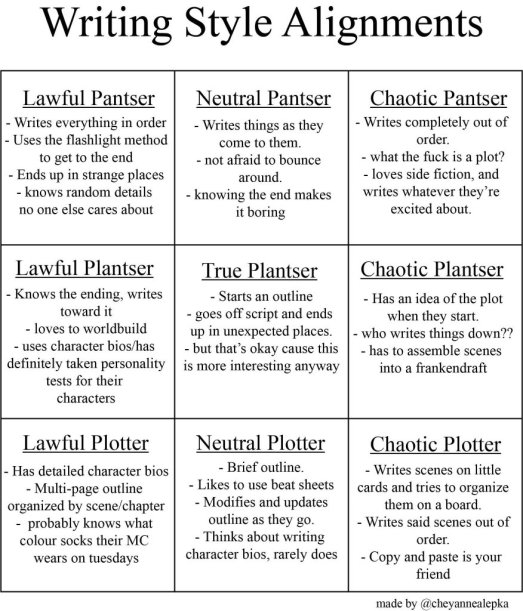
There are two kinds of Wrimos: pantsers and plotters.

Pantsers are those who go through NaNoWriMo “by the seats of their pants” or however that expression goes, and plotters are those who prepare, or plot out their book outline, extensively beforehand. I myself have participated in NaNoWriMo several times, once as a pantser, once as a plotter, and once or twice just casually taking part in the prompts and sprints and group writing sessions without aiming to get to the 50,000 word mark by month’s end. These days I fall somewhere between these Wrimo alignments, as many writers do.

nanowrimo plotter pantser

With only two weeks remaining between now and the beginning of NaNoWriMo (my next post, for context, will arrive on the day before NaNoWriMo begins), I feel as though now is the time to encourage those of you who are plotters or plantsers or otherwise in-betweeners to start digging deep into the resources you will need in the month of November. Even those of you who are pantsers or who are not at all interested in participating in NaNoWriMo on any level might find it valuable to tap into the extensive writing-related resources that Wrimos have compiled over the years. These are the kinds of resources anyone can turn to at any time of year, not just during the official NaNoWriMo period.

First, I want to point you to the NaNo Prep 101 Workshop, which is hosted by the organization that really started it all. It can be completed at any time of year for free and provides tips on the following:

  1. Developing a story idea
  2. Creating complex characters
  3. Constructing detailed plots or outlines
  4. Building a strong world
  5. Organizing your life for and around writing
  6. Finding and managing your time

You can find out more about that workshop here.

I also want to point you to NaNoWriMo’s incredible collection of author pep talks, which include several from self-publishing successes like Andy Weir as well as a number of traditionally published authors whose names you might recognize (James Patterson, anyone? Neil Gaiman? Sue Grafton? No?). Those are all available (again, for free) at the link.

I also really recommend that you spend some time looking into all of the many other excellent resources that writers all over the world have compiled on their own blogs and websites. Every author’s experience is different, and chances are that any author you meet is going to have opinions about the usefulness (or lack thereof) of NaNoWriMo to their own process. It’s pretty definitely proven, though, that there are many amazing books in the world that wouldn’t otherwise have been self-published (or traditionally published for that matter) without that core group of writers and organizers who got together and made NaNoWriMo a thing.

So, will I be participating? I’ll let you know … in two weeks. I honestly haven’t yet made up my mind, and I’m okay with that.

You are not alone. ♣︎

Do you have ideas to share? Please don’t hesitate to drop us a line in the comments section, and I’ll make sure to feature your thoughts and respond to them in my next post!

Elizabeth

ABOUT ELIZABETH JAVOR: With over 20 years of experience in sales and management, Elizabeth Javor works as the Director of Sales and Marketing for Outskirts Press. The Sales and Marketing departments are composed of knowledgeable publishing consultants, customer service reps and book marketing specialists; together, they all focus on educating authors on the self-publishing process to help them publish the book of their dreams. Whether you are a professional looking to take your career to the next level with platform-driven non-fiction or a novelist seeking fame, fortune, and/or personal fulfillment, Elizabeth Javor can put you on the right path.