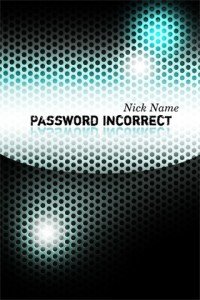
 Password Incorrect is a truly zany collection of “tech-absurd” short stories by Nick Name, pen name for Polish author Piotr Kowalczyk, which only a networked world could have unleashed. It’s available for free from Feedbooks.
Start with the title story to see the absurd in action. My Kindle sat untouched for a couple weeks while I transitioned back to the U.S. from Thailand. When I got back to my Kindle’s homepage again, I did a double take—Password Incorrect? What password? I never needed a damn password before!—until it all came back to me. My reaction is strikingly similar to the befuddlement of the uniformly oddball characters of Password Incorrect confronted by the unexpected repercussions of their tech-doings.
Nearly all the 25 stories are flash fiction; that is, under 1000 words. My favorite was “Wishes Shovel Best.”
On Christmas Eve Slawek Przekosniak received an SMS with these wishes: “Wishing yo good ping super new”. He didn’t know who sent him that surprisingly enigmatic message.
Inspired, he creates software to manufacturing randomly bizarre messages, starting an online phenomenon that makes him the 67th-richest man in Poland. Until a curmudgeonly official is offended by an SMS which reads “Wishes shovel best” and turns him over to the Inquiry Board, the Board of Inquiries, and the Special Security Agency. Black limousines appear at his house on the night he is to receive a lobbied-for Site of the Year Award. In the Age (Moment?) of Twitter, this seems less a merely imagined story than another possible permutation of reality.
Evening elementary school
“Part-time Evening Elementary School” features a school designed for kids “too busy to learn during the day due to the time spent on the difficult task of maintaining our country’s high ranking in the very competitive field of computer games.” A school where PE classes are for stretching the spine and practicing joystick skills and English is considered vital because it allows “for quick mastery of games not yet translated into Polish.”
“Happiness in a Four-Pack” is about a revolutionary new product, “ingestible energizing happiness”. Unfortunately, after an initial burst of popularity, sales soon collapse. Consumer studies reveal that “customers don’t want to be happy. They are much more effectively motivated by misfortune.” Not to worry. “That’s Sad” quickly comes on the market. Its wide popularity causes the company’s owner to throw himself from a bridge in, you guessed it, a fit of happiness.
Outlandish characters are the order of the day. A sampling includes a professor from the Department of Westernmostenatatious European Polonisation, hockey-playing bacillus, and a Dr. Kaliszewski: “He entered the room happy as a lark, which normally accompanied him when he was happy as one. Now the lark was somewhat tense and you could feel it in the air.”
These are the sort of tropes, I think, that a native-English author would reject out of hand as clichés, but in Kowalczyk’s hands, manage to find new life. Gustave Flaubert, in teaching writing, counseled writers to find the “unexplored” element in the commonest of things, and I think this is what Kowalczyk has done here. Password Incorrect abounds with literary dexterity without ever sinking to the merely clever.
A couple of the pieces don’t quite measure up, as in the one featuring a middle-aged man who regresses into an embryo and the one with a talk show host who is “So sensitive and so sweet at the same time. Handsome. Appetizing. Just like a spring onion.” Kowalczyk stretches quirky to the very edge of its readable definition, and, in a couple cases, beyond. The collection would not have suffered from having only 20 stories.
Translated from Polish by Anna Etmanska, there are several spots where the English is, well, quirky. Generally these are very minor, but still noticeable. For instance: “He imagined Czeslawa Ceracz using this liquid and kept dreaming for good.” Truth be told, I’m of two minds about this. On the one hand, these are nothing an editor couldn’t quickly fix up. On the other, they seem to me characteristic of the international English that is the world’s actual lingua franca, as opposed to that of the Queen. So long as the text is readable, I don’t see any point in standing on ceremony. The English of Password Incorrect reflects its origins in the mind of a non-native speaker, and the idiosyncrasies never seriously detract from the meaning or humor of the stories. Therefore I don’t mind them. Just bear in mind that as you read these stories, you will notice them.
We have so quickly come to take the internet for granted that I think we forget just how recent and radical a phenomenon it is. As much as anything, these stories serve as a reminder. Issued up from the heart of Poland by a wired writer in translated English making absurd light of situations unimaginable even a decade ago, ones fraught with the danger of banality. But this nimble writer deftly zigzags to humor and sheer wackiness. It has been suggested that multimedia “books” could be literature’s future, and that may well be. But I think more likely candidates are the sort of short stories you’ll find in Password Incorrect, which exploits the networked world’s novelties while remaining true to the universal commonalities of the human experience.
You not likely come across anything quite like Password Incorrect any time soon. Unless this work receives the wide audience it deserves and imitators spring up. By which time, I hope, Kowalczyk will have delivered another collection to our e-readers.
For more of Piotr Kowalczyk’s tilted take on the world, including a one-second book promo, see his blog Password Incorrect.


 This self-published book was recently reviewed by ReviewYourBook.com:
 Inc. Magazine released its annual top 500 fastest growing US businesses yesterday.
