Now, Ghostwriting

In a recent post we discussed using copywriting services to generate powerful copy for your book sales efforts. Copywriting is often a form of ghostwriting, often for blogs, articles, and promotional material. What about ghostwriting for books?

Ghostwriting is the process in which one writes for and in the name of another (even in cases where the ‘another’ isn’t even a real person). You’re familiar with the term, but may not actually see it much in practice; hence, the moniker.

Most celebrity books you’ve seen or read are in part the product of ghostwriting collaboration. Political leaders, executives, even songwriters often use ghostwriting. There are varying degrees of ghostwriting involvement in books of all genres. An author may work with a subject expert to research, fact-check, and help polish a final draft. Or, in the case of John F. Kennedy, two books bearing his name were almost entirely penned by another. And, in some instances, a ghostwriter’s name will actually appear along with the author’s in the book credits – much of Tom Clancy’s work in the early 2000’s for example. Albeit, the ghostwriter’s name reads in much smaller print.

Does that imply that the author is in fact not a good writer? Perhaps. But rarely the case. And it should not suggest that the writer’s credibility is at all diminished as a published author. It’s often the opposite. A number of popular series titles have been written under a template, in the same style and tone, but at the hands of numerous writers working together to build the ‘brand’ name of a complete pseudonym. Think Nancy Drew.

Ghostwriting finds power in collaboration, and can be a great boon for your self-publishing endeavors, whether you’re a novelist, poet, or business owner looking to develop your brand. When exploring ghostwriting options with your publisher, be sure that you can be paired with someone in whom you find a good match whether your writing from scratch or simply working through a difficult section on your nearly finished draft.

Share this Post

How important is your book title?

Self-publishing authors generally have the privilege of choosing their own book titles, which is often not so in the traditional publishing world. Blessing and Curse. I’ve worked with many author’s who have vacillated over their book title even after the final draft of the actual manuscript has been completed. I can relate. I often struggle to choose the best title for something as simple as a post for this blog. Book titles are personal. Book Titles are important. But to whom? Or more to the point, to whom should they be most important to?

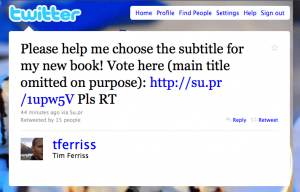
New York Times bestselling author, Timothy Ferriss, raises the question and not abstractly, but in real trial. (This is not an unusual endeavor for Ferriss, as you may recall from The Four Hour Work Week). Last month Ferriss sent the following tweet.

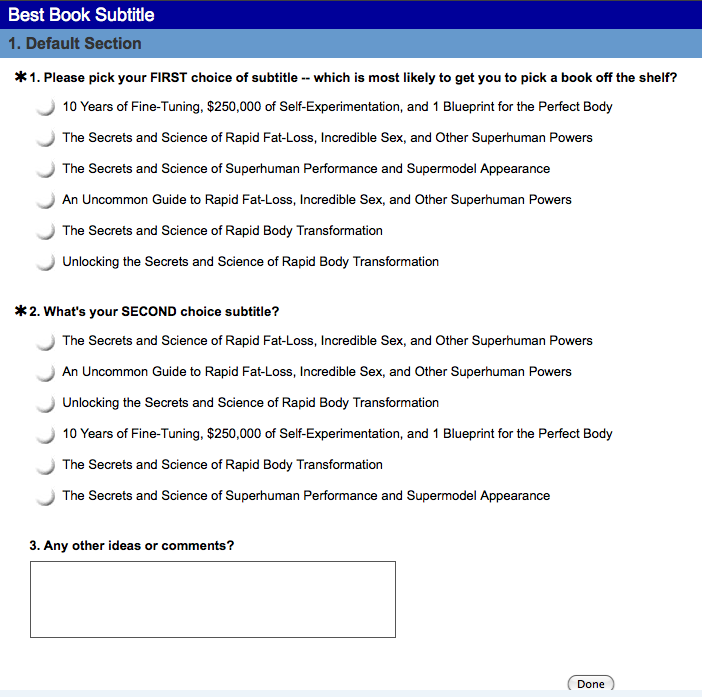
Clicking on the shortened URL navigated the user to a page on http://www.surverymonkey.com where virtually anyone could offer suggestions for The Best Book Title.

Apparently, the third option: Any other ideas or comments, did not actually allow the user to complete the survey. Perhaps that was an error on the Surveymonkey.com site. On the other hand, disabling that feature may have intentional. Think about how many contests allow for unlimited entries? Gymnastics meet with unlimited athletes. Aside from being impossible to manage from a time resources standpoint, how would any judges or spectators know the gymnasts?

A fantastic marketing tactic. Not only does Ferriss create participation – a relationship – with readers, he’s created a manageable list of potential titles that can be used through internet marketing to connect those readers to the actual book when it’s published, regardless of which title takes the cake.


Share this Post

Self-published Book Review of the Week: Of Lights in the Night

Of Lights in the Night

Of Lights in the Night; Friends and Adventure
Sean Noonan
9781432752897, $11.95

“Of Lights in the Night; Friends and Adventure” is a delightful fantasy adventure chapter book written for readers ages 4-8 and up. It is about a brother and sister Elannah and Sam and their dwarf friend Arnold, who meet in their secret Tree-House in the Jungle when they sleep and dream. They excitedly fly forth on flying bikes to see Rodger the Badger, in search of magical fireworks. They end up with the Great Wizard Grumphspawn in the Great Northern Mountains, where they experience the seven assorted sensations, the Goblin Racer, the Highlander’s Delight, the Jolly Jester, the King’s Coronation Ball, the Long Light Liberation, the Parrots, Pirates and Pancakes Piratical Pyrotechnics; and lastly the Troll’s Totally Terribly Triumphant Toothy Tongue Tingler. As might be surmised, there is not a dull moment on any page. Best of all, as morning approaches, Elannah and Sam say goodbye to their new friends, promising to return for more adventures. Black and white illustrations drawn by the author’s 6-year-old daughter are included in the book’s ending, which also promises another adventure dream-story soon, “A First Christmas; Friends and Festivity.”


Share this Post

Common Self Publishing Complaint

A common misconception that authors have about publishers is that publishing is not a business. Perhaps it isn’t even a misconception; perhaps the author just doesn’t think about it. Why would they? They have enough to think about, what with writing, editing, rewriting, proofreading, rewriting some more, designing, printing, shipping, marketing, invoicing, destroying all the books that are returned.

Authors are a busy bunch with their hands full! It’s easy to forget that publishing is a business, and in order to stay in business, publishers must make money. And here is the rub with “self-publishing.” Authors who self-publish, or writers who harbor negative feelings about so-called “self-publishing companies” often use words like “vanity” or even “scam” when referring to companies like Xlibris, Outskirts Press, iUniverse, AuthorHouse, Trafford, and the like. In some cases they even get angry that these businesses make money on a book that only sells 100 copies.  Shouldn’t they lose money on books like that, just like New York publishers do?  Well, no.  The two groups have different business models.

Anger is often the result of misinformation or misinterpretation. Writers who hold this grudge misunderstand the purpose of these companies. Granted, some of these companies are guilty of stoking that confusion, but that’s a topic for a future post.  The topic for this post is this: Would it help these authors to view such businesses not as publishers, per se, but as service companies?

With apologies in advance, allow me to share a dirty little story about oil. My uncle Fred loves working on cars. There isn’t a car he cannot fix. When it gets a ding, he hammers it out. When it gets a scratch, he buffs it. When it needs its oil changed, he rolls on up under there with a big grin on his weathered ol’ face. In fact, my Uncle Fred gets such a bang out of changing oil, he even changes his neighbors’ oil for free because he likes it.  Some neighbors have actually offered to pay him, but he waves them off. Changing oil is actually a hobby of his.

Believe it or not, my Uncle Fred hates  the Grease Monkey franchises.  He cannot fathom why someone would actually pay a company to do something so easy and fun as changing oil in a car.    After all, it only takes him 15 minutes because he has been doing it since he was eight, and he already has oil stains on his shirt, so what’s a little more?  And yet Grease Monkey has the audacity to charge upwards of $99 for the same task.  Fred thinks it is highway robbery!  “That’s $400 per hour,” he’ll sputter. “Who do they think they are, New York lawyers!” He trails off muttering something about snake oil salesmen.

Seething and red-faced, there is no use arguing with him. He’s past the point of logic and has entered a state of emotion. 

I think you can see where I’m going with this… That’s right, some writers simply don’t want to change their own oil.   It takes skill and knowledge to do it correctly; you get dirty; and you know it will take you at least an hour.  You’d rather spend time playing catch with your son or going to your daughter’s play. And, hey, look! You can be in and out of Grease Monkey inside twenty minutes.  Is that worth $99?  Depends… wouldn’t you like to think your time is worth $100-$400 an hour (even if your current boss disagrees with you)?

I wonder how Uncle Fred would feel if a customer paid Grease Monkey to change her oil, and then immediately afterwards ran a red light and totaled her car.  Fred would probably be mad at Grease Monkey!  “They made money on a car that didn’t even need an oil change!”

POD, Distribution & Self-publishing

Last week we discussed the Amazon store and a few of the resources it provides for self-published authors to utilize in promoting their books. Now let’s take a step back and take a look at how distribution works in self-publishing.

Many authors incorrectly assume that a run of books must exist physically in order for copies to be sold. And for good reason, for centuries that has been the model upon with publishers, retailers, and buyers operated under. Are there still advantages to pre-printed copies of books for authors? Sure, but that necessity is becoming increasingly less important in book distribution and sales. In some cases even a disadvantage. Among the benefits of the POD or on-demand model is that books no longer need to physically exist in order to be sold.

In some cases, books are even printed after they are sold retail. Here’s the short story: a book is purchased through any number of points of sale or retailer locations and an instantaneous print ‘message’ is sent directly to the printer where a single copy is printed, one-off and shipped to the customer with royalties accruing for authors under the pre-established royalty amount agreed upon prior to publication. This explains how POD books can be available at as many as 25,000 bookstores and sales channels across the globe, including Amazon, without that number of books actually existing.

Among the many benefits of this model can be lower retail prices and/or higher profits for authors. No physical inventory to manage, truckers to pay, stores to heat/cool and employees to compensate leaves retailers open to earn higher margins on lower prices, a pricing benefit ultimately passed on to authors.

POD provides self-publishing authors among the strongest, and newest advancements in the publishing world. But it is not the only thing to consider when preparing your book for market. We’ll hit more on those down the road.


Share this Post