News From the Self-Publishing World: 10/26/15

This week in the world of self-publishing:

This has been a huge week for self-publishing, in that there doesn’t seem to be a large media outlet left untouched.  Take this October 23rd article in Publishers Weekly, for example, in which contributor Alex Palmer demystifies a few tried-and-true self-marketing methods.  Why is this such a big deal?  For starters, when an industry giant like PW dedicates significant page-space to a (for lack of a better term) “self-help” piece specific to self-publishing authors … well, this is a tacit acknowledgement that there are enough self-publishing authors out there to make them a significant reading bloc that PW is clearly willing to go to great lengths to woo.  Ten years ago, or even five, PW would have been far more likely to publish “discovery” pieces aimed at readers (past, present, or future) of self-published books and traditional publishing experts, rather than self-publishing authors themselves.  So this is exciting.  And the tips Palmer lists (like: “call ahead to make an appointment with the librarian or bookstore owner rather than just appearing unannounced” and “build […] ties to communities long before books come out so [authors and librarians or booksellers] won’t be strangers when the time comes to ask for arranging author events and distribution”) pack a punch and are backed up with useful insights from a variety of experts.  This has to be one of the best (and most interesting) assistive pieces I’ve read this year.

Talk about making serious press with serious media outlets; this week in The Bookseller‘s “FutureBook” section, contributor Porter Anderson walks us through a variety of self-publishing related news items (some of them in the lead-up to a #FutureChat Twitter event on Oct 23), but far and away the most interesting (I find) is his commentary on the divisions and contentions that exist between the different players in publishing today, and between traditional publishers and the self-publishing author.  He asks the question: “Is independent publishing ‘the contrary’ of the Trade?” by which he means, “Do we really have to frame every conversation about self-publishing and traditional publishing as a case of binary opposites?”  (My wording on that one.)  This is partially in response to some comments made by Hachette Livre’s Arnaud Nourry at the recent Frankfurt Bookfair (in which he described self-publishing as “the contrary of my business. We look at books and decide what we do and do not want to invest in”).  Anderson comes to no conclusions, leaving the field open to conversation in the “FutureBook’s” #FutureChat and at the upcoming Author Day conference on November 30th in London.

You thought it couldn’t get any bigger, didn’t you?  Well, it did.  And by “it,” I mean “self-publishing authors making a big splash in major headlines this week.”  Take this October 20th article for People Magazine‘s online edition by contributor Drew Mackie, in which we are presented with exactly what the title promises: seven movies that have their roots in the self-publishing book industry.  The Martian has gotten plenty of press lately, and Still Alice made the rounds and raked in a whole bunch of awards as both a book club favorite and an indie film darling, but some of the other titles might surprise you: Legally Blonde, for example.  Who knew?  Not me.  And I certainly am excited to hear that Hugh Howey’s Wool has FINALLY been moved out of “Development Hell” and into pre-production.  Mackie quotes Howey as saying, “Traditional publishing is much too restrictive. I don’t want to pump out the same book over and over. I want to challenge myself and produce the work that I feel is missing from the marketplace.”  And that, dear readers, is exactly the kind of rip-roaring rallying cry we all need to hear once in a while!

This one goes out to those of you from across the Pond––no, the other pond.  Australian media supergiant Yahoo7 highlighted the accomplishments of a self-publishing Aussie in a detailed October 21st article by contributor Sophie Smith.  Beau Taplin, a native Melbournian, has been making waves not just in the self-publishing industry Down Under, but among celebrities the world over.  He counts Kim Kardashian, Jessica Stam, Sophia Bush, Bindi Irwin, and Lauren Phillips among his many readers, but far and away he can credit his social media prowess with garnering him a wide readership.  Writes Smith, “Mr Taplin is making a living from the full-time occupation [of writing] despite choosing not to refer his work, which has attracted 281,000 followers on Instagram, 16.3K on Twitter and 10,000 on Facebook, to a commercial publisher.”  Taplin, who self-professes to “lean toward the shy end of the spectrum,” sees the novel as falling naturally in line with the traditional publishing model––but he wanted to do something different.  His book, Buried Light, comprises only 100 pages of prose, but it has rapidly eclipsed Taplin’s previous two books in sales.  Of finding his voice through self-publishing, Taplin has much to say: “I was lost before this.”  You can read more about his book at the link.


As a self-publishing author, you may find it helpful to stay up-to-date on the trends and news related to the self-publishing industry.This will help you make informed decisions before, during and after the self-publishing process, which will lead to a greater self-publishing experience. To help you stay current on self-publishing topics, simply visit our blog every Monday to find out the hottest news. If you have other big news to share, please comment below.

KellyABOUT KELLY SCHUKNECHT: Kelly Schuknecht is the Executive Vice President of Outskirts Press. In addition to her contributions to the Outskirts Press blog at blog.outskirtspress.com, Kelly and a group of talented marketing experts offer book marketing services, support, and products to not only published Outskirts Press authors, but to all authors and professionals who are interested in marketing their books and/or careers. Learn more about Kelly on her blog, kellyschuknecht.com.
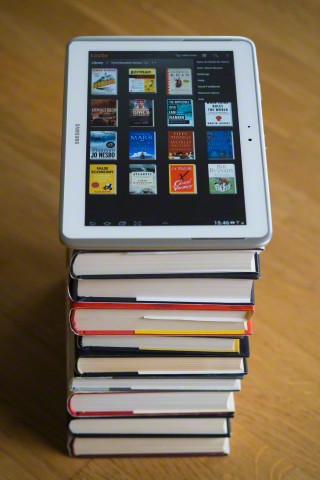
The Current State of E-Readers | An Author’s Guide (Part IV––the Samsung Galaxy Tab)

Last week, I examined the dedicated e-reader designed for use with Barnes & Noble’s stores, both digital and brick and mortar––the NOOK.  And if you read that post, you’ll recall that I mentioned Barnes & Noble will no longer be producing a dedicated e-reader, and in fact is no longer producing an e-reader at all; it is, however, lending its name and all of the might of its online platform to the latest incarnation (or should I say “one of the latest incarnations?”) of the Samsung Galaxy Tab.  The resulting hybrid will give Barnes & Noble customers the necessary continuity to keep using the interfaces to which they have become accustomed, while also lifting the burden of production and distribution (at least, partially) from a company that is still, ultimately, struggling to keep its foot in the door of print book distribution.  Amazon’s Kindle store and Apple’s iPad have collectively changed the course of ebook distribution and consumption, whether we like it or not––and like so many others, Barnes & Noble and Samsung are hoping to create the next best thing, or a near-approximation of the iPad that still gives the bookseller an edge of control over the end user.

(There are altogether too many options on the iPad for a bookseller’s tastes––too many apps and too many readable file formats within those apps.  The more options, the less easily a bookseller can drive sales in a particular direction––and profits.)

Samsung Galaxy Tab

But we’re not here to talk about the new tablet (although you can read a most thorough CNET review here).  We’re here to talk about the original Samsung Galaxy Tab series, which is now up to at least its tenth iteration … if not a higher number (they throw in variant names, with the “Galaxy Tab S” and “Galaxy Tab Pro” and so on complicating a neat and orderly numbering system).  The entire line is noted, however, first and foremost for being the first (or among the first, depending on who you ask) to embrace a full Android operating system––and as such, it became a solid, distinct, and direct competitor to both the iPad (which runs on Apple’s iOS) and the Kindle (which varies a bit from iteration to iteration, but for the most part employs a heavily modified and limited version of Android).  I think it’s worth mentioning both tablets like the iPad and dedicated e-readers like the Kindle in the same breath when it comes to the Samsung Galaxy, because the relationship between the two is hybridizing so quickly as partnership projects like the Samsung Galaxy NOOK become the new normal.

Here’s the thing with the Samsung Galaxy Tab series that gives it an edge over the Kindle and the original NOOK: it’s a fully-fledged tablet, with a far wider range of capabilities as a device than a dedicated e-reader.  You can access the Google Play store, and run a whole slew of apps that have little or nothing to do with books, and yet the reading-related apps you can download are beautifully designed and presented, so the e-reading experience is still highlighted and underscored as important to app developers.  Many people rate the average Samsung device as somewhat less responsive and intuitive than the iPad, but Apple is famously canny about using software to create closed loops around its hardware (that is, the average iPad has to be “jailbroken” before it is “hackable”––you have to actually tamper with the operating system to render it more adaptable).  Basically, Android-based operating systems like the ones the Samsung Galaxy Tablets run are way more easy to customize, tinker with, and generally geek out over.

Samsung Galaxy NOOK

And there are a lot of Samsung Galaxy Tabs out there.  There are no hard and fast numbers for me to quote to you, but it’s safe to say they’re not hurting too badly if they have the capital to launch “boutique” or specialized lines like the NOOK hybrid.  (Each iteration costs a lot of money and time and talent capital to design and maintain and run support for.)  Some recent reports do, however, indicate that sales were not quite as high as they should have been––and as the company supposedly reported them to have been––and this is a matter of great concern.  Samsung has the benefit of a large support network and a diverse portfolio to fall back on if one project or device doesn’t sell well; Barnes & Noble had no such safety net, and thus lost its ability to respond effectively to rapidly shifting market demands.

Here’s what you need to know as an author when it comes to the Samsung Galaxy Tab: it’s not going anywhere.  Oh, iterations come and go the way my love of rain comes and goes (and boy, does that one fluctuate a lot).  But the great thing about a series like this one is that Samsung will continue to make new additions as long as the market exists and as long as there is a demand for Android-based devices that aren’t locked into being dedicated e-readers like the Kindle.  Customers want variety and customizability, games and work and literature all in one device, without the need to untangle multiple cables or swap out chargers on the nearest wall outlet.  And as long as there are Android-based operating systems, the Google Play store will remain an important distribution point to keep an eye on.

Are you selling through Google Play?  I personally hope so, and if you are and would like to share your story, please (please please) drop me a line in the comment section with all of the details.

Thank you for reading!  If you have any questions, comments, suggestions, or contributions, please use the comment field below or drop us a line at selfpublishingadvice@gmail.com.  And remember to check back each Wednesday for your weekly dose of marketing musings from one indie, hybrid, and self-published author to another. ♠

KellyABOUT KELLY SCHUKNECHT: Kelly Schuknecht is the Executive Vice President of Outskirts Press. In addition to her contributions to the Outskirts Press blog at blog.outskirtspress.com, Kelly and a group of talented marketing experts offer book marketing services, support, and products to not only published Outskirts Press authors, but to all authors and professionals who are interested in marketing their books and/or careers. Learn more about Kelly on her blog, kellyschuknecht.com.

From the Archives: “The Importance of Distribution in Self Publishing”

Welcome back to our new Tuesday segment, where we’ll be revisiting some of our most popular posts from the last few years.  What’s stayed the same?  And what’s changed?  We’ll be updating you on the facts, and taking a new (and hopefully refreshing) angle on a few timeless classics of Self Publishing Advisor.

∗∗∗∗∗

[ Originally posted: April 6th, 2010 ]

If a publisher focuses on discounts to an author who buys their own book in bulk, that often communicates two things. 1) That publisher is more concerned with selling to you than to other readers. 2)  The publisher is charging you too much for lower quantities. Do you really want to be forced to buy 100 books at a time just to get a fair price? “Bulk” discounts simply trick the author into buying more books than they need, which defeats the whole advantage of on-demand printing.

I’ve seen many authors go down that road, and then end up with lots of books sitting in their garage or basement that no one knows about, because the distribution piece is missing.  The power of the on-demand printing and EDI distribution offered in custom self-publishing take advantage of wholesale availability via multiple sales channels including Amazon, Barnes & Noble, Borders, Baker and Taylor, and Ingram—North America’s largest distributor.  Look also to see that your book is available through I-Page, the book ordering system available at over 25,000 bookstores and retail chains world-wide.

Do look also for a publisher that will sell your book to you at a special author discounted price as well.  It’s never a bad idea to have access to an inventory to compliment your virtually endless on-demand inventory.

The power of distribution when paired with flexible pricing creates an advantageous sales combination for the self-publishing author.

distribution

There’s no easy way to sell books, but as this post back in 2010 points out, there’s no point to purchasing in bulk if you can’t actually move the copies into the hands of your readers.  And as the original post expounds, an effective means of distribution remains absolutely essential in order to steer clear of stocking your basement and not those same readers’ bookshelves.

So how do you distribute books?  Word-of-mouth can work, certainly, as is illustrated by the extraordinary case of Christopher Paolini, although one might argue that his case is only extraordinary because it was eventually “discovered” by the traditional publishing industry and afterwards became a massive hit.  Paolini only relied on word-of-mouth and his own ardent self-marketing methods for a short while, when looking at the total “life cycle” of his Inheritance series.

It seems that selling through an online distributer is perhaps the way to go, especially when those distributers (namely, Amazon and Barnes & Noble) come with all of the might and power of a massive international company.  There are certainly some extraordinary benefits to taking advantage of their systems, toward which end many hybrid publishing companies (such as Outskirts Press) provide packages geared specifically to exploit.  And their digital distribution platforms, while perhaps too bulky to be truly “cutting edge,” do have all of the perquisite customer support and technical maintenance that you could wish for.  There’s always an upside to walking down a path that many others are also walking down.  (I’m thinking specifically of user how-to guides and FAQ forums, here––since I take advantage of those, and often.)

The ultimate point is, however, not to rely on making bulk purchases of your own book as an author, even with the possibility of an author discount.  You want readers to be connecting some of the dots themselves, and buying through these (socially networked and easily findable) ecommerce platforms instead of only through you.  If you are the only person who is selling your book, then that creates a kind of bottleneck for sales.  Diversifying who sells your book and where it can be found is a vital component of any effective self-marketing strategy.  ♠

KellyABOUT KELLY SCHUKNECHT: Kelly Schuknecht is the Executive Vice President of Outskirts Press. In addition to her contributions to the Outskirts Press blog at blog.outskirtspress.com, Kelly and a group of talented marketing experts offer book marketing services, support, and products to not only published Outskirts Press authors, but to all authors and professionals who are interested in marketing their books and/or careers. Learn more about Kelly on her blog, kellyschuknecht.com.

News From the Self-Publishing World: 10/19/15

This week in the world of self-publishing:

This week, the interview that caught our eye was one between Sussex author Fiona Cane and Argus news editor Lucy Pearce, published on October 16th.  In the interview, Cane reveals that Peter James and Eddie Izzard had a hand in her choice to pursue self-publishing her latest book, The Other Side Of The Mountain.  “It’s just so difficult now; publishing companies take on maybe one or two authors a year,” says Cane.  But she didn’t want to become bogged down in the politics of publishing––she wanted to get her book out there, despite encouragement from other quarters to chase after a more traditional route to publication.    The Other Side of the Mountain is not Cane’s first book, but it is the one she is most proud of: “It is much more the book I have always wanted to write but was never sure if I could.”  Lucky for us that her childhood schoolfellow Izzard happened to stop by with some sage words of wisdom at just the right moment!  “He told me that I had to really push, and want it, and believe,” says Cane.  And now we have yet another stellar entry into the canon of self-published geopolitical dramas; The Other Side of the Mountain takes place in Haiti in 2001, and amidst the political and social chaos of that year.

Ever wondered where exactly AmazonCrossing stands in respect to the world of self-publishing?  How about self-publishing abroad?  Just last week, on October 15th, Porter Anderson of The Bookseller published an article with some of the much-needed details––but he admits that it wasn’t easy to put together the material: “As more indie authors focus on opening international markets, more questions than answers are at hand. It is early days in the deep field of foreign self-publishing.”  According to Anderson, the matter of translation remains a huge stumbling block for foreign authors seeking self-publication; AmazonCrossing has, however, been taking steps to help ameliorate the difficulties.  Quoting Chad Post, director of the University of Rochester’s (New York) Three Percent translation project, Anderson reveals one key detail: “With more than 150 books translated now, this Amazon Publishing traditional imprint has become the US’ most prolific translation publisher.”  That’s a lot of books, but it’s nowhere near, in our humble opinion, enough!  (Though let’s face it, there will never really be enough….in our opinion.)  Throughout the remainder of his article, Anderson attempts to unspool some of the complicating factors that surround self-publishing a translated work (or, more correctly, finding cost-effective ways to translate your already self-published book).  Well worth a read, we think.

It’s an exciting time to be a Green Bay Packers fan!  Daniel Kramer, son of the legendary Packers player Jerry Kramer, recently revealed his plans to fund and self-publish a book of his photography and essays to PRNewswire in an October 15 press release.  The project, which is being funded by a Kickstarter campaign (ending on October 20th), reached its funding goals days before its deadline … and then some.  The book itself, which takes a close look at the 1996-1997 football season, will include material co-written with award-winning author Dick Schaap and feature Jerry Kramer’s own photography, taken on the ground with a privileged insider’s view of the goings-on.  The book will be released on the 20th anniversary of the season it documents.  And even if you’re not a Packers fan, any self-published, crowd-funded project that reaches this kind of stratospheric public acclaim is very, very good news.

In more news from across the pond, celebrated Blues scholar Adam Gussow is releasing his first piece of fiction––a novel, to be precise––through BookBaby.  In an October 15th article for HottyToddy, senior managing editor Callie Daniels Bryant writes that Gussow’s book is already receiving stellar reviews on Kirkus, where the book is said to be “a fast-paced, enjoyable one, with the harmonica blues angle putting a unique spin on the European trip narrative.”  If that isn’t enough to whet your appetite, consider the fact that Gussow is “noted for his longtime partnership with guitarist Sterling “Mr. Satan” Magee as the duo Satan and Adam.”  As a self-publishing author, Gussow has found success through alternative means of self-marketing, and has captured the attention of many potential readers through his carefully curated YouTube channel.  Gussow’s own experience as a street performer, or busker, provided much of the fundamental texture of his novel––Busker’s Holiday––so necessary to conveying the actual and authentic experience.  If you’re looking for something to take away from the news this week, here it is: the pairing of authenticity with a tech-savvy approach to social media may just be the start of something great.


As a self-publishing author, you may find it helpful to stay up-to-date on the trends and news related to the self-publishing industry.This will help you make informed decisions before, during and after the self-publishing process, which will lead to a greater self-publishing experience. To help you stay current on self-publishing topics, simply visit our blog every Monday to find out the hottest news. If you have other big news to share, please comment below.

KellyABOUT KELLY SCHUKNECHT: Kelly Schuknecht is the Executive Vice President of Outskirts Press. In addition to her contributions to the Outskirts Press blog at blog.outskirtspress.com, Kelly and a group of talented marketing experts offer book marketing services, support, and products to not only published Outskirts Press authors, but to all authors and professionals who are interested in marketing their books and/or careers. Learn more about Kelly on her blog, kellyschuknecht.com.

The Current State of E-Readers | An Author’s Guide (Part III )

Did you know that Barnes & Noble sells an e-reader?  If you haven’t stopped by one of their brick and mortar stores in the last few years, you might never have known.  This is because the tablet in question never quite got the sales momentum that its primary rivals, the Kindle and the iPad, had automatically built in.  (More on that in a moment.)  And the NOOK, as Barnes & Noble has dubbed their creation, already seems to be on the way out.  I stopped by a Barnes & Noble while driving through central Montana, and … gone are the enormous beautiful displays, the wide sweeps of banners and posters emblazened with larger-than-life-size images of the tablet, its logo, and cheery recommendations on what ebook to read next.  It looks as though we’re back to basics when it comes to our favorite (by default, since it’s our only) big brick and mortar bookstore!

But what about the NOOK?  Should you as an author care about the rise and fall of this non-gargantuan piece of technology?  The short answer is yes.  The reasons why can never quite be summarized as a “short answer,” but I’ll do my best to stick to the important bits.

William Lynch, Chief Executive Officer of Barnes & Noble, holds up the new Nook Tablet at the Union Square Barnes & Noble in New York

The first NOOK was launched in October 2009, almost exactly six years ago.  By 2011, the NOOK had captured approximately 13.4% of the total global market share for e-reading devices.  But as 

The NOOK store still does brisk business.  This is in part because readers still love a good physical book in hand, and B&N is now the only large remaining bookseller, and therefore it has both a solid built-in captive audience for its internal promotions.  It may also be attributable in part to the parent company’s deft hand at package deals and perqs.  (If you bring your NOOK into a B&N store, you have free access to their entire ebook collection while there!  Who knew?  Not me, until I started researching for this blog post!)  Here are the numbers according to number-crunching website Statista.com:

NOOK sales according to Statista

As you can see, NOOK sales are certainly, shall we say, “plunging.”  But Statista still reports approximately $263.8 million dollars in sales for 2015 to date, and that’s not an insignificant percentage of the total ebook market.  The real concern, for you as an indie or self-published author, is whether any of those sales translate into profits for authors outside of the traditional Big Five publishing houses.  And that data simply isn’t available, though anecdotal evidence seems to indicate that the NOOK store is not the most profitable place to publish your ebook.  Which is not to say that it’s not a worthwhile place … however, it’s far more likely you’ll connect with a greater number of new readers through the Amazon Kindle store or through Apple’s iTunes/iBooks interface.  This is because most search engines and indexing algorithms will promote results in these two digital stores over that of Barnes & Noble, for whatever reason (and there may be several reasons, some shady and some legitimate, and some mere rumors).  And although Kindle sales have fallen and tablet sales seem to have plateaued across the entire global market, Amazon and Apple have both proven innovative and flexible enough to roll with the punches, and their devices have held up better to changing market demands.

Half of your job as a self-published author is to tackle matters of self-promotion and marketing with the business acumen of an entire PR department and the ruthlessness of a CEO.  Is a strategy proving ineffective?  On the chopping block it goes.  Is one particular edition of your book not selling?  Out the window, sayonara.  Is a social media platform or blogging interface sucking up more of your time than seems worthwhile when balanced against outreach to new readers?  It may be time to refocus.  This is why it’s so vital that you know what’s going on with the NOOK before you decide whether or not you want to pay a hybrid publishing company to publish or spend hours of your own time agonizing over the creation of an ebook edition to sell on the NOOK Store.  If your book is already moderately successful, you may find that it helps round out your total bundle of offerings.  But if you’re just starting out and you don’t have much of a budget, you may want to stick with options that are guaranteed failsafes.

Don’t despair for the NOOK.  Just don’t be sucked into thinking that, just because Barnes & Noble has been around a long time (and now enjoys a certain kind of monopoly over the physical bookstore market), readers will pay back your investment in the NOOK store with any kind of enthusiasm.  As the ebook and ereader markets mature, one thing is becoming increasingly clear: more iterations of the same device will not equate to more ebooks sold and read.  In fact, readers are turning back in droves to the physical book … and that’s not such a bad thing, in the long run.

Thank you for reading!  If you have any questions, comments, suggestions, or contributions, please use the comment field below or drop us a line at selfpublishingadvice@gmail.com.  And remember to check back each Wednesday for your weekly dose of marketing musings from one indie, hybrid, and self-published author to another. ♠

KellyABOUT KELLY SCHUKNECHT: Kelly Schuknecht is the Executive Vice President of Outskirts Press. In addition to her contributions to the Outskirts Press blog at blog.outskirtspress.com, Kelly and a group of talented marketing experts offer book marketing services, support, and products to not only published Outskirts Press authors, but to all authors and professionals who are interested in marketing their books and/or careers. Learn more about Kelly on her blog, kellyschuknecht.com.