In Your Corner: The Benefit of Personal Service

personal service

Personal service. What does that even look like?

Consider where we are, in 2017: a world where one can order groceries off of the internet for home delivery, where autonomous cars are a real and actual thing and only a couple hundred rounds of safety testing from sitting in your garage, and where robots write blogs, and pretty well, too. (Don’t worry, there’s a person writing this blog. We promise. She just needs her morning coffee.) In fact, bots run quite a lot of what we do these days.

In the world of 2017, you can quite feasibly buy all the things a person needs to live–‘food, shelter, and safety’ echoing down from fifth grade science classes–online and without ever once leaving the house. And this is a potentially wonderful thing, especially for those with anxiety disorders and mobility problems. And while a lot has been made of the whole ‘bot stealing your job!’ meme, the facts do not (yet) bear that out. Most of the jobs being ‘taken’ by bots are more like gaps in the workforce that software designers and engineers are working to fill. (Most. That blog-writing bot still has me worried.)

The thing is, sometimes we really need personal service and help, and in a world so digitized and automated, it’s hard both to find it and even to figure out that you need it in the first place. After all, if no-one’s offering it as an option and recommending it in the various blogs and news articles you read, how are you going to know that personal service–particularly in self-publishing, our industry–is of benefit to you? How are you going to know where to get it?

It’s worth paying for someone to advise you, guide you, and to help you when it comes to something as important as publishing your book. Personal help from an expert that advises authors for a living is a valuable tool, not just some luxury, and should be perceived (and treated, and marketed) as such. Of all the self-published and self-publishing authors who I’ve worked with over the years, a grand total of zero (ZERO!) have commented that they “really didn’t need as much help” as they got through the company I work for (Outskirts Press). And since Outskirts consistently wins awards for its personal service … well, I guess it’s just proof that one can’t have too much of a good and useful thing.

It’s not just Outskirts Press who offers great personal customer support, but they are a great case study. When the company was founded all the way back in 2002, the world of self-publishing was a disorganized mess! There weren’t a lot of companies in the business yet, and there weren’t a lot of options available for the discerning author to allow for the flexibility which we so take for granted today. But it became a part of our founder’s operational framework that his company would focus on customer service and personal contact, starting with an author’s first expression of interest and continuing all the way through the publishing and marketing processes. This has since become our guiding star, and exerted an influence on other self-publishing companies, as well.

When you see the benefits of personal service, there’s no going back to simple templates and click-and-paste solutions.

But what about the cost?

One of the things you’re paying for at a self-publishing company is its personal service, and the more people working on your book–a Personal Marketing Assistant, a Graphic Designer, a Copywriter–the more you can expect to pay. But once you do pay for them, whether up-front or in installments, the benefits you unlock will last for years. You’ll have a cover design of which you can be proud and which will reel new readers in. You’ll have a marketing plan laid out from start to finish, and next steps for when you’re ready to publish your next book. You’ll have promotion on a variety of platforms, perhaps a book trailer on YouTube and a press release sent to various reviewers’ inboxes. This costs money, yes, but it pays its dividends.

And there are costs to doing it the other way, too–to going people-free in self-publishing. Although some publishers offer free digital services, when you need help, no one is there to guide you through the process. And it’s an incontestable fact that books with generic, template-based covers don’t catch customers’ eyes all too often. That their interior formatting is often a mess because there was no one there to make sure it copied over cleanly. That there’s no fanfare, no publicity, no social media optimization–unless you know how to do it yourself and are willing to pay the price in time and energy to make it work.

It’s worth the cost to have someone in your court, ready to help you when you need it.

You are not alone. ♣︎


Elizabeth

ABOUT ELIZABETH JAVOR: With over 18 years of experience in sales and management, Elizabeth Javor works as the Manager of Author Services for Outskirts Press. The Author Services Department is composed of knowledgeable publishing consultants, pre-production specialists, customer service reps and book marketing specialists; together, they all focus on educating authors on the self-publishing process to help them publish the book of their dreams. Whether you are a professional looking to take your career to the next level with platform-driven non-fiction or a novelist seeking fame, fortune, and/or personal fulfillment, Elizabeth Javor can put you on the right path.

In Your Corner: When Free Isn’t Free

When it comes to self-publishing, “free” isn’t always free, if you catch my meaning. In an industry where we’re used to self-publishing and indie presses being the much-lauded “little guy” going up against the Big Five traditional publishing houses, we sometimes overlook an important fact: indie authors still need to read the fine print.

Every publisher is a business–small presses, vanity publishers, and self-publishing companies like Outskirts Press included–and therefore, publishers still must make a profit somewhere. And that “somewhere” part is … well, the key. Rather than learn about hidden fees after you’ve gotten started down the path to self-publishing, wouldn’t it be better to know ahead of time how much you’ll need to spend? Planning, budgeting, and creative control are all vital facets of the experience, and we want to put you in the driver’s seat.

To that end, here are a couple of hidden fees to watch out for:

  • Amazon’s “Megabyte” Fee: If you happen to choose the 70% royalty option when publishing through Amazon’s KDP store, Amazon will charge you for each megabyte of your document. They have a full explanation on their KDP pricing page. It’s also worth noting that Amazon is not the only publisher to invoke this kind of hidden fee; many digital publishers do. So read that fine print!
  • Cover Design: Unless you opt for a bundle or collected service from a self-publishing company which offers professional cover design, you won’t be receiving one for free! And while many online websites offer free tutorials, the results … don’t always look so good. If you need a little convincing to pay out the money for a professional cover design, see one of our many previous posts on the benefits! The same is true for professional copyediting and many other interior design aspects of your book.
  • ISBNs: Unless you already knew you needed one, you might not know about this hidden fee. It’s a sneaky one, too–but there’s help at hand! It’s easy to file for an ISBN, if you know how or who to hire.
  • Street Cred & File Conversion: Some of the unquantifiables of self-publishing include more generic “business expenses,” like establishing credibility by having an imprint’s name rather than your own personal name on the Library of Congress information page, and paying for a good and accurate conversion of your manuscript file to the final format. Neither of these things is strictly necessary, in that you can self-publish without them, but it will take you much longer to get your book out there, and much longer to sell those books once they’re printed if they’re not formatted correctly or attached to a “legitimizing” imprint.

In many ways, you get what you pay for, so hidden fees aren’t strictly an evil thing. They exist for a reason, and your success depends on knowing which of them is useful to bow to and which ones you can forego. Just be aware … they’re out there, and you need to budget them in before committing to a final bank balance.

hidden fees

You are not alone. ♣︎


Elizabeth

ABOUT ELIZABETH JAVOR: With over 18 years of experience in sales and management, Elizabeth Javor works as the Manager of Author Services for Outskirts Press. The Author Services Department is composed of knowledgeable publishing consultants, pre-production specialists, customer service reps and book marketing specialists; together, they all focus on educating authors on the self-publishing process to help them publish the book of their dreams. Whether you are a professional looking to take your career to the next level with platform-driven non-fiction or a novelist seeking fame, fortune, and/or personal fulfillment, Elizabeth Javor can put you on the right path

In Your Corner: What’s in it for you at the book fair?

What’s in it For You?

Book fairs are great! … but they can also be terrifying, or worse, difficult to access for the average self-publishing author.  Combine tens of thousands of highly passionate librarians and booksellers, teeming crowds of readers, not to mention casual browsers and you have an unparalleled opportunity for exposure!  The book fair is unequaled by anything else in the reading and writing world, and because it most often reflects the best aspects of the writing and reading and publishing processes, it has plenty of room for you, the self-publishing author.

Many self-publishing platforms and hybrid publishing companies send representatives to book fairs.  Many, including Outskirts Press, even sponsor booths in order to feature self-published books at home and abroad–face-out, not spine-out! And more than anything else in terms of presentation, face-out exposure sells books!

Audience Matters.

What kind of person attends a book fair?  Interestingly, the London Book Fair has already answered that question and thoroughly; according to the LBF website, the 2015 event drew 1,591 exhibitors from 60 countries and some 25,000 attendees from 118 countries.  In attendance also were around 900 members of the media, also from all over the world.  Since Planet Earth only sports around 196 countries at the moment, this means that the London Book Fair manages to represent at least 60% of the world’s population in some way, shape, or form–each year!  And the LBF is just one book fair among many.

You belong there.

Your book is wonderful. It needs to be read. You may be a bit of a rebel: you’re already striking out on your own, dispensing with the false and burdensome values of traditional publishing, after all. But you and your book are free to take advantage of scaffolding like book fairs without being shackled to the rest of it, and your book is a bonafide example of an author designing and creating and publishing exactly what he or she envisioned.  That kind of artistic integrity creates its own gravity, its own magnetic attraction to readers.  Fair-goers will pick up on that authenticity right away!

Your book ought to be the star of the show.

Often a busy or crowded space isn’t the most comfortable environment to spend time talking or browsing for new reading material.  Think of Starbucks–and of bookstores like Denver’s the Tattered Cover.  Both of these companies use small nooks to great effect, and it’s not by just packing in a lot of stuff and posters and wallpapering the whole area with product information.  A book fair is not a bookstore; it doesn’t revolve around books.  A book fair revolves around authors and the worlds that they create.  People can order whatever they like off of Amazon and have it in their hands with far less expense of time and energy and money than attending a book fair–but people still flock to them!  And why?  Because they want to participate in the social world of books.  They want to meet the people who make books happen.  They want to meet you and your book.

So, how do you make your book the star of the show?  You winnow down your display and your presence to the absolute essentials–with full face-out exposure–and you focus on building human connections with the people there. All you need is the confidence to go, and perhaps the support of those who have gone before.

You are not alone. ♣︎


Elizabeth

ABOUT ELIZABETH JAVOR: With over 18 years of experience in sales and management, Elizabeth Javor works as the Manager of Author Services for Outskirts Press. The Author Services Department is composed of knowledgeable publishing consultants, pre-production specialists, customer service reps and book marketing specialists; together, they all focus on educating authors on the self-publishing process to help them publish the book of their dreams. Whether you are a professional looking to take your career to the next level with platform-driven non-fiction or a novelist seeking fame, fortune, and/or personal fulfillment, Elizabeth Javor can put you on the right path

In Your Corner: Where (& Where NOT) to Sell Your Book

Typically, a (midlist, traditionally-published) book tour can only last so long–about three months, on the average–and that same book has about the same length of time to linger around brick-and-mortar bookstores like Barnes & Noble before being shuffled off to (midlist, traditionally-published) book heaven. There are exceptions to the rule, of course, and those rare blockbuster successes like Harry Potter and John Grisham’s latest book will never know these trials. But what about self-published books and self-publishing authors? It’s hard enough to get your book on any shelf, period, so how do you figure out which shelves matter the most, given the limited times that various retailers will be interested in stocking it?

I would offer up the following list of places to consider NOT selling your book:

  1. Big box stores. I read somewhere recently that around seventy percent of American adults haven’t stepped inside a bookstore for the last ten years. Blame the skyrocketing usefulness of digital services if you like, but the point is … most people aren’t going to find your book if it’s only for sale in a bookstore, particularly a big box store like … well, Barnes & Noble and now Amazon’s physical bookstores (Amazon’s algorithms are always sure to privilege Kindle Direct-published titles, anyway). The greatest problem of all with big box stores is, however, simply this: they won’t go to bat for you. There are too many other competing concerns, and they’re not likely to take the time to care about your individual success in the midst of all that. This isn’t to say you shouldn’t try at all to stock your book at B&N and elsewhere, but be prepared to have your books returned to you after some months if you don’t actively promote your book in each location yourself. We’ve mentioned it elsewhere on the blog, but stores may not even be willing to stock your book if you don’t give them a free return option.
  2. Independent bookstores. This one might get me into trouble with some other self-publishing authors, but my point is that independent bookstores are for the most part incredibly crowded places, with thousands of competing titles jammed into a small space. I would posit that the indie bookstore is a fantastic place to hold a reading, but a difficult place to sell books if you yourself are not present at a book launch party or a reading in order to promote it. Indies don’t have the budget to do that for you, and as with all other sales locations you should expect to bear the brunt of the marketing.
  3. Restaurants and wine bars. There can be ways to make a restaurant or wine bar or coffee shop or other “edible” establishment a happy home for your book, but usually only as a live event space–for readings and launch parties and such. Problematically, however, these locations tend to charge for such events, often a hefty sum, and the cost can outweigh the advantages–especially if there is a library or civic space nearby where you can hold your reading for free. If you’re going to sell at a restaurant, be ready to have to compete with lots of other activity and noise OR to be sectioned away from the main public area and therefore unable to draw newcomers in. It’s hard to feed serendipity when there’s a wall between you and the front door!
  4. Online. Not all algorithms are created equal, right? Amazon has come under fire in the last few months for deliberately downplaying indie and self-published works that were produced by other publishers than their own Kindle Direct service, and Barnes & Noble’s Nook store has never seen the same level of traffic as their amorphous competitor. You should not expect for your book to sell, magically, online without extensive marketing on your part and careful attention to where you sell. As in a lot of other facets of self-publishing, you want to sell through people who will go to bat for you. The folks over at Outskirts Press seem like a great example of such a company, and their online bookstore is easy to find and navigate.
  5. Under your bed. There are plenty of ways to NOT sell your book, but hiding them under the bed and expecting them to sell without you having to put in some serious elbow grease is perhaps the worst of all. The other entries on this list of “NOTs” is still a better place to start than here, in the realm of neglect. Promote, promote, promote!

… but of course, every challenge has its flip side. I would offer up this second list, in increasing order of value, as a compendium of places to DEFINITELY sell your book:

  1. Local indies. Look, I know what I said about independent bookstores on list #1. But local indies are another story. A nearby town has three of them, and they constantly compete to get visiting and local authors to stop by and sign books, host readings, and generally be a presence in their stores. It’s a mutually beneficial partnership, and many of the problems of the general indie bookstore disappear when you’re able to stop by multiple times a month and make yourself a part of the life of your local indies. They’re often willing, even, to pass word along about your other local events–readings at libraries and such. The three local indies I mentioned above all network with the big city library to take some of the pressure off in hosting parts of the annual state book festival. When things are local, they become fertile ground for long-lasting relationships.
  2. Local libraries. For many of the same reasons as with local indies, local libraries are fantastic places to sell your book. Not just at book launch parties and readings, although those too are fantastic, but possibly even at the front desk or via the community bulletin board. The point is, again, to keep yourself an active presence at the library, to stop by both at planned and unplanned moments to engage with the library patrons and staff. To cultivate relationships. One little local library I visit regularly had a special relationship with a local historian who published books about the town, and always had one or two copies of his book on hand to sell for him. When he passed away, those books suddenly became very hot property in the community, and the library hosted a farewell memorial with his family. I won’t say this particular arrangement is a common occurrence, but it’s a possibility.
  3. Local businesses. There are all kinds which might be willing to partner with you, either by putting up posters or keeping a couple of copies by the register–hair salons, museums, art galleries, specialty stores, you name it! Wherever people browse slowly, that’s an opportunity. And it’s all the better if you have a personal connection with the staff at these businesses, so that they’re interested in picking up the books themselves and having a read. The more people who know what’s inside the covers of your book and who stand behind counters in authority positions, the better, I say! The author who had that special relationship with his library? His books really move at the local city museum, too. There ought to be at least one place which just fits so perfectly for you, right?
  4. Elevators. You will have heard of the “elevator pitch” if you’ve hung around authors or businessfolk at all, and I can’t overemphasize the importance of having one of your own. There are countless opportunities to deliver a thirty-second spiel as you’re going about your daily life, your weekly routine, and your monthly once-offs! It’s all in the mindset, and flipping that switch which turns you from a regular everyday commuter to a self-promoting self-publishing author. It’s often a conscious decision, and it’s not always easy–we all want to just zombie around and relax, every now and then. Social interactions can be awkward enough as it is! But every day is full of opportunities, and if you’re sensitive to them and the mood of the person stuck in that hypothetical elevator with you, you might just have a potential future fan on your hands.
  5. Online. Yeah, yeah, I know this made my list of “NOTs” earlier. But it’s more about how you go about it and where you do that going-aboutness. And as always, think in terms of relationships. Where can you cultivate relationships so that you’ll be creating a team of people willing to promote your book with you? Very likely, social media will play an important role–but only if you’re willing to spend the time to cultivate real and actual, authentic interactions with your followers. So long as you’re dependent upon people you trust and care about–your fans–and not some faceless algorithm, you have a very good chance of growing your reach and selling some books along the way.
Girl (6-7) standing in front of bookshelf
Girl (6-7) standing in front of bookshelf — Image by © Sasha Gulish/Corbis

You are not alone. ♣︎


Elizabeth

ABOUT ELIZABETH JAVOR: With over 18 years of experience in sales and management, Elizabeth Javor works as the Manager of Author Services for Outskirts Press. The Author Services Department is composed of knowledgeable publishing consultants, pre-production specialists, customer service reps and book marketing specialists; together, they all focus on educating authors on the self-publishing process to help them publish the book of their dreams. Whether you are a professional looking to take your career to the next level with platform-driven non-fiction or a novelist seeking fame, fortune, and/or personal fulfillment, Elizabeth Javor can put you on the right path.

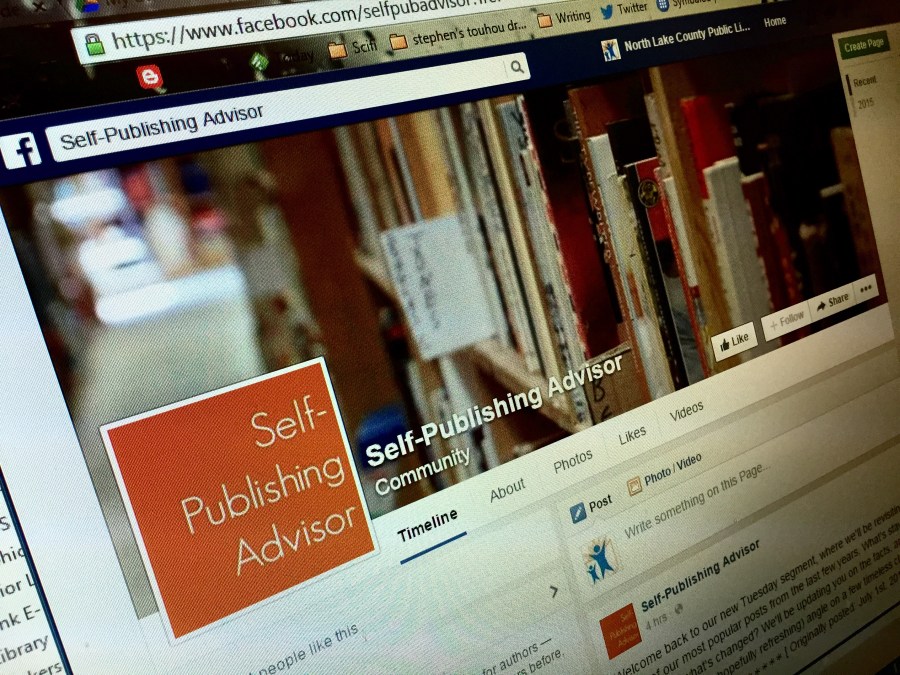
In Your Corner: Use Facebook to Promote Your Book!

Facebook

It’s not exactly breaking news anymore when we say “Facebook can help you sell books and create a platform!” to our readers here on the blog, since we’ve written about it before and maybe even a brace, a thicket, a luxuration of times—but it can never be said frequently enough, in my opinion.

Facebook can help you sell books and create a platform!

There, whew. We can all go home now.

Or can we?

There are hundreds upon thousands of resources out there specifying how and when to take advantage of Facebook, but the greater challenge is deciding which of those multitudes is actually useful for you, isn’t it? Being “findable” (there’s a five-dollar word for you!) doesn’t mean much if the platform isn’t providing you with something sustainable and enriching on your own terms.

Here are my top five recommendations for putting Facebook to work:

  1. Build a fanbase. Facebook is great as a bulletin board space, but its real power is in mobilizing large groups of people who all share a passionate interest in something, and you won’t mobilize anyone if you yourself aren’t on your page, engaging with readers, reviewers, and more generally, fans—on a regular and sustainable basis! Make it worth their while, too: upload “behind the scenes” videos and create events, use QR codes to direct traffic to your page and paper-bomb your town with it, guerrilla-style! Once you have a large fanbase, you’ll be able to do pretty much everything else that you want as well.
  2. Use your Facebook account to link with other websites. Whether it’s your email signature or those wonderful “log in using Facebook!” ancillary websites, which allow you to create and link your Facebook account in order to streamline the login process, interlinkage is a useful stratagem on many fronts. It gets your name and face out there, yes, but it also makes it extremely easy for fans to follow your movements around the internet—from Twitter to Instagram to Goodreads to Ko-Fi to Kickstarter and more! That way, even though you’re making use of all of these websites’ useful and peculiar features, you’re working with one central account.
  3. Go elsewhere. By this, I mean: use your Facebook account to interact with other authors, on their turf. Facebook is about community, and no community thrives when it’s one-sided, so don’t expect everyone to come to your page without first having something to offer on theirs! You can do a little market research while you’re at it, too, and steal ideas from authors whose pages reflect the kind of presence you yourself want to establish. You can share specific posts that you enjoyed on your own timeline, which also builds that community spirit.
  4. Keep it visual. You’ve probably heard the word “clickbait” floating around on the interwebs, but if you haven’t, the term refers to material which takes full advantage of social media users’ predilection for clicking on links which have immediate visual appeal—usually a catchy image or an equally catchy, brief, and possibly controversial headline. You don’t need to dip into the controversy side of things, but you too have a good reason to pay attention to this particular market trend, and to pay attention to the psychology behind it! Facebook users are equally as visual as those on Instagram and Pinterest, so don’t skimp on posting images to your account and your timeline. Photos bring in clicks and views more than anything else! It doesn’t just have to be images of your book, of course, although some of my favorite accounts carry out a kind of “book scavenger hunt” or “book road trip” activity, where the author takes pictures of their books in interesting locations—or ask readers to take pictures and then share those pictures to your timeline as well!
  5. Make a meal of Facebook Insights. This is the Facebook equivalent of Google Analytics, since even without a paid account, Facebook keeps detailed track of what users are looking at your page and when, how long they spend, what they interact with, and more! It’s profoundly useful, for example, to know when your “peak viewing” period is—when the highest percentage of people access your page every day—and post new material right then, for them to enjoy. It’s also useful to know, for example, that your readers really do prefer your images over your text posts—and by a factor of … well, it will vary from person to person! Once you know your fans’ habits, it may be time to explore paying for a Facebook ad … or you may not need one, depending on the circumstances!

However you choose to use Facebook, you’re not wrong. But there may be a few things you can tweak in order to do even better, as I am learning every day.

You are not alone. ♣︎


Elizabeth

ABOUT ELIZABETH JAVOR: With over 18 years of experience in sales and management, Elizabeth Javor works as the Manager of Author Services for Outskirts Press. The Author Services Department is composed of knowledgeable publishing consultants, pre-production specialists, customer service reps and book marketing specialists; together, they all focus on educating authors on the self-publishing process to help them publish the book of their dreams. Whether you are a professional looking to take your career to the next level with platform-driven non-fiction or a novelist seeking fame, fortune, and/or personal fulfillment, Elizabeth Javor can put you on the right path.