ORIGINAL BOOK REVIEW: “The Portal” (CORT Chronicles Book 1) by David D. Bernstein

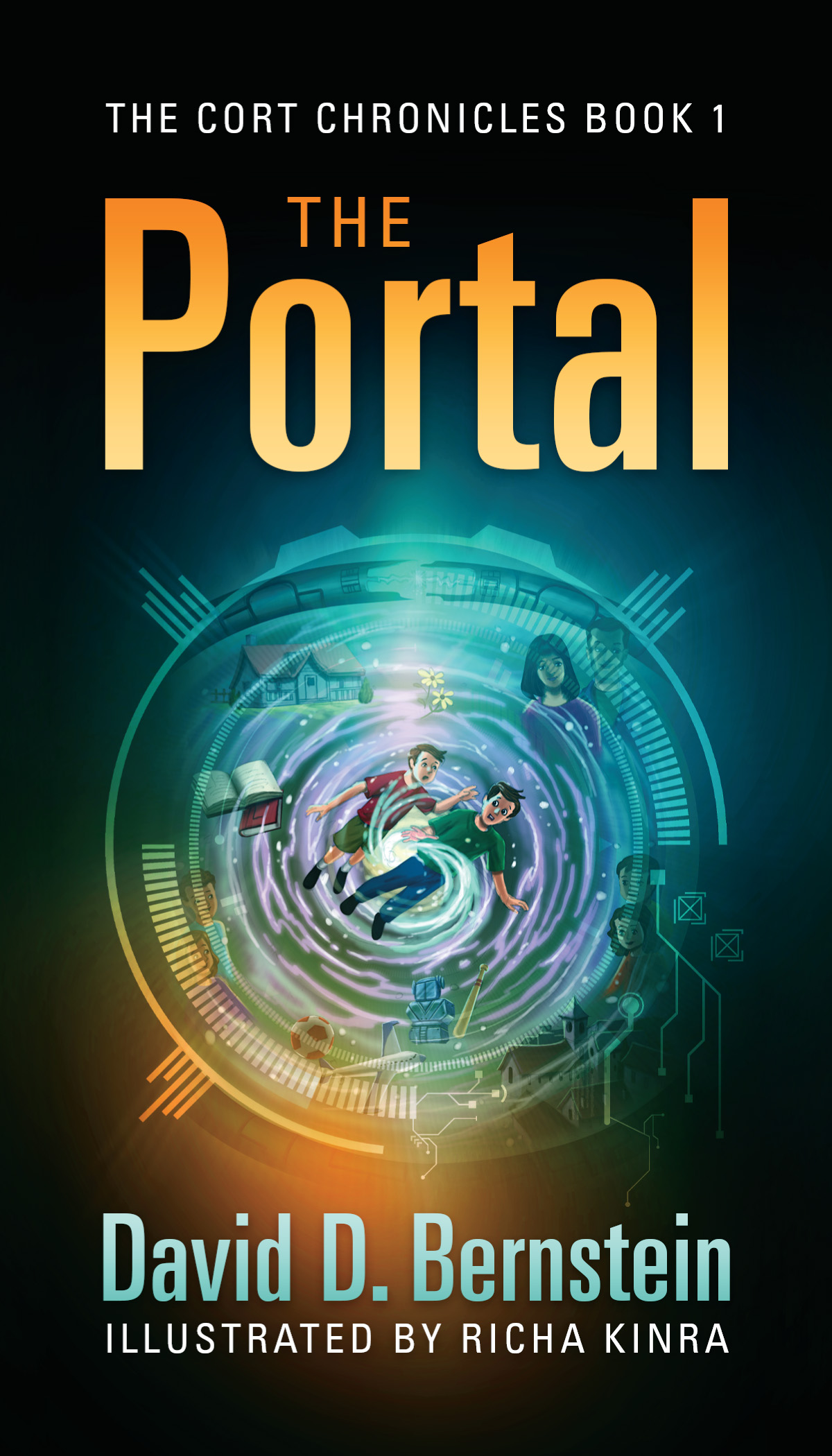
“The Portal” (CORT Chronicles Book 1) by David D. Bernstein; illustrated by Richa Kinra

OFFICIAL DESCRIPTION*:

After falling into a time portal during a Little League baseball game in Trinity, New York, eleven-year-old Andy finds himself transported to a ghostly version of his hometown––101 years in the future. Twisted metal, rotten wood, and garbage litter the seemingly empty streets, but Andy will soon discover that the city is controlled by CORT robots . . . and that this reality is Earth’s possible future. When thirteen-year-old Zack receives a strange letter that guides him through the portal, he and his brother are reunited, and together they must journey through a nightmare world that only they can change. But how can two young boys alter the present by saving the future?

REVIEW:

101 years in the future, thirteen-year-old Zack and eleven-year-old Andy find themselves caught up in a new civil war. After various misadventures including time-traveling portals at baseball fields and old abandoned supermarkets, a three-dimensional letter, and a ruined library full of frightful reminders that they are nowhere near home, the boys team up with future teenage resistance fighter Wendy and her crew. The boys face trial after trial as they begin to figure out what, exactly, is going on in this future: fifty years of cultural memory has vanished, and every possible thing is now manufactured by a shadowy organization––CORT. Children and seniors live segregated lives, with children brainwashed into accepting the new system from toddlerhood. One of the boys is captured, leading to the formation of a rescue party and a cliffhanger ending.

Now, I personally am not the biggest fan of cliffhangers! Many a young adult or middle grade novel has been flung across the room in my house because of an unfinished series leaving readers hooked–and frustrated that they can’t keep going the minute they finish earlier books in the series. (I do not condone the throwing of books, whether print or digital. As a librarian, here is my obligatory reminder to take good care of your precious stories.) Having said all of this, I do know that cliffhangers are an effective tool in an author’s toolbox, and that the mere fact I’m still grumbling about those cliffhangers from the distant past indicates those authors have made good use of this particular tool. Still, I am eager to lay my hands on the next book in this series so that I can learn the ultimate fates of Zack, Andy, and Wendy.

Middle grade readers will probably also be familiar with dystopias–future worlds where the systems governing society and/or government have somehow gone awry and are no longer serving to protect and serve those people who remain. There is always some rather mature themes involved in communicating dystopic ideas, and The Portal is no exception. Parents and readers should be aware that bombs fly and skeletons turn up at the most inopportune times, and yet the reading level or difficulty of this series indicates that it is written for those transitioning from Easy Reader (ER) books into chapter books. I could see this being a hit with the demographic currently (if clunkily) referred to as “struggling readers”: in other words, those children struggling to make the transition in reading level difficulty to the Junior Fiction section of the local school or public library. (I’m thinking of the Dork Diaries audience here.) The combination of an action-driven plot. lower-difficulty language, and eye-catching illustrations set these books apart from your more standard chapter books.

And those illustrations–I really can’t say enough about Richa Kinra’s ability to communicate so much in simple black-and-white pencil sketches. The face of each and every character is just so expressive, and important details within the story well featured. I’ve been drawing and painting since I could hold a pencil (or brush) and I absolutely could not even halfway imitate Kinra’s fantastic work.

What’s not to love? There are action sequences: The bombs! The evil robots! The people running! The purple flames! And there are also the mysteries: Who sent the letter? And how? Where do the seniors and children go? What is CORT really after? How did the resistance first get started? At around 75 pages, Bernstein’s first book in this series only just hints at answers still to come. Despite the occasional typographical hiccup, The Portal reads as a fun, immersive romp. Here’s hoping there are many installments left to come!

IN SUMMARY:

Going into this book, I expected it to be solidly good. I’ve never yet been disappointed by any book picked out by the CIPA EVVY process as a merit or award winner, and The Portal was in keeping with that high expectation. As much a work of fantasy as it is of science fiction, this book is very much written with a middle grade audience in mind, and is packed with the kind of zany adventures junior readers love.

WHERE TO BUY?

You can find The Portal wherever good books are sold, including Bookshop.org, Barnes & Noble and Amazon. You can also find out more about it on the book’s Outskirts Press listing.

WHAT NEXT?

The next book on my list is rather a pithy one: a nonfiction exploration of both the present and historical past of the Old Spanish Trail, portions of which I happen to be a bit familiar with, but much of which has intrigued me for years! I’m definitely the kind of person that can get lost in a guidebook to (name a national forest or park or monument) or any book along the lines of A Roadside Geology of … book. Much to look forward to!

I received a copy of this book in exchange for an honest review. 

* Courtesy of Bookshop.org book listing.


SONY DSC

ABOUT KENDRA M.: With nine years in library service, six years of working within the self-publishing world, as well as extensive experience in creative writing, freelance online content creation, and podcast editing, Kendra seeks to amplify the voices of those who need and deserve most to be heard.

ORIGINAL BOOK REVIEW: “Our Story: Jamaica’s Visionary Experimental Secondary Classes (1954-1960)” ed. by Jonathan Goodrich & Owen Everard James

“Our Story” ed. by Jonathan Goodrich & Owen Everard James

OFFICIAL DESCRIPTION*:

Equal opportunity for children to access “good education” has to be one of the primary obligations of any government. In a developing country like Jamaica, such opportunity is tantamount to ensuring the country’s viability if not its very survival. OUR STORY is a collection of first-person narratives by graduates of one of the most visionary and effective yet undocumented experiments in the history of secondary education in the English speaking Caribbean. The poetic prose of graduate Trevor Thomas highlights this shortcoming: “A brilliant meteor had streaked across the bleakness of Jamaica’s education landscape, briefly illuminating its dark canopy, but attracted scant attention, and the remains were unceremoniously buried without headstone or epitaph.”

The observation of Prof. Emeritus, the Hon. Errol Miller, OJ, CD, Ph.D., DLL (Honoris Causa), an internationally recognized scholar on the subject, further emphasizes the sentiment in his exceptional foreword: “Our Story recounts and reflects upon a unique chapter in the history of Jamaican secondary education told sixty-seven years after it began and sixty years after it ended by some students who assess its impact on their lives.”

Although OUR STORY focuses on the period 1954-1960, it directly references critical antecedents as well as pivotal outcomes from the period, especially in the area of Education Policy. The revolutionary role of the Hon. Edwin Leopold Allen, the then Minister of Education who envisioned and implemented the Experimental Secondary Classes, and the notable teachers that were the definitive agents of the success of the endeavor are recognized. The inextricable connection between the Classes and the broader history of Secondary Education in Jamaica is boldly clarified in the volume.

OUR STORY references Jamaica’s political, economic, and cultural history as these unfolded during the period immediately preceding and immediately following, national Independence in 1962. The absence of the story of the Classes from the larger narrative of secondary education in Jamaica substantiates a void in the history that should be addressed. This history and the related influence of the imposed, traditional, generally elitist, and highly discriminatory, imposed British system of education are well known and documented. This history is therefore not the main driver of this effort. Instead, the effort is driven by the realization that the Experimental Secondary Classes have not received the recognition and credit that they unquestionably deserve.

The historical linkages with our own stories demand that we acknowledge the nature, cause, consequences, and relevance of the international protests instigated by the worldwide recognition of systemic discrimination against people of color. It would be irresponsible not to do so. The common origins, direct relevance, and impact on how we may view our own heritage, and the future of the land of our birth are inescapable. Notably, the protests are in direct response to historical inequities in the opportunity to access crucial socio-cultural prerequisites such as education, justice, and the benefits that generally accrue from a clearly flawed, artfully marketed participatory economy that is extensively dependent on the education status of participants.

Hopefully, as the stories are told and read, the telling will not be in vain.

REVIEW:

If this last year has taught me anything, it’s that our education systems (globally speaking) still leave a lot to be desired. One might say they “need some work.” When students’ education suffers, no matter what grade or level they are at, society suffers––both in the moment and for decades to come. I had the benefit of an unconventional childhood, with a mix of homeschooling with dedicated and deeply invested parents, and a middle and high school education overseas. I can’t speak for the intervening years since I finished high school, but at the time, that particular education system ranked fairly high on the various “best education systems” lists that are released every year. It certainly wasn’t perfect, but it was challenging in some really good ways that prepared me incredibly well for college.

I can’t say the same was true for my fellow students in college and graduate school––many of my friends struggled, especially in the first two semesters, with the workload and the different ways of thinking that university-level courses require of students. I remember feeling rather proud to have received a “better” education (although to an extent that word is subjective), and now I feel a bit ashamed of having lorded that over my friends. As many research reports have shown, blame for poor performance across American school districts and elsewhere shouldn’t be placed on the shoulders of the students or teachers––the system itself is broken, and the fractures show at every level, from childhood through adulthood.

In Our Story: Jamaica’s Visionary Experimental Secondary Classes (1954-1960), editors Jonathan Goodrich and Owen Everard James have collected the background, methods, and results of a unique educational experiment carried out in Jamaica during a six-year periods ending in 1960. It is, I must say, an exhaustive document––fully book-length––about this educational programme, and yet it is also fascinating. I knew very little about the history of education in Jamaica and the other Caribbean islands, merely that it had been altered irrevocably by the area’s colonization by various foreign actors, namely Spain and Britain, and the import of imperial cultures along with slave labor from Africa (and later, indentured Chinese and Indian peoples). The native Taino peoples had been devastated, so I only expected that the country’s education system would reflect norms established during the British occupation. This book deals with what was essentially an educational experiment carried out in the years immediately prior to Jamaica’s emancipation in 1962, making it an interesting historical document of a time of great change on the island––and the ways in which all of these changes impacted how education was done. And indeed, the first chapter alone documents far to many of these changes for me to summarize effectively here.

As is stated in the forward, “Our Story is about fruitful lives: some thirty-fold, some sixty-fold and some a hundred-fold, made possible by access to good quality education with international currency.” It is, by its mere existence, a document that refutes the argument that educational success ought to be approached in the same way as business success. The book draws on personal recollections collected well after the fact, and the editors acknowledge both the benefits (hindsight and lived experiences) and the drawbacks (erroneous and incomplete memories of events as they happened) of this approach. Its editors set the scene for the unfolding of this particular experiment by first describing the various (and often ad hoc) other competing systems in use during this period. But as Goodrich and James put it, the book exists not to focus on these things but rather the experiment itself––the ESCs (Experimental Secondary Class)––and to remedy the fact that these classes had never “received the recognition and credit that they unquestionably deserve.”

A quick note for those of you who like to know such things: There is a religious inflection to this book and the educational experiment it documents. This is something of an historical artifact of the period being discussed––and of the British heritage and influence that even now persists in an independent Jamaica.

Would the ESC system work today, in 2021, in my country? I have no idea. It would certainly require a complete restructuring of the system––a system admittedly that I’ve previously described as “broken.” In this I’m not exactly unusual; almost everyone I know is unhappy with the current state of things and with the quality of education that children and teenagers are receiving. The challenge isn’t one of motivation, but rather execution: How can a country overhaul its educational system without a period of great disorganization, and without protest against the ways and means of getting it done? Goodrich and James document one possibility, carried out as an experiment with a limited reach that still managed to make a vast difference. I would certainly recommend that educators and administrators take a look at this book––it might just prove the very thing that’s needed going forward.

IN SUMMARY:

Editors Goodrich and James cover the results of the Experimental Secondary Class (ESC) programme in Jamaica in the years before that country’s independence. The book provides a thorough and inspiring template for modern educators to learn from as we continue to face educational systems drained of funds and adequate support, as well as the freedom to innovate.

WHERE TO BUY?

You can find Obsolete wherever good books are sold, including Bookshop.org, Barnes & Noble and Amazon. You can also find out more about it on the book’s Outskirts Press listing.

WHAT NEXT?

The next book on my list is The Portal by David Bernstein, which won a CIPA EVVY merit award back in 2018 for Juvenile Fiction. It’s a work of fantastical science fiction, and promises me robots and time portals, so I’m quite excited about that!

I received a copy of this book in exchange for an honest review. 

* Courtesy of Bookshop.org book listing.

SONY DSC

ABOUT KENDRA M.: With nine years in library service, six years of working within the self-publishing world, as well as extensive experience in creative writing, freelance online content creation, and podcast editing, Kendra seeks to amplify the voices of those who need and deserve most to be heard.

ORIGINAL BOOK REVIEW: “When the Bullying Stops,” by Bernice L. Dunlap

Welcome to 2021!

And … on to the review!

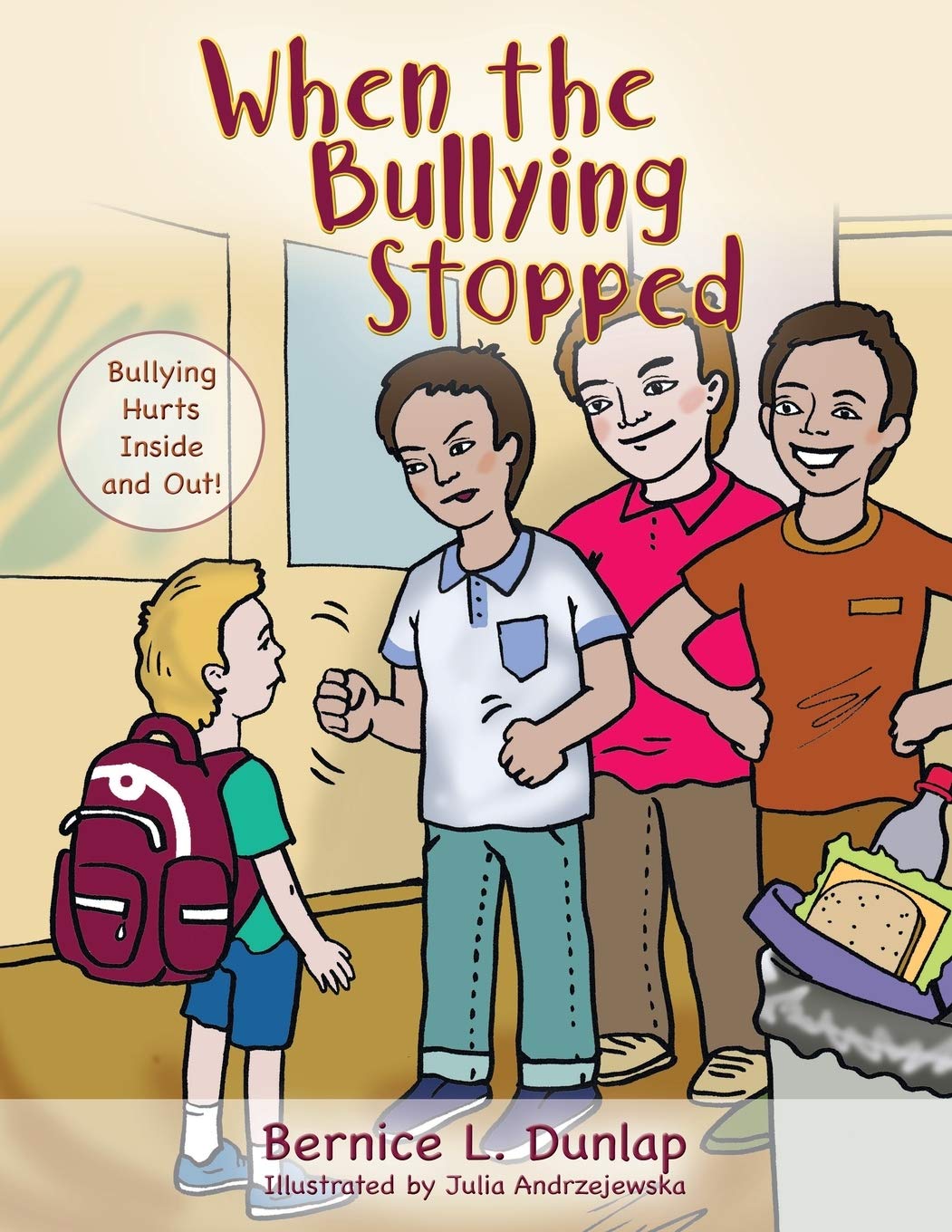
When the Bullying Stopped by Bernice L. Dunlap

OFFICIAL DESCRIPTION*:

KEEPING SILENT ABOUT BULLYING ENABLES IT TO CONTINUE

This story is about an eight-year-old boy named Peter, who was in the third grade at Leonard Street Elementary School. Alex and his friends, Max and Jax, picked on Peter every day. These boys were also in the third grade at the same school. This bullying made life miserable for Peter, and he knew he had to find the courage to tell his parents how Alex and his friends were terrorizing him at school.

REVIEW:

Oh, how the world needs more books like this one.

In When the Bullying Stopped, written by Bernice L. Dunlap and nicely illustrated by Julia Andrzejewska, we start with three bullies and one victim: Peter. Peter is a bit less muscled and a whole lot less of a dominant personality than Alex, the bullies’ ringleader, as well as Max and Jax, Alex’s sidekicks. (I am curious why the author chose to end all three bullies’ names in ‘X’s! I found it interesting––but that may just be coincidental.) Alex and co. give poor Peter a rather rough time, trashing his lunch one day and stealing his lunch money the next. Peter is a good boy, although he feels mighty small when faced by those bullies, so while he is at first afraid enough to go hungry, he eventually brings his parents and the school principal into the conversation, and just desserts (suspensions) are handed out to the three villains. Two of these villains, Jax and Max, move out of town (and therefore the narrative) at this point, while Alex continues on.

The book then transitions to following Alex instead of Peter, and here is where the bully becomes the bullied. Some kids from another local school rough Alex up, and he is left injured and frightened by the experience. Peter, who is indeed a very good boy, attempts to help his former bully despite Alex’s protests and the other kids in the schoolyard keeping well enough away. (I assume this is because they themselves had been hurt by Alex and co. in the past, and were hesitant to get near him––but this might prove an interesting point for discussion.) Peter then searches out the principal on his own and finds Alex the help he needs. Receiving assistance from someone he has wronged in the past proves a good learning experience for Alex, who eventually changes his ways and makes friends with Peter, gaining the confidence of his other peers as well.

All of this, and in only 24 pages!

The book pages are divided evenly between alternating full-page illustrations and full-page text-centered pages. There is quite a lot of text on those latter pages, proportionate to the page number, so I do recommend that readers take it slow and spend ample time pointing out what they see mirrored in the illustrations. The text is nicely edited and formatted for When the Bullying Stops to be an easy read for those who, like me in my library life, have to read their picture books upside down. I appreciate a readable-while-inverted book!

While I did not notice any negatives while reading, I do have two suggestions in order to ensure that those using this book meet with the best possible success. Parents, grandparents, teachers, and other caregivers will want to make sure to define and contextualize some of the more advanced words or terms used by Dunlap; a word like “protruding” or a term like “fetal position” are entirely possible to explain, especially in context, but they are unlikely to prove easily understandable to younger readers in kindergarten or, possibly, first grade. My other suggestion for these same youngest readers would be to break up the reading of the book into two distinct readings with some discussion in between as well as after. While the story itself is straightforward, the first section deals with a victim of bullying making the great decision to report his experiences to his parents and principal, and the second section deals with the bully, who after he is suspended is bullied himself. The book ends with some possibilities for rich future discussion with young readers. Why did the other children, many of whom had been bullied themselves, not assist the bully when he was beaten up? What does this book tell us about forgiveness and compassion? How would you respond if someone threw your lunch in the trash? … and so on.

I’m excited to see what all this book can do out there in the world, in homes and classrooms. And speaking of classrooms, I’m very interested indeed to see how this next year of hybrid/remote/classroom education settles out. Here’s hoping we achieve a new (and healthy, happy) normal sometime soon!

As a final note, consider this book’s title: When the Bullying Stops. What does happen afterward? As Dunlap suggests, it may just be an opening for personal growth, change, and classroom rapport. I’m sure you all might have some suggestions, as well!

IN SUMMARY:

In a world where bullying is tragically common, an accessible picture book like When the Bullying Stopped by Bernice L. Dunlap might just make a big difference in a child’s life. I also highly recommend checking out Dunlap’s other books for children.

WHERE TO BUY?

You can find Stella the Rejected Star wherever good books are sold, including Bookshop.org, Barnes & Noble and Amazon. You can also find out more about Marc McCormack’s work on the book’s Outskirts Press author page.

WHAT NEXT?

I received a copy of this book in exchange for an honest review. 

* Courtesy of Outskirts Press book listing.


SONY DSC

ABOUT KENDRA M.: With nine years in library service, six years of working within the self-publishing world, as well as extensive experience in creative writing, freelance online content creation, and podcast editing, Kendra seeks to amplify the voices of those who need and deserve most to be heard.

ORIGINAL BOOK REVIEW: “Stella the Rejected Star” by Marc McCormack

OFFICIAL DESCRIPTION*:

Stella wasn’t like all the other stars in the skies above Bethlehem. She was a four-pointed star in a five-pointed world, and the other stars teased her because of it. Then one day, the stars heard an important event was about to happen-and God would choose one star to play a crucial role.

Could that star be Stella? Not if the other stars get their way, and they will do anything to stop her!

Stella’s story shows us that often the ones considered different in the world are the ones who shine the brightest through their faith, hope, and love.

Stella the Rejected Star was written by Marc McCormack when he was eleven. Almost forty years later, Stella’s story has turned out to be his son Brady’s story. Brady, who is blind and nonverbal with autism, navigates his way through the world as both a star who has sometimes been rejected, and one of the brightest-shining ones.

Set against the first Nativity, Stella the Rejected Star is more than a Christmas story and is for everyone, especially those young readers with four points in a five-pointed world.

Stella’s story is the perfect one to teach children the importance of empathy and acceptance. If your child loves Christmas and stars, even mischievous ones, they will love Stella the Rejected Star!

Some of the proceeds from the sale of this book will be donated to autism-related charities.

REVIEW:

Once upon a time ….

The first time I read Stella the Rejected Star, I found myself humming “Rudolph the Red-Nosed Reindeer” aloud to myself. There are definitely some parallels between the stories of Rudolph and Stella––bullying by one’s peers, physical difference as a subject to be grappled with, a sort of “inspecting of the troops” or competition to guide an important process, and a message involving the triumph of the innocent over the cruel––and I think this parallel provides a unique and interesting starting point for discussions between parents (or grandparents, or caregivers) and young children.

How are these stories similar? It certainly doesn’t hurt that both Rudolph and Stella literally as well as metaphorically shine brighter than their peers, or that when Stella and Rudolph are both brought to the attention of God and Santa respectively, they take the high road and refrain from punishing their peers, even though they have acquired the power to do so.

(A quick aside: I still feel uncomfortable about having put Santa into the same sentence as God, particularly since I grew up in a household where the secularization of Christmas was a regular discussion. Whatever your or my personal stances might be on this particular depiction of the divine, I think it’s pretty safe to assume we’re all aware that the Nativity story occupies a sacred and beloved space in many households around the world, and I definitely do not want to imply I do not take the faiths of my friends, family, and neighbors seriously. I do think it’s important to specify that this book resonates specifically with mainstream Christianity as experienced in America, to prevent confusion.)

How are these stories different? Well, we’ve established that God is not Santa (and vice versa). And while Rudolph’s mission is one of spreading good cheer, Stella’s is to lead the shepherds and wise men to the newborn Jesus. McCormack also distinguishes his story with an added twist: in Stella the Rejected Star, faithfulness magnifies a star’s light, while the bully stars discover that their unkindness leads to a loss of this same light. Not only does this provide an opportunity to talk about bad behavior and bullying with kids, but it also introduces the concept of faithfulness and the relationship between faithfulness and behavior.

I find it incredible that an 11-year-old wrote this story, but that’s the background: McCormick wrote it as a boy and published it in honor of his son Brady, who has an autism spectrum disorder (ASD). That Brady was himself was a preemie and only surviving twin underscores the importance of this story, both to McCormick, and to those who learn from his picture book. Beyond the value of teaching children to empathize with and be kind to those who stand out for their differences, there is another moral to this story. Hardship, McCormick hints, provides a backdrop against which both heartbreaking and incredibly beautiful stories can play out. All of this in 32 pages, half of them Seth A. Thompson’s colorful and evocative illustrations. I can’t imagine a better way for families of faith to finish out 2020 than with a story of hope, faith, and maintaining joy through hard times.

You can find another detailed review of Stella the Rejected Star on the Readers’ Favorite website, reviewed by Emily-Jane Hills Orford. It is encouraging to me personally that other highly-rated reviewers have begun to pick up on McCormack’s wonderful story.

IN SUMMARY:

Stella the Rejected Star is a sweet and wholesome picture book for those looking to re-invest the holiday season with the magic of love and kindness present in the Nativity story. Marc McCormack’s story and Seth A. Thompson’s illustrations combine to create what will quickly become a modern classic for English-speaking Christian families.

WHERE TO BUY?

You can find Stella the Rejected Star wherever good books are sold, including Bookshop.org, Barnes & Noble and Amazon. You can also find out more about Marc McCormack’s work on the book’s Outskirts Press author page.

WHAT NEXT?

There are several more children’s books in my TBR pile for me to get through before the end of 2020, with my next review scheduled for the afternoon of January 1st. I can’t imagine a better way to start off a new year than with a good book!

I received a copy of this book in exchange for an honest review. 

* Courtesy of Amazon book listing.


SONY DSC

ABOUT KENDRA M.: With nine years in library service, six years of working within the self-publishing world, as well as extensive experience in creative writing, freelance online content creation, and podcast editing, Kendra seeks to amplify the voices of those who need and deserve most to be heard.

ORIGINAL BOOK REVIEW: “God and Country” by Joseph Bylinski (Religion, Politics & State)

OFFICIAL DESCRIPTION*:

The Bible and politics unite in a new non-fiction book which discovers that finding the answers to the Biblical mysteries leads to understanding that politics and the Bible must come together for our country of freedom to survive.

Hidden within the Bible are many creatively written and cleverly placed phrases which specifically point to these times. And when these extraordinary phrases are rearranged, they clearly explain our current world and answer one of the Bible’s biggest mysteries. They identify the Beast of the book of Revelation, the being commonly known as 666. And to obtain this elusive answer the Biblical phrases will take the reader on an incredible journey back to the birth of America to discover why we have our freedom and they’ll make it known that the true meaning of Jesus is what binds our nation together.

In God and Country the Biblical phrases unlock the secret to understanding how our freedom is earned, and more importantly, the Biblical phrases warn us that our country and our freedoms will not last unless we do indeed become “One Nation under God and Indivisible”. All of our countrymen shall live by God’s words or we will fail. And this becomes evident when the Beast is revealed.

The rearranged Biblical phrases expose our nation’s problems but in doing so they also reveal the secret to discovering the solution …..that politics and the Bible must become partners in a free democracy.

Our country was founded upon the Bible. Our laws are based on the Bible. And unfortunately, we are currently throwing the Bible out the window. Our country has wandered away from its founding ideals as we have pushed aside, ignored and thrown out God’s laws without realizing that they are here to discipline us and keep us in control.

Let it be known that freedom comes with the restriction of living by faith, that freedom has responsibilities with our mutual duty to be kind and considerate to one another, and that freedom must be constrained by discipline, and that this discipline is the Bible.

It’s time to change America’s politics, values and direction.

REVIEW:

I’m not particularly shy about my religious background, which in this case is probably a good thing, since Joseph Bylinski’s God and Country: ….United We Stand! ….Divided We Fall! is itself not even remotely shy about its stance and content. In my case, I come from a conservative Evangelical Christian household with supremely specific and controversial interpretations of the scriptures. I’m much more of a seeker and questioner now as an adult, but none of my more recent struggles and doubts have erased the practically perfect recall of the passages Bylinski refers to that I acquired in my childhood.

I absolutely refuse to spoil the main points of a book that is entirely built upon the principle of unveiling hidden truths! You’ll just have to buy a copy if you want to unlock them all. Without spoiling anything, I will simply say that the book leans heavily on the notion of freedom, stating in its early pages that “by understanding the concept of freedom that [the founding fathers] created back in the 1700’s […] helps us realize that we all have a greater obligation to fulfill in being a citizen beyond just taking an oath or being born on this soil.” Bylinski’s book is deeply political in that many of the passages he analyzes are, he argues, built entirely to communicate political truths and citizenship ideals.

For someone who lives within a community like mine, Bylinski’s claims make perfect sense once grasped. This particular book draws upon a long legacy of biblical interpretations that lean on numerology or cypher cracking in order to better understand the meanings and prophetic declarations within red letter passages. Bylinski’s approach is not quite either of those things (numerology or cypher based, that is) but it will likely appeal to those readers who have found something to value in them. And yes, it goes without saying that those who don’t already buy into the sanctity and inerrancy of these same passages will likely not walk away with the same degree of sympathy and agreement as those who do. But that, too, is perfectly in keeping with a long tradition; even within the bible itself one can find the acknowledgement that “the message of the cross is foolishness” to those who are not a part of the community of believers (1 Cor 1:18, NIV).

This is certainly one book that asks, repeatedly: Are you a believer?

IN SUMMARY:

Decisive in voice and unafraid to stick to its unique approach to the sacred texts of Christianity, God and Country: ….United We Stand! ….Divided We Fall! by Joseph Bylinski is a bold book in these unprecedented times. For those who fall within its ideal audience, it is likely to be an absolute hit.

WHERE TO BUY?

You can find God and Country wherever good books are sold, including Amazon and Barnes and Noble. You can also find out more about Joseph Bylinski’s work on the book’s Outskirts Press author page.

WHAT NEXT?

It’s been quite the busy e.

I received a copy of this book in exchange for an honest review. 

* Courtesy of Barnes & Noble book listing.


SONY DSC

ABOUT KENDRA M.: With nine years in library service, six years of working within the self-publishing world, as well as extensive experience in creative writing, freelance online content creation, and podcast editing, Kendra seeks to amplify the voices of those who need and deserve most to be heard.