reading succesAs a self-publishing author, you may find it helpful to stay up-to-date on the trends and news related to the self-publishing industry. This will help you make informed decisions before, during and after the self-publishing process, which will lead to a greater self-publishing experience. To help you stay current on self-publishing topics, simply visit our blog every Tuesday to find out the hottest news.
The success of EL James and her Fifty Shades of Grey trilogy did much to overturn the stereotype of a self-published author. Now academic research further challenges the image of eccentric hobbyists scribbling away in their sheds by revealing that it is middle-aged and well-educated women who dominate the growing e-publishing market. This article is an interesting read for all female writers.
This list of top self-published books is an excellent resource for authors wanting to learn more about the industry and craft by studying other writers. I recommend reading successful books by self-published authors as a way to see what works, what doesn’t work, and to improve your own writing and marketing approach.
If you have other big news to share, please comment below.
ABOUT KELLY SCHUKNECHT: Kelly Schuknecht is the Executive Vice President of Outskirts Press. In addition to her contributions to the Outskirts Press blog at blog.outskirtspress.com, Kelly and a group of talented marketing experts offer book marketing services, support, and products to not only published Outskirts Press authors, but to all authors and professionals who are interested in marketing their books and/or careers. Learn more about Kelly on her blog at http://kellyschuknecht.com.
As promised, I’m back this week to unpack some of the specifics when it comes to using titles and tags to boost your dividends during the Search Engine Optimization (SEO) process.Two weeks ago, you’ll remember, I launched this series with a brief history of search engines and an inquiry into the necessity of SEO.First, I investigated a few ways in which we can better employ keywords.A week ago, I dedicated an entire blog post to talking about matters of content.This is because keywords are often an important doorway, or entry point for many new readers––that is, the way in which they first stumble across or access your work––and content is the house you build behind that doorway, the material that absorbs new readers and gives them a place to settle into conversation with you.
It might be tempting to view titles and tags as merely decorative––a nice piece of wall art to hang above your mantel, or a set of attractivebut generic photographs to tuck into the guest bathroom––but this is far from the truth, and far from doing justice to the potential benefit that a knowledgable and strategic use of these tools can provide.Titles and tags are highly functional components of your digital content.Think of them as the windows, screen doors, and patio of this metaphor; they increase the visibility of your material.Today, I’m going to lead you through two additional steps that may be of use to you as you get started with your own SEO.
Step 3: Optimize Your Title
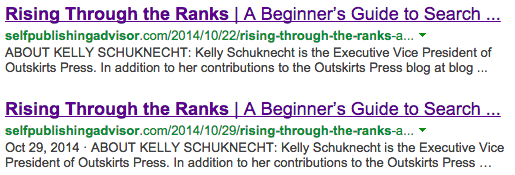
Coming up with a title for your digital material can be every bit as difficult as creating the content that follows.As other websites can tell you, search engines like Google and Bing have character limits on title tags.This means that above and beyond considerations of readability on your website or YouTube channel or blog page, you have to consider an additional layer of presentation: will enough of your title show up on a search engine listing to pull new readers in?To show you what I mean, I plugged “Rising in the Ranks” and “Self Publishing Advisor” into Google (top) and Bing (bottom), just to see how much of my own title tags are showing up after my blog posts are indexed and cached:
Google search listingBing search listing
As you can see, Google displays the titles of my individual blog posts twice––first, in a larger typeface and a more eye-catching color, and then again in a smaller font.The larger typeface only leaves room for 55 or so characters, and the rest is covered by an ellipsis (the “…” at the end of the line).The smaller font below allows for my full titles to be displayed, along with the dates of posting, my screen name, and however many of my tags (more on that later) as can fit.The shorter your titles, the more room there is for tags.
Bing, on the other hand, doesn’t repeat the titles and omits the tags altogether.Instead, it provides an excerpt from my biographical information.The moral of this particular story is: while most search engine listings will include the title of your individual posts, the rest of what they may show is up for grabs (that is, determined by different algorithms).The only common denominator between search engine results is your title.
So, what makes for the best of all possible titles, when it comes to SEO? A balance of simplicity with accuracy and description.This may prove to be a bit of a tug-of-war, especially if you’re posting complicated and thematically rich material––but three quick rules of thumb are:
… keep your title concise, catchy, and grammatically correct,
… include one or more of your most relevant keywords, and
… try to stay below the 50-60 character limits imposed on the listings.
Step 4: Optimize Your Tags
I’ve already mentioned that tags boost the visibility of your digital content.Google and other search engines will sometimes display your tags, or meta descriptions, on search results as a kind of preview to help readers to determine what your blog post or YouTube video or other digital content is actually about.As with keywords, you want to prioritize what you include in your tags.Tumblr, for example, only indexes the first 20 tags you attach to a post.This sort of cutoff is fairly typical for both normal and micro-blogging platforms.
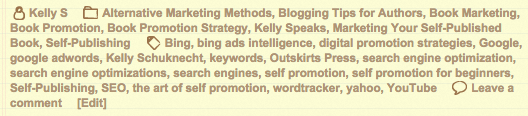
So, what do tags look like?Here are just a few examples, posted with permission:
SelfPublishingAdvisor.com (WordPress) tagsOne of Tumblr’s may tag display optionsAnother of Tumblr’s many tag display options.One of Blogger’s tag display options
As you can see, each platform has its own ways of displaying tags, and sometimes a single platform will allow you to customize the appearance of said tags.Even if you set up your blog to not display tags, make sure you do generate metadata for every post or page, since tags play a vital role in how search engine algorithms determine the relevance of your material to searches your target audience will be running.
I should note that there’s a difference between the tags that are displayed alongside blog posts like this one and meta tags, which are the actual chunks of mostly-invisible HTML code that make up the architecture of your digital content.It used to be true that if you wanted to build a website, you had to develop a working knowledge of HTML in order to take advantage of SEO.Today, most of the big blogging platforms (like WordPress, Blogger, Tumblr, and so on) allow you to input information in the tag field and they convert some or all of that information into HTML meta tags for you.It’s not a perfect translation––but if I’m getting too technical here, remember that the point of SEO is to take advantage of as many simple tricks as you find feasible and translate those tricks into increased website traffic. Not every trick is going to be one that fits your needs. As with all other self-marketing methods, you must weigh the benefits against the costs yourself––and the main cost here is time: the time it takes to learn HTML may offset the actual net benefit, especially if you can take advantage of built-in features like tag fields.
Well, I’ve run out of room this week—check back here next Wednesday to learn more about search engine optimization.I’ll be addressing the matter of analytics!
If you have a question about any of these tools for self promotion, would like to hear from me about something specific, or have other big news to share, please comment below!
ABOUT KELLY SCHUKNECHT: Kelly Schuknecht is the Executive Vice President of Outskirts Press. In addition to her contributions to the Outskirts Press blog at blog.outskirtspress.com, Kelly and a group of talented marketing experts offer book marketing services, support, and products to not only published Outskirts Press authors, but to all authors and professionals who are interested in marketing their books and/or careers. Learn more about Kelly on her blog, kellyschuknecht.com.
As a self-publishing author, you may find it helpful to stay up-to-date on the trends and news related to the self-publishing industry. This will help you make informed decisions before, during and after the self-publishing process, which will lead to a greater self-publishing experience. To help you stay current on self-publishing topics, simply visit our blog every Tuesday to find out the hottest news.
In this article, author Anthony Otero discusses his self-publishing journey and his advice to other authors. His words of wisdom cover support, accepting help, and not taking things personally. This is a fascinating read for authors considering self-publishing.
The expo boasts new exhibitors and an expanded program to help self-publishing authors. This year’s show, held Saturday, November 15, from 9 a.m. to 5 p.m., at the Roosevelt Hotel in New York City, features an expansive program of education panels, events, and exhibitors. Be sure to check out the full article to learn about this year’s show.
If you have other big news to share, please comment below.
ABOUT KELLY SCHUKNECHT: Kelly Schuknecht is the Executive Vice President of Outskirts Press. In addition to her contributions to the Outskirts Press blog at blog.outskirtspress.com, Kelly and a group of talented marketing experts offer book marketing services, support, and products to not only published Outskirts Press authors, but to all authors and professionals who are interested in marketing their books and/or careers. Learn more about Kelly on her blog at http://kellyschuknecht.com.
Last week, I launched a series of blogs to provide a primer to––or a launching point for future discussions about––one vital way to augment your digital presence: Search Engine Optimization (or SEO).I argued that by making our digital content easier for the average internet user to find, we can boost traffic to our websites––and by extending the reach of our voices, expand our audiences.
I have already examined the specific benefits to refining the way we use keywords, particularly in our website or blog titles, tags, and so on.This week, I’m going to turn to matters of content.How can we better utilize the meat and potatoes of our digital content––the bodies of our blog posts, for example––to push our websites up through the ranks of similar websites that show up in search engine results?
Step 2: Optimize Your Content
Even though traditional strategies for SEO (like keyword optimization) are vital and critical practices for the average blogger, the search engines of today call for even more sophistication.Consider: in 2013, Google alone had already indexed more than thirty trillion individual web pages.That’s 30,000,000,000,000 pieces of content vying for the top slot on any individual search.Thankfully, search engine algorithms are fairly good at slicing away unrelated material, but you get the idea.There is a lot of digital content, so you have to take certain steps to make yours stand out––and the best way to stand out is to create unique content.
The basic notion is this: readers have access to plenty of useful data, but they are looking for something more than just another blog on a given topic.They’re looking for the best blog on a given topic.And search engines like Google are getting better at finding it!According to blogger Sujan Patel, Google in particular looks for “longer content, images, videos, correct spelling, proper grammar, proper text formatting and […] both outbound links to other high quality sites and inbound links (and social shares) from high quality sources.”You’ll note that this list implies a certain level of polish in respect to presentation (grammar and et cetera), but leaves room for you to play with subject and theme.
If certain elements of SEO sometimes seem like common sense, that’s because search engines are getting better at shaping common sense into measurable data sets, and using those data sets to refine the search process.It may prove helpful to consider search engines as just another ‘average’ reader, albeit a powerfully influential one.So, how do you create content that hooks in the average reader or search engine?By posting regularly, on diverse but thematically resonant topics, using means that are equally diverse and up-to-date as well as easily shared across social media platforms, and by tying your content to other websites using links, keywords, and meta data.(As a matter of fact, Google does hire actual and real people to rate websites for quality of content.The process is a fascinating one, and well worth a look.)
As I mentioned last week, it’s important to remember that we’re not just looking for more users to stumble across our websites; we’re looking for the right sort of users––those users who will stick around long enough to fall in love with our written voices and, hopefully, our books.We all have probably had some experience in stumbling across bloggers who are so good at making their content findable that they forget to make it readable, personable, or worthwhile.Ultimately, your readers want to find a little bit of you in every blog post (or YouTube video, or tweet, or Facebook post) you put together.You are what keeps them coming back, week after week after week.Taking the time to craft quality content that reflects your personality is a practice that will pay dividends for a long, long time.
Check back every Wednesday for the next installation of this blog series!I’ll be taking a look at titles and tags in a week’s time––and how can you use lofty ‘meta-data’ to bolster your SEO.See you then!
If you have a question about any of these tools for self promotion, would like to hear from me about something specific, or have other big news to share, please comment below!
ABOUT KELLY SCHUKNECHT: Kelly Schuknecht is the Executive Vice President of Outskirts Press. In addition to her contributions to the Outskirts Press blog at blog.outskirtspress.com, Kelly and a group of talented marketing experts offer book marketing services, support, and products to not only published Outskirts Press authors, but to all authors and professionals who are interested in marketing their books and/or careers. Learn more about Kelly on her blog, kellyschuknecht.com.
As a self-publishing author, you may find it helpful to stay up-to-date on the trends and news related to the self-publishing industry. This will help you make informed decisions before, during and after the self-publishing process, which will lead to a greater self-publishing experience. To help you stay current on self-publishing topics, simply visit our blog every Tuesday to find out the hottest news.
In this article, Allison Carmen, an author who has published with both a self-publishing company and a traditional publisher, shares her story in hopes of helping you decide the best way to publish your book. This is an interesting read for all writers.
The Twible: All the Chapters of the Bible in 140 Characters or Less . . . Now with 68% More Humor! by religion scholar Jana Riess has won First Place in the Nonfiction category in the Writer’s Digest 2014 Self-Published Book Awards. The honor includes a $1,000 cash award, a one-year membership in the Small Publishers Association of North America, and a one-year membership to Book Central Station. I always recommend writers study successful self-published authors as a way to learn about the industry and improve their craft.
In this article, two writers each make their case for their view on the Amazon debate. This is an interesting read for all writers.
If you have other big news to share, please comment below.
ABOUT KELLY SCHUKNECHT: Kelly Schuknecht is the Executive Vice President of Outskirts Press. In addition to her contributions to the Outskirts Press blog at blog.outskirtspress.com, Kelly and a group of talented marketing experts offer book marketing services, support, and products to not only published Outskirts Press authors, but to all authors and professionals who are interested in marketing their books and/or careers. Learn more about Kelly on her blog at http://kellyschuknecht.com.




 Self Publishing Advisor