Self-Publishing & Merchandising : Working with Barnes & Noble

Last week, you’ll recall that I put together a few words about working with Amazon to merchandise your work.  (And really, they end up doing much of the work for you, which is nice.)  I also mentioned the fact that much of the merchandising we’ve looked at together over previous weeks takes for granted that the book is its own complete product, the sum of its parts (see: book covers and jacket design, interior design, special additions, and the blurb), and the sum of other parts, too (see my posts on the book review, as well as how to get and give blog reviews).  As a massive online retailer, Amazon happens to be one of those parts, but what about Barnes & Noble?  Is there any work to be done there, when it comes to merchandising your self-published book?

Despite the fact that Barnes & Noble seems to be losing its edge in the digital book market, it is still a juggernaut of a force to be reckoned with.  The decision whether or not to self-publish your book through Barnes & Noble’s NOOK Press ought not to be touched, yet, by rumors of the company’s eventual demise––a demise which may indeed come, but not before the retail giant sells many more books, of which yours may be one (or two, or three, or five hundred).  Instead of asking “Should I?” a better question might be, “How can I best take advantage of the service while it exists?”

GETTING STARTED :

Luckily, as with Amazon’s Kindle store, Barnes & Noble itself takes care of much of the heavy lifting for the independently published author.  The first step, of course, is to sign up for a NOOK Press account, a simple enough process, and one that is available to authors residing in the United States, the United Kingdom, France, Germany, Spain, Italy, Belgium, and the Netherlands.  With an interface not much different from that of Kindle Direct or Kobo, the NOOK Press website allows authors to publish in Spanish, German, French, Italian, and Dutch as well as the default language of English––and it allows authors to be paid in their local currencies, also, which is a nice touch.

PRESENTATION CREATION :

It is easy to upload manuscript files to NOOK Press, and while the uploaded ePub files often end up riddled with errors, the NOOK Press interface allows authors to make changes without uploading new files––a nice feature, and one that you should absolutely use, given my advice in weeks past about the importance of presenting a polished document to ensure a positive reading experience.  A beautifully formatted book is its own advertisement, after all.

The same golden rules of self-publishing applies to the Barnes & Noble NOOK Press experience as it does anywhere else––and the NOOK Press makes the upload of a book’s cover image incredibly easy.  All you have to do is access the “Cover Image” tab while creating a new project.  (It is easiest, I find, to create a new project through NOOK Press with all of the files you need already in hand, cover image included, than it is to alter an existing project or try to go back and forth between the tabs when creating a new project.)  It’s equally important to render your book ‘findable’ by entering in all of the book’s data at the beginning, including keyword-rich descriptions and summaries.  It’s best not to leave any of the fields provided by the NOOK Press interface blank, as each one generates computer code that subtly tweaks the algorithms that show your book in the NOOK Store and elsewhere online.

EDITORIAL REVIEWS

As with many other self-publishing venues, the NOOK Press interface allows indie authors to incorporate editorial reviews into their book listings, and this is an important feature to take advantage of!  It is, according to Barnes & Noble, only “optional,” but you should question the wording!  Editorial reviews may well be truly necessary to your book’s findability and salability.  Once you ensure you have the rights to publish a review, you should get to it.  You can include up to five (5) editorial reviews with each book you publish through NOOK Press, and every single one of them adds to the reputation and visibility of your book.  (And if you’re looking for more instructions, indie author Sarra Cannon has put together a detailed step-by-step guide to using the NOOK Press interface, complete with screen captures to illustrate each step.)

IN-STORE MERCHANDISING :

Unlike Amazon, a retailer which has found enormous success without a physical presence, Barnes & Noble retains a number of brick-and-mortar advantages in the book-selling market––and not least among their many resulting strengths is the company’s cadre of merchandisers, flesh-and-blood employees whose entire jobs revolve around marketing Barnes & Noble products to the eager book-reading public.  While Amazon and other companies also keep merchandisers on staff, they rely heavily if not almost exclusively on computer algorithms to group products with other products, and those who sell online through Barnes & Noble still benefit from the company’s understanding of what objects and pleasures a casual shelf-browser may find resonant with each other.

THE FUTURE NOOK :

There are plenty of reasons to be both excited and apprehensive about the future of the NOOK Press and Barnes & Noble in general.  The company is splitting, and has indeed shown quite a few fissures for years now, as its NOOK and college stores peel away from the parent company with its lasting brick-and-mortar experience.  This time, the changes run deep, down to the bone of the company.  Still, there’s no reason to expect this split to have immediate consequences for NOOK sales or ebook sales in general, even though I always recommend that the informed author should keep abreast of ongoing shifts in the hazy underworld of book-publishing and book-retailing board rooms.  The ebook market is stabilizing, not backsliding, and new overseas markets continue to open up the industry and inject it with fresh vim and vigor. ♠

I’m realistic, or I like to think I am.  This topic is bigger than just me and my own thoughts.  I’d like to open the floor to you, dear reader.  If you have any thoughts to share on the topic of merchandising, or questions you’d like answered, send them my way via the comments box below!  I want to hear from you, and I love nothing more than a good excuse to do a little research if I don’t know something off of the top of my head.  Jump on in!

KellyABOUT KELLY SCHUKNECHT: Kelly Schuknecht is the Executive Vice President of Outskirts Press. In addition to her contributions to the Outskirts Press blog at blog.outskirtspress.com, Kelly and a group of talented marketing experts offer book marketing services, support, and products to not only published Outskirts Press authors, but to all authors and professionals who are interested in marketing their books and/or careers. Learn more about Kelly on her blog, kellyschuknecht.com.

Self-Publishing & Merchandising : Working with Amazon.com

Much of the merchandising that we’ve examined over previous weeks has to do with the book as its own complete product, the sum of its parts (see: book covers and jacket design, interior design, special additions, and the blurb), feathered out around the edges with paraliterary addendums (see my posts on the book review, as well as how to get and give blog reviews).  But what about retailers?  Is there any work to be done there, when it comes to merchandising your self-published book?

Yes, absolutely!  Each retailer–including Amazon and Barnes & Noble–has its own built-in set of perqs and pitfalls, as well as its own custom-developed features designed to set it apart from the herd and create a better, more salable product.  I’m going to start with Amazon because it is, for better or worse, the most recognizable name in book retail and self-publishing right now.  And since it now owns CreateSpace, Amazon is even more a force to be reckoned with.  You want a starting point for launching your merchandising strategy?  Start with Amazon.

And, handily, Amazon has created a system which makes it easy to centralize all of your hard labor in merchandising.  It’s called “Author Central,” and every author gets one, whether you’re in the business of publishing physical books or ebooks or both.  Author Central allows you to create a biography, list your books, connect your blog and social media feeds, and generally create a polished platform for presenting yourself to the reading public.  Most of us know how to centralize our own personal digital presence using apps or other programs that condense down all of our different presences–Facebook and Twitter and Instagram and Flickr and Goodreads and Skype and iMessage and blog feeds from WordPress and Blogger are so interconnected that a post to one will ripple out through the others without any additional effort.  Author Central allows you to centralize your public presence in much the same way.  Readers will have incredible access if you take the time to set it up right early on–take advantage!

The second feature of Amazon you can use to your benefit is the book page.  Every book you publish through or list on Amazon will have its own unique book page, and the more information you input, the more findable you will be, as Amazon’s smart algorithms scan and index them to generate their internal linkages.  (Those “If you like …. you might try …” recommendations?  They happen because authors maximize their use of book pages and Author Central, among other things.)  The book page also has the power to make or break a reader’s decision to purchase–the more eye-catching, the more polished your book page, the more likely a reader is to click a button and buy your book.  It’s never a bad idea to use high-resolution images, strongly written excerpts, blurbs, book trailers, and the like.  It’s also worth checking into Amazon’s various “deals” features, including Amazon Associates and the Kindle Countdown promotion, though you must be willing to sacrifice some revenue in the short term by running specials to do so.  Amazon also allows you to offer pre-orders on your Kindle books, which is handy for generating preliminary interest.

The long and the short of it is, Amazon sells so many books because its interface and its algorithms really, for the most part, work well.  Now, Amazon may not always be working for you, the self-published author–and especially you, the brand spanking new self-published author without a wide reading base–but for the majority of authors, Amazon is the Starbucks of the indie book world.  It works well for most people, and exceptionally well for a few why pull the right strings.  Which isn’t to say it’s an irredeemable system–after all, just as Starbucks made mostly-delicious whole-bean coffee affordable for most people, Amazon has created a mostly-viable self-publishing program and made it possible for most authors to sell books through it.  It’s well worth studying their model before you decide how else you can elevate your game!

“Thinking outside of the box” will only take you so far if you think book trailers and social media connectivity is avant-garde.  You can bet that once a feature comes built-in with a company like Amazon, it’s assumed that these are just the “done things.”  They’re no longer innovative–they’re expectations. To be truly creative in your merchandising, you’re going to have to take the box apart and play to your strengths.  Do the “done things,” yes, but also the undone things.  What isn’t everyone else up to?  There may be an unexplored opportunity there. ♠

I’m realistic, or I like to think I am.  This topic is bigger than just me and my own thoughts.  I’d like to open the floor to you, dear reader.  If you have any thoughts to share on the topic of merchandising, or questions you’d like answered, send them my way via the comments box below!  I want to hear from you, and I love nothing more than a good excuse to do a little research if I don’t know something off of the top of my head.  Jump on in!

KellyABOUT KELLY SCHUKNECHT: Kelly Schuknecht is the Executive Vice President of Outskirts Press. In addition to her contributions to the Outskirts Press blog at blog.outskirtspress.com, Kelly and a group of talented marketing experts offer book marketing services, support, and products to not only published Outskirts Press authors, but to all authors and professionals who are interested in marketing their books and/or careers. Learn more about Kelly on her blog, kellyschuknecht.com.

Self-Publishing & Merchandising : How to Give and Get a Blog Review

We’ve examined several facets of the merchandising machine in light of our platform as self-published authors: the background, extras and special editions, book covers and jacket design as well as interior design, the all-important blurb, and even, in summary, the book review.  This week, I’ll be examining the book review–or more specifically, the book blog review.  As I promised in last week’s review, I’ll be examining the blog dos and don’ts, the ins and outs of diving into the pool of self-published authors looking for a good review in the blogosphere.

Perhaps I should preface the body of this post with a quick proviso: getting and giving book reviews is an incredibly simple process.  It is so very simple, in fact, that it almost seems too simple, deceptively simple, the kind of simple that an incredibly obvious villain in an incredibly obvious film might whisper into the ear of incredibly obvious innocent.  The fact of the matter is, there is only one rule to blogging book reviews, both as giver and receiver.  And that is ….


The Golden Rule of Book Blog Reviews:

Review others as you would have them review you.


Everything else follows from this one precept.  For example, if you’re looking for a good blog to request a book review of your own novel, look for fellow authors and bloggers who deal with the same sort of material as you, or evidence a similar perspective on key issues you’re concerned with.  Look for other authors and bloggers who are in the same position as you–self-published or otherwise independent writers with a need to raise publicity about their work.  Shoot them off an email suggesting a book and book review exchange, whereupon you will review that person’s book in exchange for that person reviewing your book–and honestly.

Honesty is important, here.  Remember that Golden Rule?  Something in you, something deep and inherent, rebels against the notion of a falsely enthusiastic book review even as it similarly rebels against an unnecessarily harsh and critical book review.  We, as humans, don’t enjoy being misled.  So how can we pursue honesty, even when a book we’ve been asked to review isn’t to our tastes?

First of all, we can admit the reality of the situation.  Saying, “This book isn’t my cup of tea” is, in the end, an acceptable alternative to florid prose or undue despair over a book’s failings.  A better response still might be to forego expressions of taste and opinion, and instead fasten upon elements of the book you’re reviewing that you can engage with.  Analyze the scope, subject, genre, and context of the book.  How does it fit into current social or cultural trends, or intersect with the greater publishing world as it exists in this moment?  Your personal reactions may find a more fitting framework in this sort of big-picture review.  A lot of book bloggers right now are turning to what’s loosely called a “reaction gif” or Graphics Interchange Format file that serves as an emotional touchstone for their reactions to different plot twists and so on.  This sort of out-of-the-box angle on the book review can infuse an otherwise ho-hum post with a zesty stab at storytelling (but do watch out for copyright issues!).

So where do we look for fellow authors and book blog reviewers?  We look to the internets, of course!  The first step is to make yourself “findable,” and the second is to stake your claim as a voice with something to say.  You can get your own blog listed at places like bookbloggerlist.com if you review other peoples’ books more than once a month, and there are simply loads of websites that serve as compendiums of book bloggers.  Book bloggers also tend to hang out in one of three places: Twitter, Goodreads, and WordPress.  (Though this isn’t to say there aren’t quality book bloggers on, say, Tumblr or Facebook.)  The third step is to take the time to go through these websites looking for bloggers with similar tastes and concerns–to put in the research legwork, so to speak.  And last but not least, the fourth step is to go out on a limb and initiate contact.  Fire off a tweet, an email, or a message by carrier pigeon, to all kinds of writers from all walks of self-published life.

The key is not to be afraid–literally, every indie or self-published author is coming from the same place, and both understands what you’re trying to do and the reasons why you’re doing it.  People, for the most part, want to help.  And if a book blogger is extremely popular and overburdened with requests, their silence or quiet nay is not meant to sting.  As you know, life sometimes doesn’t allow us to be as generous as we’d like; still, for the most part, you’ll find that your fellow self-published strugglers are eager to welcome you into their networking communities.

I’m realistic, or I like to think I am.  This topic is bigger than just me and my own thoughts.  I’d like to open the floor to you, dear reader.  If you have any thoughts to share on the topic of merchandising, or questions you’d like answered, send them my way via the comments box below!  I want to hear from you, and I love nothing more than a good excuse to do a little research if I don’t know something off of the top of my head.  Jump on in!

KellyABOUT KELLY SCHUKNECHT: Kelly Schuknecht is the Executive Vice President of Outskirts Press. In addition to her contributions to the Outskirts Press blog at blog.outskirtspress.com, Kelly and a group of talented marketing experts offer book marketing services, support, and products to not only published Outskirts Press authors, but to all authors and professionals who are interested in marketing their books and/or careers. Learn more about Kelly on her blog, kellyschuknecht.com.

Self-Publishing & Merchandising : What About Reviews?

[ Apologies for my absence last week!  I *should* be getting a new hard drive in the next few weeks, but in the meantime I’ll be struggling along as best I can.  You are the entire reason I hang out here every week, dear readers, and I hate it when I leave you hanging! ]

So.  We’ve examined several facets of the merchandising machine in light of our platform as self-published authors: the background, extras and special editions, book covers and jacket design as well as interior design, and the all-important blurb.  This week, I’ll be examining the book review–or at least, I’ll be examining a few of the book review’s many, many permutations and details.  We’ve touched on the matter of reviews before–here and here, for example, and also here and here, just to point you to a few examples–but I think it’s worth noting that the matter of book reviews for self-published authors is somewhat of a moving target.  There’s no one-size-fits-all understanding, much less solution, for your average indie writer.

Why are reviews important?

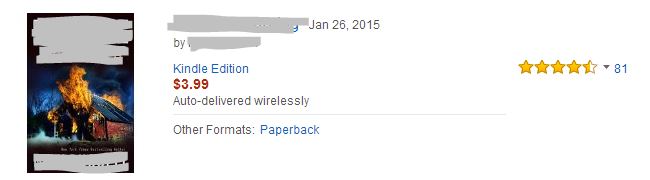
As I pointed out in 2011, the number of reviews you receive on a website like Amazon, paired with each title’s star rating, leverages a lot of weight on new readers.  If all you had to go on was this:

poor reviewsgood reviews

… which book would you be more likely to choose?  The book with more reviews and a higher star rating, of course!  (Of course there are other factors at play to distinguish these two books from each other, including a skillfully designed cover versus a sort of ho-hum cover, as well as the emotional weight of a free book versus a not-quite-free book … but you get the drift.)  And every outlet through which your book is reviewed, whether it’s Amazon or Kirkus or some other website, magazine, or blog, will boost your book’s visibility.  Having a presence is extremely important!

How do I get reviews?

This is where things get complicated.  The short answer is: any way you can.  Query book bloggers that you follow, and authors that you admire, and of course your friends and family.  (They’re your built-in audience, so take advantage of them!  Just, you know, not too much.  You don’t want your reviews to radiate desperation.)  While there’s no one single right or wrong way to go about querying for reviews, do keep in mind that reciprocity is an important part of the publishing world, especially the world of self-published and indie authors, who have to build digital communities and networks for themselves.  It’s a great idea to offer to review another author’s book in exchange for a review of your own; that way, both authors benefit, not to mention avid readers of indie literature!

There are, of course, other reliable places where book reviewers hang out.  Amazon’s top reviewers make up one such group–and the best part is, it’s their job to review new products, and they tend to love it!  Some may have specific product and even genre preferences, but you should definitely consider turning to them when you’re looking to build your reviewer base.  Remember BookPleasures.com, BookReviewsRUs.com, MidwestBookReview.com, ReadersFavorite.com, and ReaderViews.com.  And don’t forget about Goodreads!  We’ve blogged about giveaways in the past (here and here), but it’s worth mentioning again: dedicated, socially-connected readers gravitate to Goodreads, even while avid book-buyers will head to Amazon.  Consider hosting a Goodreads giveaway to bolster both the visibility of your book and the number of reviews!

I only have so much time in the day–where should I spend my time?

The best thing you can do for your self-published book is to keep writing.  The more books you write and publish, the more linkages you will build between texts, and the larger your circle of influence will grow.  But also, you know, you are a writer first and foremost–so in all things your craft should come first, and promotion second.  That being said, self-promotion and merchandising is always going to be work.  Sometimes it will even be hard and thankless work.  In the long run, however, your book’s visibility will benefit if you put in a little time here and there, and chip away at the reviewing machine.

Next wednesday, I’ll be looking at reviews again, but with a more refined microscope: I’ll be examining the blog review–dos and don’ts, and the how to make them happen fiddly bits that didn’t fit into today’s blog.  Stay tuned!

I’m realistic, or I like to think I am.  This topic is bigger than just me and my own thoughts.  I’d like to open the floor to you, dear reader.  If you have any thoughts to share on the topic of merchandising, or questions you’d like answered, send them my way via the comments box below!  I want to hear from you, and I love nothing more than a good excuse to do a little research if I don’t know something off of the top of my head.  Jump on in!

KellyABOUT KELLY SCHUKNECHT: Kelly Schuknecht is the Executive Vice President of Outskirts Press. In addition to her contributions to the Outskirts Press blog at blog.outskirtspress.com, Kelly and a group of talented marketing experts offer book marketing services, support, and products to not only published Outskirts Press authors, but to all authors and professionals who are interested in marketing their books and/or careers. Learn more about Kelly on her blog, kellyschuknecht.com.

Self-Publishing & Merchandising : On The All-Important Blurb

Let me introduce you to some blurbs.  These are selected randomly from my to-read bookshelf (yes, I have a whole bookshelf dedicated to my to-reads), and are therefore subject to my intensive pre-read evaluation, which consists entirely of three questions:

1. “Is it shiny?” “

2. “Does it sound interesting?” and

3. “Does it fit in my purse?”

That last question is why Barbara Kingsolver’s The Lacuna remains on my to-read shelf, two years after I lay hands on it.  More importantly, however, you will have picked up on the fact that the second question is tied directly to the blurb, that abbreviated section on the book’s back cover that summarizes important plot points.  I say I selected the following books randomly, but the selection has proved somewhat fitting, as there are many genres represented—fiction, science fiction, nonfiction, junior fiction, self-published and traditionally published—as well as many flaws and triumphs in blurb-writing.  I shall address each individually, if briefly.


“What would you do if the world outside was deadly, and the air you breathed could kill? 

     And you lived in a place where every birth required a death, and the choices you made could save lives—or destroy them? 

     This is Jules’s story. 

     This is the world of Wool.”

— Hugh Howey’s Wool

And so we begin, with one of my favorite blurbs of yore, for the erstwhile poster child for self-publishing success stories, Hugh Howey’s science-fiction thriller, Wool.  You’ll note that the blurb begins with two questions, neither of which is answered in the blurb itself, and these questions are followed by two very short––to-the-point short––declarations.  We as readers receive the exact number of details we need in order to make a decision about whether to read the book or not: the protagonist’s name and agency in the story, the nature of his environment, and at least three potential challenges the protagonist must overcome (the physical problem of toxic air, the social problem of regulated lives, and the psychological problem of making big decisions that will impact others).

If you’re looking for a blurb that does its job and does it well, you need look no farther than that on the back cover of Wool.  As one of my writing professors would say, “Trim the fat, dear.”  Trim the fat, and what’s left will do some great work.


“‘Are you a gifted child looking for special opportunities?’ 

“When this peculiar ad appears in the newspaper, dozens of children enroll to take a series of mysterious, mind-bending tests.  (And you, dear reader, can test your wits right alongside them.)  But in the end just four very special children will succeed.  Their challenge: to go on a secret mission that only the most intelligent and resourceful children could complete.  With their newfound friendship at stake, will they be able to pass the most important test of all? 

“Welcome to the Mysterious Benedict Society.”

—Trenton Lee Stewart’s The Mysterious Benedict Society

This blurb does some very interesting things.  It employs both third and second person, including a parenthetical aside that serves as a direct address to the readers––a challenge designed to instigate their participation and emotional engagement with the book.  It employs an excerpt of a fictional primary document––another rhetorical question!––as its opening hook, and it leaves more room for exposition than Howey’s, clocking in at almost double the word count.  The effect is subtle, yet straightforward, placing the emphasis on the mission to be embarked upon by the book’s four insofar-unnamed protagonists.  This blurb is the sort to appeal to readers of adventure tales, mysteries, and other tension-driven readers.


“Nearing thirty and trapped in a dead-end secretarial job, Julie Powell resolved to reclaim her life by cooking, in the span of a single year, every one of the 524 recipes in Julia Child’s legendary Mastering the Art of French Cooking.  Her unexpected reward: not just a newfound respect for calves’ livers and aspic, but a new life—lived with gusto.”

—Julie Powell, Julie & Julia

Maybe you’re like me and you’ve already seen the movie, starring Amy Adams and Meryl Streep as Julie and Julia (respectively).  Given that the book’s cover is a still shot from the film, it’s fair to say that the publishers are relying on their audience’s familiarity with the story to boost interest in the book.  This assumption explains, in part, the brevity of the blurb––unusual in nonfiction, by and by, a genre given to longer blurbs in general––as it serves more as a reminder of what readers loved in the movie than it serves to deliver new information.  The blurb is matter-of-fact, wasting no space, and wraps up with a dash of humor, referring to two of the more challenging recipes Julie will faces as she wends her way along through the books.  That humor is vital, I think, in drumming up interest for nonfiction books, which in general have more specific, less across-the-spectrum mainstream appeal.


“In their youth, Florentino Ariza and Fermina Daza fall passionately in love.  When Fermina eventually chooses to marry a wealthy, well-born doctor, Florentino is devastated, but he is a romantic.  As he rises in his business career he whiles away the years in 622 affairs, yet he reserves his heart for Fermina.  Her husband dies at last, and Florentino purposefully attends the funeral.  Fifty-one years, nine months, and four days after he first declared his love for Fermina, he will do so again. 

     With humorous sagacity and consummate craft, García Márquez traces an exceptional half-century story of unrequited love.  Though it seems never to be conveniently contained, love flows through the novel in so many wonderful guises—joyful, melancholy, enriching, ever surprising.”

—Gabriel García Márquez, Love in the Time of Cholera

Márquez’s book is not one of the thicker volumes in my collection, but its blurb weighs in at a whopping two paragraphs, dense with detail and information.  Not only do we get a blueprint to the entire plot, including insight into several of the protagonist’s major decisions, but we also get a final sentence that goes out of its way to flatter the book with purple prose, talking up the book’s appeal on an emotional level.  These kinds of appeal achieve varying degrees of success, and while this one is nicely written, it tends towards the overblown side.  The whole blurb runs a bit long on talk and fairly short on impact, as it carries none of the punch of the actual book’s prose––or at least, so we hope.  If I had not been exposed to Márquez elsewhere and come to appreciate his artistry, I might not choose to give the book a try based on its blurb.  (But that, of course, comes down to personal taste.)


“CLAUDIA: This is the officially true history of the War Between the Tapper Twins.  As documented by me, Claudia Trapper—the mature, responsible, and totally innocent half of the Tapper twins.

REESE: What?  That’s crazy!  This whole thing was your fault!

CLAUDIA: Not according to this book.

REESE: Then this book is a big, skronking lie!

CLAUDIA: (A) Skronking is not a word.  And (B) did you even read it?

REESE: I meant to.  Is it just your side of the story?

CLAUDIA: It’s everybody’s side of the story.  Yours, mine, Sophie’s, Akash’s, your evil friend Xander’s…. You seriously have to read this book ASAP.”

—Geoff Rodkey, The Tapper Twins Go to War

And here we have our representative for junior fiction, the colorfully designed and written cover for Rodkey’s The Tapper Twins Go to War.  This blurb looks radically different from any of the others, as it is formatted as an exchange between the two primary characters, transcribed as dialogue.  This is part and parcel with how the book itself is written, and therefore provides a useful reference point for new readers, but it could easily confuse them just as much.  Why dialogue?  What does writing it this way do for the reader that a straightforward prose description wouldn’t?  It definitely generates an ‘interest factor.’  It also sets the reader’s expectations for certain plot details, including secondary characters and relationship dynamics.  It’s light, it’s energetic, it’s fun, it’s different––and it reads like an inside joke, one that will make an increasing amount of sense as the book progresses.  That’s an interesting sort of unspoken challenge to the reader, I think, and one that hooks me in––just a little.


New Yorker writer Rebecca Mead was a young woman in an English coastal town when she first read George Eliot’s Middlemarch, regarded by many as the greatest English novel.  After gaining admission to Oxford and moving to the United States to become a journalist, through several love affairs, then marriage and family, Mead read and reread Middlemarch.  In this wise and revealing work of biography, reporting, and memoir, she leads us into the life that the book made for her, as well as the many lives the novel has led since it was written.

     My Life in Middlemarch takes the themes of Eliot’s masterpiece—the complexity of love, the meaning of marriage, the foundations of morality, and the drama of aspiration and failure—and brings them into our world.  Offering both an involving reading of Eliot’s biography and an exploration of the way aspects of Mead’s life uncannily echo that of the author herself, My Life in Middlemarch is for every ardent lover of literature who cares about why we read books, and how they read us.”

—Rebecca Mead, My Life in Middlemarch

This blurb is interesting in part because it is such a perfect summation of everything we understand nonfiction books to be––long, dense, intricately researched, philosophically unwound.  Generally speaking, readers of nonfiction expect their books to be a bit of ‘work’ to follow, and based on the highly complex relationship between biography, reporting, and memoir––which we are told are this book’s underpinnings––we can expect this book to fall neatly in with its genre fellows on that score.

Another feature which distinguishes this blurb from others is its emphasis on the author.  In our other blurbs in this blog post, the authors sometimes merit a mention, but they remain just that––mentions.  Here, in the blurb to Mead’s tome of literary nonfiction, Mead herself is made vitally important, and transfigured into a major plot element.  I won’t say that this is uncommon, per sé, but it is only made possible by the blurb’s detail and length.  The jacket copy writer goes to great lengths to assure us, Mead’s readers, that this book is both important to Mead and important for us to read.  I find the blurb a touch long-winded, but then I know a fair amount about Middlemarch, and so my interest was determined more by my relationship to that book than by my exposure to this book’s description.


I’m not trying to be coy by writing this blog as a series, held together by little more than pulp and wood glue.  But by presenting you with a number of blurbs––all of which do some things right, occasionally while also doing something not quite so right––I hope that you’ll see first and foremost just how much diversity there is to the world of blurbs.  There’s no one way to write one, and no one way to ruin one.  Plenty of other blog sites will give you detailed how-to lists of what to do and what to avoid doing when writing (or requesting) a blurb, but I find that the standard rules of good clean writing tend to apply here, as elsewhere.  These rules are perhaps best summed up in the KISS principle (Keep it Simple, Stupid).  Which is not to say you are stupid––that’s simply the mnemonic my college professors used to teach me, and I most definitely was a touch stupid then.  KISS is easy to remember, in part because it both is and advocates simplicity.

 Finding ways to describe and compliment your own work––without coming off as a foppish and overblown self-flatterer––is incredibly difficult.   But worth it, in the end, I think.  Many other blogs have compiled lists––lists which only rarely lead to sound blurbs, as modulating your voice can feel awkward and generate awkward blurbs.  Take a look at books in your genre, and at your own favorite blurbs.  What are they doing well?  And how might they serve as touchstones for your own blurb?

[ NOTE: If you’re looking for the first blog in this post, a general overview of merchandising for self-published authors, you’ll want to look here.  If you’re interested in reading up on extras and special editions, take a look at my second post in this series.  For the third post, on book cover and jacket design, follow this link.  And last but not least, if you missed last week’s post, on shaping a book’s interior design, fall into this looking glass. ]

I’m realistic, or I like to think I am.  This topic is bigger than just me and my own thoughts.  I’d like to open the floor to you, dear reader.  If you have any thoughts to share on the topic of merchandising, or questions you’d like answered, send them my way via the comments box below!  I want to hear from you, and I love nothing more than a good excuse to do a little research if I don’t know something off of the top of my head.  Jump on in!

KellyABOUT KELLY SCHUKNECHT: Kelly Schuknecht is the Executive Vice President of Outskirts Press. In addition to her contributions to the Outskirts Press blog at blog.outskirtspress.com, Kelly and a group of talented marketing experts offer book marketing services, support, and products to not only published Outskirts Press authors, but to all authors and professionals who are interested in marketing their books and/or careers. Learn more about Kelly on her blog, kellyschuknecht.com.