How important is your book title?

Self-publishing authors generally have the privilege of choosing their own book titles, which is often not so in the traditional publishing world. Blessing and Curse. I’ve worked with many author’s who have vacillated over their book title even after the final draft of the actual manuscript has been completed. I can relate. I often struggle to choose the best title for something as simple as a post for this blog. Book titles are personal. Book Titles are important. But to whom? Or more to the point, to whom should they be most important to?

New York Times bestselling author, Timothy Ferriss, raises the question and not abstractly, but in real trial. (This is not an unusual endeavor for Ferriss, as you may recall from The Four Hour Work Week). Last month Ferriss sent the following tweet.
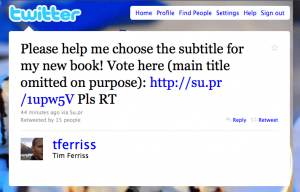
Clicking on the shortened URL navigated the user to a page on http://www.surverymonkey.com where virtually anyone could offer suggestions for The Best Book Title.
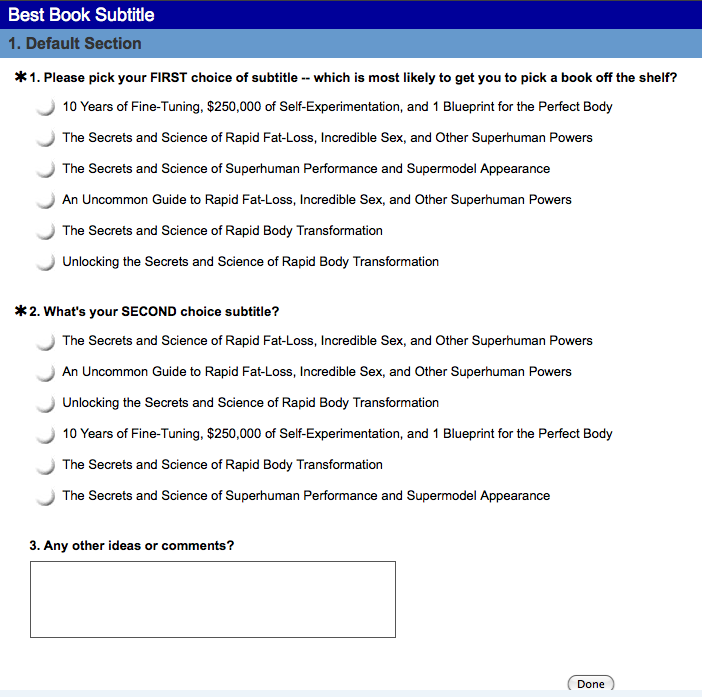
Apparently, the third option: Any other ideas or comments, did not actually allow the user to complete the survey. Perhaps that was an error on the Surveymonkey.com site. On the other hand, disabling that feature may have intentional. Think about how many contests allow for unlimited entries? Gymnastics meet with unlimited athletes. Aside from being impossible to manage from a time resources standpoint, how would any judges or spectators know the gymnasts?

A fantastic marketing tactic. Not only does Ferriss create participation – a relationship – with readers, he’s created a manageable list of potential titles that can be used through internet marketing to connect those readers to the actual book when it’s published, regardless of which title takes the cake.


Share this Post

Stocking Self-published Books

Understanding how distribution works in the current POD publishing model makes a strong case for focusing book sales and marketing exclusively from literally tens of thousands of online exclusive venues from the micro-niche outlets to the whopper marketplace that is Amazon.

Even though this model is over a decade old, the concept has been slow to absorb among authors and retailers alike. Visiting a brick-and-mortar store is an experience after-all, and there is value in reaching real readers in real spaces.

Whether or not to stock a book in a brick-and-mortar store is a decision for each author to make upon careful consideration to the content, market, and return-on-investment, etc., because there are distinct qualifications most books must meet in order for a store buyer to decide whether or not to physically stock a book in their store. Remember, Amazon can stock virtually every book available in the ‘cloud’ or virtual space. Brick-and-mortar stores have very real limitations in terms of space and their own ROI to consider.

So if your goal is to stock your self-published ‘on-demand’ book in physical retail locations, consider these 3 qualifications when preparing your book for publication:

  1. Retail Returns – this is like insurance for the retailer, allowing them to return any unsold books after a set period of time. A handful of full-service on-demand publishers offer this option. It will come at a cost to the author.
  2. Distribution Discount – while online retailers will often stock a book as low as 25%, offline stores will require a steeper discount – 50-55%. Their cost and investment is higher. The downside means lower royalties and/or higher retail prices for the book.
  3. Buzz – sure, books printed and sold on-demand require ‘buzz’ too, but that buzz comes before the book is sold, and sells the book. A brick-and-mortar store is taking a bigger risk, buying books that have yet to actually sell to a reader, so they’ll be looking for a book they feel has a potential to move. Don’t hesitate blowing your own horn. Or, look for a publisher that will help do it for you through options like copywriting, custom design work, personal marketing assistance, and press campaigns.


Share this Post

Copywriting Services in Self-publishing

More important than copyright registration for many self-publishing authors is professional copywriting assistance. That’s right, a writing service for writers. This is a step to be completed during the pre-production or production phases of your book in preparation for publication and marketing efforts.

The back cover copy and author biography is second only to a dynamic cover when it comes to motivating a reader to buy. Many talented fiction, non-fiction, children’s book authors are wonderfully just that—talented fiction, non-fiction, etc. writers. Writing sales copy is a different skill all together. It is the art of using words to create hype about a product and convince consumers to spend money. The fact is, most authors of any genre are capable of generating decent sales copy, but don’t like the idea of having to justify or brag about their hard work. Sales copy is an important element in getting books in reader’s hands. The good news is with this service, others can do that work for them.

Look for this optional service when researching and partnering with your self-publishing choice. The content should not be entirely out of your control though. Make sure you can submit your book summary and author biography draft to your publisher who will employ its professional staffers to rework it into shiny, packaged sales copy. Do also make sure you have the option to review and approve the final copy (your content control should not be limited to just your manuscript).

You can then continue to use the powerful copy on your webpage, on your book’s back cover, in media, and virtually anywhere you find a productive venue as your book promotion efforts unfold.


Share this Post

The Amazon Experience

Amazon is the single largest book retailer available, and the company model couldn’t be friendlier in helping self-publishing authors publishing through a POD publisher/distribution model. Whether you’re published or still in the writing or production process, prepare these Amazon options to maximize your books sales.

Amazon Search Inside the Book: This is the online equivalent to flipping through your book on the shelf. An optional feature, “Look Inside” provides icon over your book’s cover image, and allows readers to browse through portions of your interior content. Amazon claims that books utilizing this option see considerably higher sales over those that do not. Pretty intuitive.

Amazon Key Word Submission: One of the best user features Amazon provides comes in allowing readers to browse instantly by category or ‘key words.’ Imagine being transported instantly around a bookstore the size of football fields without having to use a map or ask an employee for directions. This is the experience Amazon customers find in typing in a simple keyword or phrase. (Few readers browse titles by author, and even less so for first-time authors.) They key is determining around 10 top keywords to tag your book with in order to provide the widest exposure possible.

Amazon Kindle: The Kindle is everywhere, and for good reason. It is a revolutionary digital reading device that allows individuals to purchase books anywhere, anytime, and instantly. One source noted that Kindle owners, on average, buy 3x more books than non-Kindle owners. Kindle editions must be submitted through special formatting, which some POD publishers offer, and will see listing everywhere books are sold throughout the Amazon site.

And finally, email, call, and knock on the doors of everyone you know who may contribute a credible review of your published book and have them post those on your book’s Amazon listing page.


Share this Post

Progressive Book Marketing for Authors

The industry is learning that sales and marketing efforts are perhaps as much an effort in getting books to readers as good content. Now, progressive self-publishing options are beginning to provide them for authors regardless of where you have published. Or, if you’ve yet to initiate the publishing process, it’s never to early to begin looking and learning about marketing tactics like…

• Amazon Kindle Edition
• Amazon Keyword Tagging
• Celebrity Endorsements
• “Search inside the book” options with major retailers
• Even Personal Marketing Assistance

Now that the information is in your hands and resources at your fingertips, how many readers will your book find?


Share this Post