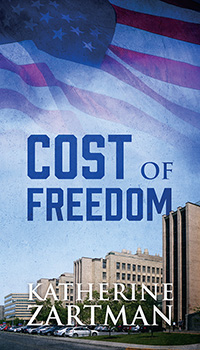
ORIGINAL BOOK REVIEW: “Cost of Freedom” by Katherine Zartman (Fiction)

OFFICIAL DESCRIPTION*:

Is it the cost of missing legs, arms or sight, or is it something more valuable…

Walk through the dark halls of our VA’s, filled with damaged men and the one woman who brings light back to their traumatic days and nightmare-filled nights. Arlene, a very experienced nurse, touches the lives of all she cares for. John, an armless vet in love with Arlene but unable to fulfill his dreams. Lars, another maimed vet, tall, blond, a damaged Viking, fragile, sensitive and falling in love with this sexual woman who knows his most intimate thoughts and body. Warriors stalled on distant battlefields and the woman who can stop the bullets with words of love and compassion.

* Courtesy of Outskirts Press book listing.

REVIEW:

There is nothing more beautifully sincere than a book by someone who has lived and loved (and in this case, lost as well) the kind of people that it paints so clearly and sympathetically. Such is the case with Cost of Freedom by Katherine Zartman, who was both the daughter of a WWII Colonel and a Vietnam veteran, declares in her book biography that she felt “well acquainted with the problems veterans face” and wrote this book (and its sequel) in the hope of “help[ing] readers gain a deeper understanding of the pain and trauma involved as vets transition back to civilian life.”

This, she certainly accomplishes–and then some.

Zartman’s book may be a work of fiction, but it is characterized by a rawness of emotion that quickly made me forget the occasional rawness of form. Even without the more romantic elements of this book (love triangles galore for those who seek out books specifically for them) I found myself cheering for our main character, Arlene, and celebrating her fineness of character. I’m not the most knowledgeable person when it comes to the tropes and tools of the romance genre, but from what I could tell the relationships were the realistic kind that can form in only specific situations and under the kinds of extreme pressures and stresses that VA hospital work and recovery can bring. I knew I was in safe hands as soon as Zartman started fleshing out Arlene’s world with the kinds of little details that only someone who’s been through that kind of experience would think to include in a book, like the intricacies of helping an injured or incapacitated soldier maintain his dignity in the bathroom when in need of assistance, or the careful management of patient safety by way of checks, balances, and a guy named Mike. (You’ll see what I mean when you get there.)

This is a book that really ticks along. It’s not terribly long, really–I suppose you might call it a novella in respect to length, and recently I’ve been reading a lot of novellas. They’re short, sweet, and to the point–and they feel as rewarding and compelling as novels without being as daunting. With so many people (including myself) struggling to move through our TBR (to be read) piles at our usual paces, I think it’s important not to undervalue the importance of a book that knows where it wants to go from the first page and gets there in under 200 pages. It’s also a testament to Zartman’s eye for story that she knows exactly which scenes to share in order to make Arlene’s days feel both full and rich in detail.

I’m excited to have discovered that there is a sequel–Cost of Freedom II–that is already out in the world. While this first novella feels complete in and of itself, I wouldn’t mind spending more time learning about the minutiae and emotional weight of Arlene’s work within the VA hospital, particularly her interest in assisting those with PTSD. A number of my friends struggle with varying forms of this disorder, and it can be difficult to learn more about how to be the best possible friend to them without re-traumatizing them. Accessing some of the complexities of PTSD through a fictional set of characters and circumstances (some of them inspired by Katherine’s own experiences, I think) provides a safe place for me both to learn more and have a conversation about it that doesn’t require them to revisit their own traumas and possibly trigger an episode. “So I was reading this great book the other day, and one of the characters goes through something really interesting and I would love to hear your take on it …” is always a great way to tackle tough subjects, in my opinion.

Sorry for rambling a little bit here about my personal life! I just think it’s an incredibly important subject (or a collection of very important subjects, since this book really tackles quite a lot) and one that I am truly excited to have an insider perspective on, even if fictionalized.

IN SUMMARY:

Inspired by her own life and experiences, Katherine Zartman introduces readers to Arlene, an experienced nurse at a VA hospital, who carefully and thoughtfully seeks to navigate the inner worlds and outer bodily needs of patients who may or may not be more than a little bit in love with her. Inflected with just enough romance to add a bit of spice, this novella-length work knows exactly what it’s doing.

WHERE TO BUY?

You can find Cost of Freedom wherever good books are sold, including Amazon and Barnes and Noble. You can also find out more about Katherine Zartman’s work on the book’s Outskirts Press author page.

WHAT NEXT?

It’s been quite the busy month around here, and I have no doubt it’s equally busy for everyone else! I have been working steadily to bring in the fall harvest from my overgrown and overwhelming garden, which is more or less entirely sunflowers, squash, and misbehaving greens (like kale and collards) at the moment. My cherry tomatoes have finally ripened, but I’m still waiting on my regular ones–and the weather is already getting down too low for my comfort at night. So I’ll be staving off frost and such for the next little bit, but I promise to bring you more bookish thoughts in two weeks! Watch this space.

I received a copy of this book in exchange for an honest review. 

* Courtesy of Amazon book listing.


SONY DSC

ABOUT KENDRA M.: With nine years in library service, six years of working within the self-publishing world, as well as extensive experience in creative writing, freelance online content creation, and podcast editing, Kendra seeks to amplify the voices of those who need and deserve most to be heard.

Self-Publishing News: 9.1.2020

And now for the news.

Highlights from this month in the world of self-publishing:

Here’s a bit of much-needed good news! The Publishers Weekly staff have released their latest round of self-published titles, which comes out each month. The books released in the month of August included some real standouts, such as Janet R. Macreery’s A Little Noble, in which 13-year-old “Mercy must rely on Calum, a Highland lad, to finish her mission by midsummer. Their journey takes Mercy to places she had never imagined and Calum to the place he vowed never to return to.” Perfect for younger fans of the Outlander series, right? Mercy is something of an expert on plants despite her youth, and between them Calum and Mercy make for a great (and funny) team. And of course don’t neglect the other interesting books on PW’s August list! There are 97 in total to choose from. (So many books, so little time. Our favorite problem of all.)

One could be forgiven for thinking, at first and even second glance, that Jeva Lange of The Week has something of a chip on her shoulder when it comes to self-publishing. And perhaps she does; like almost all articles pertaining to free speech and self-publishing right now, she approaches the medium’s absence of gatekeepers as the death of fact-checking and good grammar. (You probably already know which examples she cites in her article.) But Lange concludes her article with an interesting statement:

It’s true Trump Jr. has fired a shot across the bow of traditional publishers as self-publishing becomes an appealing alternative for conservative writers both financially and politically. But for the imprints that have legitimized falsehoods with their reputable logos for decades, it’s time to say good riddance.

Steering clear of the electoral politics involved in this quote (and the article at large), it’s clear that Lange and others who bemoan the decline of traditional publishing (which we see as a co-evolution, by the way; self-publishing and traditional publishing are not mutually exclusive propositions) are also on another level aware of its benefits. Self-publishing, as we’ve argued before, is a democratizing influence. Instead of editors and publishers and agents deciding upon whose voices get to be heard (on any subject, not just politics), everyone has a chance to speak up and speak out. In a country as fractured and polarized as ours is just now, the thought that there are more voices of all kinds speaking on a given topic ought to be an encouraging one. We aren’t limited to just two options (for or against, either or or) any one idea, despite the careful curation of certain conversations to seem that way by some others. As a market force, self-publishing has opened the floodgates to countless new perspectives on critical issues, including those guaranteed to ratchet up the tension of  dinner table conversations everywhere. And because readers are hungry for more information, and are hungry for more perspectives on topics they care about, self-publishing happens to be a safe place for authors of all kinds to weigh in. We hope that the publishing houses Lange discusses in her article catch on to the benefits of a both/and world as opposed to an either/or. 


spa-news

As a self-publishing author, you may find it helpful to stay up-to-date on the trends and news related to the self-publishing industry.This will help you make informed decisions before, during and after the self-publishing process, which will lead to a greater self-publishing experience. To help you stay current on self-publishing topics, simply visit our blog each month to find out the hottest news. If you have other big news to share, please comment below.

In Your Corner: A Month of Romance (part 3)

In my last few posts, I have started the conversation about the Romance genre by discussing who the genre is for as well as who writes in the genre. This week, I’m going to start digging into the writing of Romance by posing the question: What do readers expect from a book in the genre?

Maybe now is a good moment to pause and think about what you remember most about the Romance books you’ve read. What elements do they share? Which of those elements do they maybe sacrifice in order to stand out from the crowd without sacrificing the genre label totally?

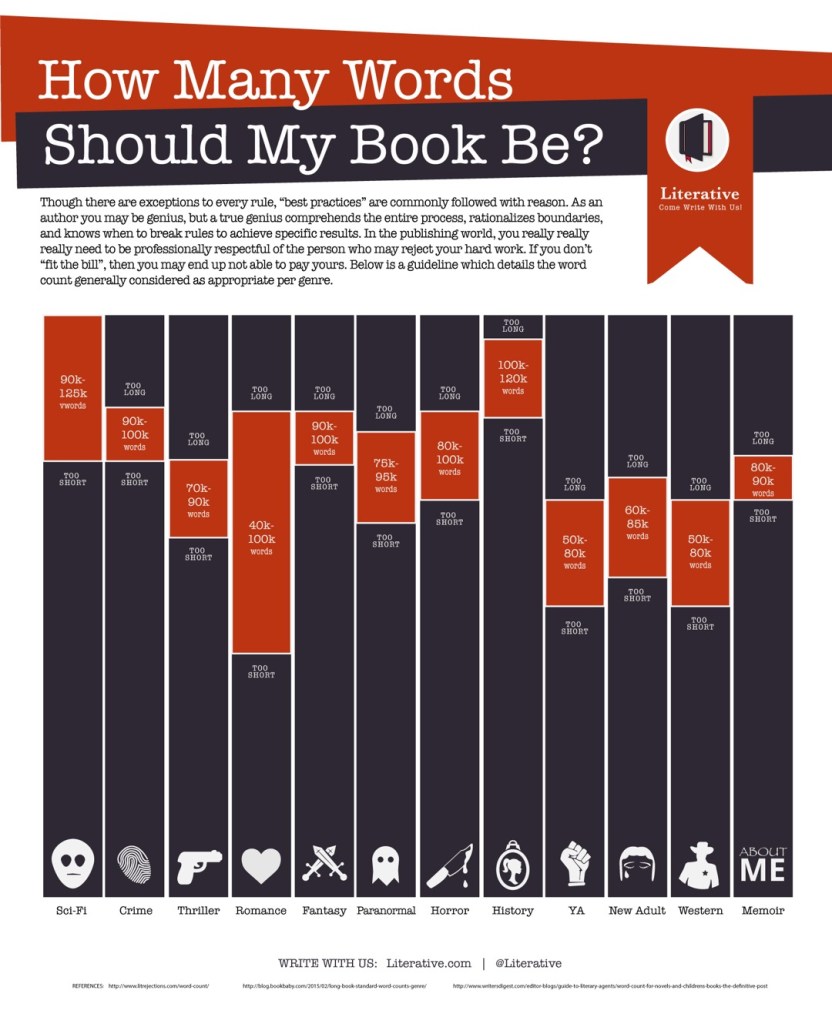
One thing to consider, of course, is the scope of the project you’re undertaking. As this infographic from Literative, a digital collective of fiction writers, demonstrates, Romance is one of the more flexible genres when it comes to length (they drew upon a number of resources to make this infographic, so definitely check their website out for more on that).

As you can see, Literative’s infographic would seem to indicate that the successful Romance novel can flirt with a length from anywhere from forty thousand to one hundred thousand words in length. That’s a much more forgiving range than a Western novel or a Memoir, just to point to two other examples.

And yes, of course rules are made to be broken, especially in self-publishing, where gatekeeping doesn’t serve as an editorial force the way it does in traditional publishing, where recommendations are less optional than they are in our corner of the bookish world.

If even traditional publishing can recognize that Romance is a forgiving genre when it comes to length expectations, that’s really good news for you! Whatever the scope of your next Romance novel may be, there’s room for it in the hearts and minds of dedicated readers. But what do those same readers expect when it comes to content? Here’s where we return to the Romance Writers of America, as we have done previously. (They’re a great resource! And you don’t have to be traditionally published to be a member, apparently.) On the RWA website, the association notes that their definition of the genre is one where “Two basic elements comprise every romance novel: a central love story and an emotionally satisfying and optimistic ending. […] Romance novels may have any tone or style, be set in any place or time, and have varying levels of sensuality—ranging from sweet to extremely hot. These settings and distinctions of plot create specific subgenres within romance fiction.” They then go on to note that there are slightly more specific expectations for content within each subgenre, but never so long or complicated that you can’t grasp the basics in a sentence or two. The subgenres they acknowledge include contemporary, erotic, historical, paranormal, suspense, spiritual, and young adult. Their two “tentpole” characteristics for defining Romance apply to all of them–it’s just that they may be framed a bit differently from each other depending on audience.

So if the Romance genre is so forgiving in respect to content as well as scope, isn’t that essentially permission to write pretty much anything, so long as it features … well … a romance? Absolutely! The difficulties involved in writing a Romance have less to do with what is expected of you and a lot more to do with winnowing down all of the possible things you can do to an achievable list of what you want to do with each specific book.

In my next post, I’m going to take on the challenge of selecting one’s direction: How can a writer ever narrow the options down to pick just the ones they want to focus on right now? We’ll find out together.

You are not alone. ♣︎

Do you have ideas to share? Please don’t hesitate to drop us a line in the comments section, below.
Elizabeth

ABOUT ELIZABETH JAVOR: With over 20 years of experience in sales and management, Elizabeth Javor works as the Director of Sales and Marketing for Outskirts Press. The Sales and Marketing departments are composed of knowledgeable publishing consultants, customer service reps and book marketing specialists; together, they all focus on educating authors on the self-publishing process to help them publish the book of their dreams. Whether you are a professional looking to take your career to the next level with platform-driven non-fiction or a novelist seeking fame, fortune, and/or personal fulfillment, Elizabeth Javor can put you on the right path.

ORIGINAL BOOK REVIEW: “Got Knee Pain?” by William Ruch (Self-Help)

OFFICIAL DESCRIPTION*:

There is little rational care for knees, yet bad knees are often a factor in falls, one of the leading causes of death for older people. Surgeons do not realign the bones during surgery. Physical therapists do not care that the tibia is out of place in rehab exercises. Yet aligned knees provide stability and ease of movement.

In his book Got Knee Pain? Where Is Your Tibia? William Ruch shares a key finding of his decades of chiropractic work: the tibia misaligned with the femur is a common cause for knee pain. Got Knee Pain? does three things: guides readers to where the tibia is, gives a procedure to realign the tibia, and guide readers about what not to do.

Got Knee Pain? benefits people with injured knees. If you have knee pain, and it is interfering with your life, then you need this book.

REVIEW:

Got Knee Pain? by Dr. William J. Ruch, D.C. is a chronicle of ways in which bodies can go wrong, if by “wrong” we are talking about unnecessary pain above and beyond what’s useful to stimulate reflexes and prevent further damage. But as its semi-humorous subtitle (Where is your Tibia?) indicates, this book is also designed to provide easy access to the principles of pain management for those who, like me, are not exactly medical experts themselves.

I say “semi-humorous” because the question of “Where is your Tibia?” is actually quite a serious and recurrent one in Dr. Ruch’s years of working in chiropracty. He opens his introduction by noting that he is continually “appalled by the lack of rational care provided for knee injuries. In my clinical experience I find that in the majority of my patients I encounter with knee pain as a symptom or complaint, the Tibia is not properly aligned with the Femur.” I don’t know about you, but that’s a rather strong start to a book about pain. One of my major bones may not even be lined up correctly? And my orthopedist, physical therapist, chiropractor, and other medical specialists aren’t looking for that first off when I come in for treatment? I’m glad to have heard this can be a thing before I encounter major knee pain myself, knowing that it’s very definitely in my future given the kinds of temporary strains and stresses and aches that I’ve experienced since childhood and how they tally up in respect to my body’s future.

It is, as Dr. Ruch himself points out, somewhat shocking that so many specialists could have received so little training on this one specific issue. But as he also points out, “Evaluation of knee problems requires direct palpation of the joints and bones to fully understand the displacement. You have to have someone, even if it is you, feel what is going on.” If I have one big takeaway from this book, it’s that––not to live in fear of educating myself about my own body, bones, and muscles, and to pursue the kind of hands-on medical care that will get at root causes.

Dr. Ruch repeatedly encourages his readers to consider whether or not they are receiving “rational care,” care that treats causes (injuries) and not just their most disruptive symptom (pain). He sets out to put the power for positive change back in the patient’s hands (sometimes literally) in a world which seems increasingly to divorce patient and power. As Dr. Ruch puts it, “You are the most convenient, and motivated, person available to perform these maneuvers” as laid out in this book.

The maneuvers themselves are simple, straightforward, and easy to understand for a novice like me. Because they require the pain-sufferer to examine the actual position of various bones in relation to one another, they are difficult to get wrong (i.e. to use them incorrectly). They are also rather gentle, at least compared to the kind of chiropractic work I have personally experienced myself (in the wake of a car accident several years back). As long as a reader understands that they should never feel additional pain as a result of these maneuvers, and doesn’t overdo it, I see no danger of additional injury. My only warning would be for those who are from the same school of thought as several of my own relatives who don’t think it’s “working” unless it feels like the body has been strongly worked on. (These are the type of people who emerge from a massage with bruises. I love them very much, but I don’t think added pain is a marker of success in the pursuit of pain management.) I was able to determine that my knees are at present not terribly misaligned, but that I may have a tendency towards one of the displacements illustrated by Dr. Ruch. I’ll have someone I trust double-check me, but I thought it was really interesting to have that confirmation.

I would like to point out as I tidy up this review that I am *not* a medical expert, and my reading of Dr. Ruch’s book probably reflects that. Any mistakes in terminology or concept in this review is entirely mine and does not reflect at all on the quality of Ruch’s writing!

IN SUMMARY:

Not to put too fine of a point on things, but Dr. Willaim J. Ruch, D.C. has been practicing and teaching as long as I’ve been alive, and when it comes to muscular and skeletal issues such as knee pain, experience really does show. Got Knee Pain?: Where is Your Tibia? is the summary record of this experience, and gave me much food for thought as I move into the critical time of life when much of my body’s long-term health will be determined. For those who experience chronic pain in the knee area, this is definitely worth a look before pursuing expensive (and sometimes ineffective) treatments.

WHERE TO BUY?

You can find Got Knee Pain? wherever good books are sold, including Amazon and Barnes and Noble. You can also find out more about Patrick McLean’s work on the book’s Outskirts Press author page.

WHAT NEXT?

For my next review, I’ll be tucking into Katherine Zartman’s Cost of Freedom, a novel set in a VA hospital and following the lives and loves of both the soldiers returning from the battlefield and a nurse who knows more about them than even they do. I rarely read romance or war novels (I’m keenly aware of how easily books touch me emotionally, and tend to steer clear), so this should be an interesting experience!

I received a copy of this book in exchange for an honest review. 

* Courtesy of Amazon book listing.


SONY DSC

ABOUT KENDRA M.: With nine years in library service, six years of working within the self-publishing world, as well as extensive experience in creative writing, freelance online content creation, and podcast editing, Kendra seeks to amplify the voices of those who need and deserve most to be heard.

Self-Publishing News: 8.18.2020

On-trend 2020 calendar page for the month of August modern flat lay.

And now for the news.

Highlights from this month in the world of self-publishing:

Sometimes, a book is more than a book. Sometimes, a book is a way of connecting with tradition and the faith of one’s family. In the case of Brian Blum, self-publishing his father’s letters was a way to practice Kaddish, the Jewish prayer that both celebrates life and marks one’s passing. In an article published to The Jerusalem Post, Blum describes his father Walter Blum, a 35-year veteran of the San Francisco Chronicle, as a man who had dreamed of being a published author. “Every night after dinner, he would retire to his home office where he would diligently type away on his IBM Selectric, crafting his fiction until it was time for the evening TV sitcoms,” writes the younger Blum. Walter had left a nearly completed draft of his latest work-in-progress on his computer, which Blum’s brother emailed to him after he died age age 81. “What if I were to edit my father’s last book and publish it for him, posthumously?” Brian asked himself, a question which kicked off a nine-month editorial spree with many challenge along the way, and then a ten-year period where Blum let the novel be. Finally, after a conversation with Israeli poet Michal Govrin, Blum took the leap and self-published his father’s semi-autobiographical book. The moving conclusion to his article demonstrates what the freedom to write and the freedom to publish can truly offer at its best: a deeply personal connection to the work at hand. Writes Blum,

Dwelling in the imaginative world my father fashioned gave me new insights into his feelings on religion, his own parents, and following one’s passions. The fact that, like my father, I had originally hoped to launch a career in radio before turning to writing, only made the narrative of The Bell Tower more resonant.

I stopped saying the traditional kaddish before the first year was over. But in many ways, I’ve never stopped saying it. It’s just taken me 10 years and 103,000 words to convey it properly.

You’re going to have to give us a moment; there are tissues around here somewhere and we need them right now.

Not everything we express will be lasting or meaningful. Yet, when you choose to express something meaningful, be as authentic as you can be. That’s the only way you can profoundly make a difference for others. In the bigger picture, meaningful expression matters. Just saying.

Thus concludes Jon Ochiai’s recent article for the Good Men Project, a reflection on his decision to write and self-publish a book after his therapist suggested a rather different writing activity (some language included, fyi). Ochiai looked to  his childhood, his Aikido training under Mizukami Sensei, and the film narratives that he loved to help shape his desire to write, and to write meaningfully. Ochiai’s article is a thoughtful, unexpected encouragement to those who know they have a story worth telling but aren’t quite sure that they should tell it. He writes honestly,

My book was not the fairy-tale bestseller. So far, I’ve sold a few dozen copies. Three of them I bought for Mom, Sensei’s wife, Alyce, and one for myself. Really, I shared my trials and tribulations for someone who could have been me. Someone who had experienced his or her life turbulence. I wanted that person to know that he or she is greater than they know themselves to be, to grind it out, to make it work. That was meaningful enough for me to say.

We are so inspired by Ochiai’s decision to self-publish! And we wish him and his new book the best as he continues to inspire others out there in the world.


spa-news

As a self-publishing author, you may find it helpful to stay up-to-date on the trends and news related to the self-publishing industry.This will help you make informed decisions before, during and after the self-publishing process, which will lead to a greater self-publishing experience. To help you stay current on self-publishing topics, simply visit our blog each month to find out the hottest news. If you have other big news to share, please comment below.