Conversations: 3/3/2017

MARCH INTO SPRING

WITH A SPRING IN YOUR WRITING STEP Part I

Are you one of those writers who learns by doing—learns by experience? I am, too. Yet there is so much that I want to learn about and skills I want to develop that I’d need to live ten lifetimes in order to do and/or experience it all. READING has become my university, but not the textbook educational delivery system that we most often think of as the source for higher education. I learn best through story—either personal experiences shared with the passion they were lived, well-researched historical fiction, or inspired writings by people of deep faith who are telling their story through the beauty of  belief.  So it is that this month I’ll mention a few books written by authors who meet my criteria of educational reading—with an added comment (of course) about how these types of books can enhance the education of all writers no matter what genre we write.

Author William Guthrie calls himself “a student of the human condition.” He’s written several books in various genres. However, the book I’m highlighting today is ahhh Biography/Memoir: A Woman of Valor, A Woman of Strength: The Latchmin Bridgelall Story. This story is heralded as a “touching story” written by the son of an “amazing family matriarch whose sacrifice, courage and wisdom shaped a generation of children.” AND…I will add…will continue shaping generations of children yet to be born.
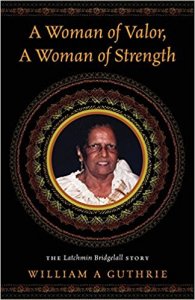
This is the beauty of Memoir.  Guthrie understands this well and explains it saying: “…if something is not written down or recorded it is lost…. Then the family loses its history and its lore and all that has gone before is virtually lost to future generations. In a fundamental and almost visceral sense, it is what humanizes us on this planet and gives us a sense of identity among billions and billions of other earthlike creatures like ourselves.”

Guthrie also states that “whether we like it or not, we all stand on the shoulders of generations of relatives gone by.” This is also so true of the writers who have gone before us! Therefore, for those of us who have a passion for Memoir/Biography writing it is advised to read the work of the respected biographers such as: Leonie Frieda, author of Catherine de Medici: Renaissance Queen of France; John Taliaferro, author of All the Great Prizes: The Life of John Hay, from Lincoln to Roosevelt; and Humphrey Carpenter, author of J.R.R. Tolkien: A Biography.

Here are a few of my basic “tips” that will help you along the road:

  • Photographs are great memory-refreshers
  • Research into specific daily possessions used during various time periods is essential (cars, radios, telephones, etc.)
  • Letters and journals offer insight, but DO NOT over-step the boundaries of their use.
  • Find the voice of the main person the memoir is about and, if possible, the voices of those closest to them.

The main concept I’ve developed over the years about Memoir writing is this: Start from the heart. Don’t be afraid of the guts. Close with inspiration.

AND…don’t hesitate to self-publish! The “ordinary people” we write about have “extraordinary” information for us to share with the world showing us the way to survive the struggles of life with joy, love and laughter.  ⚓︎


Royalene

ABOUT ROYALENE DOYLE: Royalene has been writing something since before kindergarten days and continues to love the process. Through her small business—DOYLE WRITING SERVICES—she brings more than 40 years of writing experience to authors who need “just a little assistance” with completing their projects. This is a nice fit as she develops these blogs for Outskirts Press (OP) a leading self-publisher, and occasionally accepts a ghostwriting project from one of their clients. Her recent book release (with OP) titled FIREPROOF PROVERBS, A Writer’s Study of Words, is already receiving excellent reviews including several professional writer’s endorsements given on the book’s back cover.  

Royalene’s writing experience grew through a wide variety of positions from Office Manager and Administrative Assistant to Teacher of Literature and Advanced Writing courses and editor/writer for an International Christian ministry. Her willingness to listen to struggling authors, learn their goals and expectations and discern their writing voice has brought many manuscripts into the published books arena.

Conversations: 2/24/2017

FOUR DOZEN ROSES—FOR WRITERS—IV

Once upon a time—at a writers conference—one of the speakers opened with this question: “Why did the ancient cave dwellers draw on the walls? To tell their story, of course.” This was her introduction to the Memoir writing workshop.  However, what I took special note of that day was the story-fact that roses were part of Cleopatra’s scheme to capture the attention of Rome’s Mark Anthony—having thousands of rose petals scattered in her quarters before his arrival in Egypt. The rose we know today as “the Cleopatra Rose” is basically a wild bush with flowers that go to full blossom almost immediately after blooming. “Going wild” is not a useful quality for serious writers who not only want to write with excellence, but also have something of value to impart to their Readers.

Here is my fourth dozen of tips for you—as you build your writing career.

  1. IF you “hit a wall” and just cannot move past a certain point in the story—GO BACK to the last one or two chapters and read them. Like restarting an engine from the top of a hill, this usually kicks the plot back in gear.
  2. The very old cliché that “there is nothing new under the sun” is basically true when it comes to plot/storyline development. SO select one of your favorite authors in the genre you’re writing and outline the plot they used. No, this isn’t plagiarizing. It is learning from the best. You and only you are writing your Your characters are unique, as are the various settings, etc. However, being able to see a successful plot outline may be just what you need to complete your project.
  3. As you approach the conclusion of your first draft take another look at the main theme and any thread themes you’ve created. There need to be enough clues (information) in the final third of the book for your reader to discover and understand the solutions.
  4. Also, by the time the last third of the story is written, Readers should be pretty clear about who the main protagonist is so they can be participating in the adventure. UNLESS, of course, you’re developing a new Sherlock Holmes-type character who reveals all at the very end.
  5. Even though you’ve written (and probably rewritten) the first sentence/paragraph of your novel multiple times, consider rewriting it one more time AFTER you’ve written THE END.
  6. Consider placing your manuscript with a professional editor who will critique with grace. Ask other writers for recommendations. If you’ve decided to self-publish, ask to “interview” they editing/critique staff. FRESH eyes can hone a well done manuscript into a masterpiece.
  7. When the manuscript comes back to you, FIX IT YOURSELF. You are the author. You know the people/characters. The critique will help you see what needs to be adjusted.
  8. Remember: the words on those book pages will be creating your reputation as an author, and a person living on this planet. Be honest and ethical in your writing and storytelling.
  9. Write from the heart. Write what you need to write.
  10. CONTINUE to watch people—everywhere. Make note of the fine points of life as you observe them in daily living. These will feed your creative spirit and help you develop more stories.
  11. Also make notes about your own personal life experiences. No event—happy, sad, accidental or planned—is wasted material of the writer.
  12. DON’T GIVE UP! Don’t quit! Keep writing—no matter what may try to stop you.

Bottom line…these four dozen TIPS have been offered as experience-taught concepts to be consider—NOT as “rules” of writing—but as guidelines. May you and your creative works prosper! ⚓︎


Royalene

ABOUT ROYALENE DOYLE: Royalene has been writing something since before kindergarten days and continues to love the process. Through her small business—DOYLE WRITING SERVICES—she brings more than 40 years of writing experience to authors who need “just a little assistance” with completing their projects. This is a nice fit as she develops these blogs for Outskirts Press (OP) a leading self-publisher, and occasionally accepts a ghostwriting project from one of their clients. Her recent book release (with OP) titled FIREPROOF PROVERBS, A Writer’s Study of Words, is already receiving excellent reviews including several professional writer’s endorsements given on the book’s back cover.  

Royalene’s writing experience grew through a wide variety of positions from Office Manager and Administrative Assistant to Teacher of Literature and Advanced Writing courses and editor/writer for an International Christian ministry. Her willingness to listen to struggling authors, learn their goals and expectations and discern their writing voice has brought many manuscripts into the published books arena.

Conversations: 2/17/2017

FOUR DOZEN ROSES—FOR WRITERS—III

There is a book on the self of my local library that enjoys what I call “staying power.” The title: Cheaper by the Dozen fits right into my theme this month of beautiful things, excellent writing and good lessons learned when we write with passion and purpose. This novel was first printed in 1948, made into its first movie in 1950, then a second movie in 1952, followed by the stage play in 1992, and two more recent movies in 2003 and 2005. Although several of the tips listed below apply to the Cheaper by the Dozen novel, stage play and films, the authors recognized the passion and purpose in the lives of these characters and the love and laughter we Readers appreciate.

Here is my third dozen roses for you to consider…

roses

  1. IF you’re considering using a Narrator to tell your story, you must develop this person with as much detail as you’ve done for all the other characters.
  2. Be prepared to re-write and re-re-write until you’re heart and head tell you it’s time to let this book fly.
  3. Words are the writer’s friend—and enemy. If you don’t know the definition and usage of a word DO NOT USE IT.
  4. Don’t allow yourself to be derailed by ideas for other The simple fact that you ARE a creative writer/thinker opens the door to many other book ideas while you’re developing the current book. KEEP FOCUSED ON THIS ONE BOOK.
  5. IF you have an idea about another book, write a one-line concept sentence into a notebook that is SET ASIDE specifically for these ideas.
  6. Many authors have discovered that their dreams will guide them, especially when they feel stuck. It might be necessary to have a notebook or tape recorder beside your bed.
  7. Find a reading/writing friend who trust, and who will sit and talk with you about “the story” you’re writing. You do not have to take their comments literally. However, they will help you move the story forward.
  8. Don’t even try to creatively write a chapter and simultaneously edit it. These are two separate processes and where you can find personal enjoyment in both.
  9. Value yourself as a writer and value what you’re writing. These words your building into a book will define your writing career and, in many ways, define you.
  10. Take laughter breaks! Play with your children. Go to a movie. Take a nice walk with the dog. Have a picnic with your sweetheart! Not only will you feel better physically and emotionally, but your inspiration quota will increase!
  11. Remember: Every novel is about people. We all have quirks and one or two of your characters may be very “quirky.” However, too much quirky-ness is not an easy thing for Readers to enjoy.
  12. As you’re writing visualize the people/characters IN THE MOVIE. Go back to your very detailed, very descriptive backgrounds you’ve written about each character. Is there an actor (past or present) who fits? Listen to their on-screen dialog and watch their actions and reactions.


NEXT WEEK: the fourth dozen. ⚓︎


Royalene

ABOUT ROYALENE DOYLE: Royalene has been writing something since before kindergarten days and continues to love the process. Through her small business—DOYLE WRITING SERVICES—she brings more than 40 years of writing experience to authors who need “just a little assistance” with completing their projects. This is a nice fit as she develops these blogs for Outskirts Press (OP) a leading self-publisher, and occasionally accepts a ghostwriting project from one of their clients. Her recent book release (with OP) titled FIREPROOF PROVERBS, A Writer’s Study of Words, is already receiving excellent reviews including several professional writer’s endorsements given on the book’s back cover.  

Royalene’s writing experience grew through a wide variety of positions from Office Manager and Administrative Assistant to Teacher of Literature and Advanced Writing courses and editor/writer for an International Christian ministry. Her willingness to listen to struggling authors, learn their goals and expectations and discern their writing voice has brought many manuscripts into the published books arena.

Conversations: 2/10/2017

FOUR DOZEN ROSES—FOR WRITERS—II

Have you ever read a sequel to novel (that you just loved) and found it lacking the intensity—the passion and purpose—you enjoyed in the first book?

William Shakespeare is the author who penned the words “…that which we call a rose by any other name would smell as sweet,” which I paraphraroses royalenesed in last week’s blog (Romeo and Juliet, 1600). Tradition tells the story that Shakespeare was poking fun at a local theatre group at the Rose Theatre (rival to his Globe Theatre), considering his to be the better environment. And he wrote the critique right into his play.
There are many skills a writer must develop when creating excellent work. I’m not so sure that throwing punches at other writers within a storyline is one of them. So it is that you’ll find my second dozen roses below—for you to consider as you build your own, personal writing career!

  1. AS you are writing/developing #s 4 and 5, begin a PLOT file—a plot timeline. Keep this first plot draft in chronological order. You’ll have plenty of creative time later to mix things up should you choose to do so.
  2. As you’re developing the theme, you’ll discover the conflict in the story. Like the difference in the right side of a spoon and wrong side, your story will not hold the plot without knowing the right and wrong side of issue/theme.
  3. Using your creative thinking while accomplishing the first seven tips will begin to show you the best perspective from which to reveal this story. Each character must stay true to their specific point-of-view. However, you may choose to complete the story through one point-of-view—or several.
  4. Also, as you get to know your characters, they will share the crises of their lives with you. You can make a separate list of these crisis elements—or you can incorporate them into the plot timeline.
  5. Look for the joy in your character’s lives. This term “joy” is defined quite differently in the lives of various characters. Be sure you understand your characters well enough to what bring true joy into their hearts.
  6. Look for the explosion factor in each main character. What event, action or missing action, cause your characters “scale” to be tipped?
  7. When you started writing you may have had one specific resolution or outcome in mind. Keep an open mind. Your characters may point to a totally different solution—or there may be several mini-solutions that just might carry you into a second or third novel.
  8. Make sure you have one solid character who Readers can cheer for. This could be—but doesn’t have to be—your main character. Supporting characters, who have one major problem that is resolved by the end of the book, can eventually become main characters in your next book(s).
  9. As you begin the actual manuscript draft remember: every sentence must either advance the plot, reveal more about the characters and/or the theme you’re developing.
  10. At the end of every chapter (or section) give the pages a “reality check.” Does this scene live? Are the actions of your characters realistic as they deal with the situations?
  11. Look for the miraculous as well as the ordinary events in your character’s lives.
  12. Challenge your thinking about how the story is growing. Allowing our “left-brain/right-brain” argument time often leads to amazing outcomes.

NEXT WEEK: A third dozen … ⚓︎


Royalene

ABOUT ROYALENE DOYLE: Royalene has been writing something since before kindergarten days and continues to love the process. Through her small business—DOYLE WRITING SERVICES—she brings more than 40 years of writing experience to authors who need “just a little assistance” with completing their projects. This is a nice fit as she develops these blogs for Outskirts Press (OP) a leading self-publisher, and occasionally accepts a ghostwriting project from one of their clients. Her recent book release (with OP) titled FIREPROOF PROVERBS, A Writer’s Study of Words, is already receiving excellent reviews including several professional writer’s endorsements given on the book’s back cover.  

Royalene’s writing experience grew through a wide variety of positions from Office Manager and Administrative Assistant to Teacher of Literature and Advanced Writing courses and editor/writer for an International Christian ministry. Her willingness to listen to struggling authors, learn their goals and expectations and discern their writing voice has brought many manuscripts into the published books arena.

Conversations: 2/3/2017

FOUR DOZEN ROSES—FOR WRITERS—I

February (and the last week of January) is a season that is full of family birthdays for me. My Mother’s birthday started the celebrations rolling and she loved roses. When someone admired her centerpiece vase full of red, yellow and white roses, she was always pleased. However if anyone happened to mention that “a rose by any other name would smell as sweet,” she would gracefully argue the point. Often she took several roses from the vase and requested that each rose be smelled individually so that her visitor would realize the subtle differences. There was even one variety of rose (which I can’t seem to recall at the moment) that had no scent at all, yet was most exquisite. In my Mother’s world, each individual rose—no matter which bush it came from—was uniquely beautiful and brought joy into our home.

roses

So it is with each individual writer who writes with Passion and Purpose—which is exactly what I’m hoping you are doing. In the spirit of beautiful roses and beautiful writing you’ll find my first dozen roses for you below—things to consider as you build your writing career!

  1. READ a LOT of books in the genre you’re writing in! When you find something in one of those books that you don’t like about it—make a note about it—so you can avoid doing the same thing in your book.
  2. READ the occasional book that connects with your writing/story interests, but is from a different genre.
  3. Set yourself up for SUCCESS! Decide what time of day is the best for your creative mind to kick in and flow. Then set your writing schedule accordingly. This could be an everyday schedule, a 5-days-a-week schedule, 3-days a week. Being aware of the needs your life demands of you will (yes, WILL) give you the time you need to write.
  4. Then—if your schedule tells you it’s time to be writing—go write! Don’t allow moods the power to remove a day of writing.
  5. Do your best to relax while writing. If you’re a spiritual person, mediate or pray before you begin—or simply practice some deep breathing (to bring oxygen to your brain)—and begin.
  6. Prepare yourself to work hard. Writing and becoming a published author is not an easy career.
  7. Always, ALWAYS, back up your files on a disc and/or memory stick.
  8. Think about your audience. Who is that one person who will understand your story because they’ve lived it? Or because they’re dreaming about living it? IF you don’t know who this person is you’ll run the risk of boring them to sleep.
  9. Consider making your first notes (files) by hand. Those wonderful legal-pads of lined yellow paper are excellent tools and as you type them into a computer file the creative embellishments will flow with ease.
  10. Begin to write one-liners about the theme of your story(s). What words express this theme? Could you write an essay about the essence of it?
  11. Develop your characters TO THE MAX. Let them tell you who they are and what makes them This means ALL of your characters. IF you bring a character on stage you must know at least the basics about them.
  12. Develop the setting (environment) where your characters live. Use LOTS of descriptive words and detail as you break-out each specific setting in relation to each character’s timeline.

Next week: The second dozen!⚓︎


Royalene

ABOUT ROYALENE DOYLE: Royalene has been writing something since before kindergarten days and continues to love the process. Through her small business—DOYLE WRITING SERVICES—she brings more than 40 years of writing experience to authors who need “just a little assistance” with completing their projects. This is a nice fit as she develops these blogs for Outskirts Press (OP) a leading self-publisher, and occasionally accepts a ghostwriting project from one of their clients. Her recent book release (with OP) titled FIREPROOF PROVERBS, A Writer’s Study of Words, is already receiving excellent reviews including several professional writer’s endorsements given on the book’s back cover.  

Royalene’s writing experience grew through a wide variety of positions from Office Manager and Administrative Assistant to Teacher of Literature and Advanced Writing courses and editor/writer for an International Christian ministry. Her willingness to listen to struggling authors, learn their goals and expectations and discern their writing voice has brought many manuscripts into the published books arena.