Your Book WILL Be Judged by Its Cover

Today’s post is by publishing industry expert, Cheri Breeding.

Readers will judge your book by its cover — and quickly. Statistics show that the average person will decide to buy your book within 8 seconds of  seeing your cover. That’s an expensive piece of real estate! It helps you get noticed and is usually directly correlated to sales success.

My book is well-written and packed with intriguing content. Doesn’t that count for something? Of course, but if no one ever sees your book’s content because of a boring cover, how much will that help your sales? Have you ever heard the old saying “a picture is worth a thousand words”? This is especially true for books. Your cover should be 10x better than the content on the inside. So, if you have AMAZING content, you must have an EXTRAORDINARY book cover.

To put it in another perspective — when you go shopping for clothes, how do you pick what to wear? Do you pick the best-looking shirt? Or, do you blindly choose a shirt off the rack irregardless of looks? If you’re like most people, you choose based on aesthetics. This example was about clothes, but books are no different. People are drawn to things they find attractive. There’s very little attraction to a Plain-Jane cover. People like to see pictures and text intertwined in a visually pleasing way. Some books can get away with text only covers, but the layout must be creative in some way to get people to read it.

If you saw the two covers below (for children’s books), which would you choose to find out more about?
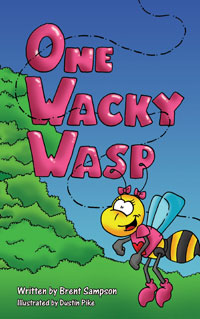
One Wacky Wasp book cover

If you’re like most people, you chose the top book. Don’t you see just how important a “pretty” cover is to your book sales?

A professionally-designed cover is important for online sales, but even more important if you plan to “sell” your book to the brick-and-mortar booksellers. A buyer will also apply the 8 second rule to your book before making the decision to purchase it. They see many books every day. If yours doesn’t stand out, they likely won’t be interested.

Getting a custom cover design is expensive! What if I can’t afford to pay for it? Maybe now is not the best time to publish your book. Continue saving and set aside enough money to do it right the first time. That way, you won’t have any regrets later. Think of your cover design as an early investment in your book promotion strategy as a lame design can affect the overall “saleability” of the book.

DISCUSSION: Did you pass on a professionally designed book cover? How do you think you think your sales have been affected?
Cheri Breeding ABOUT CHERI BREEDING:
Since 2005 Cheri Breeding has been working as the Director of Production for Outskirts Press. In that time, she has been an instrumental component of every aspect of the Production Department, performing the roles of an Author Representative, Book Designer, Customer Service Representative, Title Production Supervisor, Production Manager and, Director of Production. She brings all that experience and knowledge, along with an unparalleled customer-service focus, to help self-publishing authors reach high-quality book publication more efficiently, professionally, and affordably.


Paperbacks, Hardbacks, and eBooks — Oh My!

Today’s post is by publishing industry expert, Wendy Stetina.

Authors often ask whether they should publish a paperback, hardback, and eBook version of their book? In most cases, the answer is yes, but in some cases, publishing additional editions isn’t the best idea.  Let me clarify here…

Some full-service self-publishing companies, such as Outskirts Press, allow authors to publish a hardback instead of a paperback or they may publish a hardback in addition to their paperback. Authors are also able to add editions for the various eReaders — for example an Amazon Kindle or Barnes&Noble Nook. Editions above and beyond paperback usually add an additional cost to producing your book.

I rarely recommend that a first time author publish primarily in hardback because these books come with a higher price tag and will possibility have a lower sales performance than paperback. I love for an author to have both formats for two reasons it gives the book a standard (the paperback) and a premium (the hardback) version and two price points.

I look at the hardback as an investment into your book promotion strategy. I do not see it as the version that is going to drive sales volume but more as a “special” edition for the author to sign and give as gifts etc.

If budget is an issue, I would suggest investing the money into either a custom designed cover or professional copyediting as neglecting either of these options could seriously cloud the public’s perception of your book.


ABOUT WENDY STETINA:
Wendy Stetina is a sales and marketing professional with over 30 years experience in the printing and publishing industry. Wendy works as the Director of Author Services for Outskirts Press. The Author Services Department is composed of knowledgeable customer service reps and publishing consultants; and together, they all focus on educating authors on the self-publishing process in order to help them publish the book of their dreams. Whether you are a professional looking to take your career to the next level with platform-driven non-fiction, or a novelist seeking fame, fortune, and/or personal fulfillment, Wendy Stentina can put you on the right path.

Is Your Back Cover Copy Driving Away Potential Readers?

Today’s post is by publishing industry expert, Cheri Breeding.

When I’m looking for a book to read, the first thing that catches my attention is the front cover — whether it’s good, bad, or somewhere in between. After that, I flip the book over to take a peek at what’s said on the back cover. After roughly 10-15 seconds of reading, I know whether I want to buy that book. That’s how crucial effective copy is to the success of your book.

Are you making rookie mistakes that are pushing readers in the opposite direction of your book? Here’s a quick test to be sure:

  • How much time did you put into writing the copy for your book cover? You should spend a good amount of time here. Of course, you don’t need to spend as much as you did writing the book, but you must put some serious thought into crafting the “right” back cover copy.
  • Did you include a hook? A hook is a brief (possibly 5-7 words) statement that “hooks” the reader into wanting to read more. A catchy hook is second only to a strong title (and a well-written book). It usually appears at the top of the back cover.
  • Can your reader get intimate with your book’s topic or characters in the synopsis? Your synopsis should be to the point yet interesting. Ideally, you should introduce one or two (or more) of your main characters/topics in the synopsis as well as provide a bit of background for the story.
  • Does your potential reader know what to expect from your story by reading  the synopsis? If I don’t know what I’m getting myself into with a project, I’m hesitant to get involved. The same is true for books. If you haven’t given me a “sneak peek”, I will be less likely to move forward with the purchase.
  • Are you introducing yourself in your author bio? Make sure to include an author bio that allows people to get to know you on the level you prefer. Your bio should read as if you’re a real person — BECAUSE YOU ARE!

If you find yourself stuck on any of these, it’s better to hire a professional writer to compose these pieces for you. Your publisher may be able to point you in the right direction. For example, at Outskirts Press, we have  service called Cover Scribing where one of our writers compose your back cover copy for you.

DISCUSSION: Do you have any experience with back cover copy gone bad? Share your thoughts in the comments below.

Cheri Breeding ABOUT CHERI BREEDING:
Since 2005 Cheri Breeding has been working as the Director of Production for Outskirts Press. In that time, she has been an instrumental component of every aspect of the Production Department, performing the roles of an Author Representative, Book Designer, Customer Service Representative, Title Production Supervisor, Production Manager and, Director of Production. She brings all that experience and knowledge, along with an unparalleled customer-service focus, to help self-publishing authors reach high-quality book publication more efficiently, professionally, and affordably.

Is Your Ineffective Book Title Costing You Sales?

Today’s post is by publishing industry expert, Cheri Breeding.

Did you know that a strong book title can many times translate to more sales for the author? Or that a weak (or ineffective) title can many times mean lackluster sales?

Not only do readers judge a book by its cover, but they also find books based on their title. For instance, if you’ve written a book about the battles of the Civil War, you surely want readers to find you using the term “civil war” or “civil war battles”. If your title is not reflective of the subject, you can miss out on readers. The title Love Lost, for example, would not be one I would click to if I’m looking for information about the war. Your title, while catchy and creative, just cost you a sale.

You should consider ALL of the following when choosing a book title:

  • How catchy is it (will people remember it)?
  • Is it unique/original (search bookstores for other books with the same title)?
  • Does it include the keywords/phrases you want to be found for?

Remember your title doesn’t have to stand alone. A strong subtitle can help a title that may not be descriptive enough alone. Referring to the example above, Love Lost: Short Love Stories of the Civil War is much more descriptive and would encourage a reader searching for “Civil War battles” to at least take a peek (provided you have an attention-grabbing cover).

While a subtitle is not required, you can see that many times it can make the difference by adding a few additional keywords, etc. that are related to the title.

DISCUSSION: What tips do you have for authors choosing a book title?

Cheri Breeding ABOUT CHERI BREEDING:
Since 2005 Cheri Breeding has been working as the Director of Production for Outskirts Press. In that time, she has been an instrumental component of every aspect of the Production Department, performing the roles of an Author Representative, Book Designer, Customer Service Representative, Title Production Supervisor, Production Manager and, Director of Production. She brings all that experience and knowledge, along with an unparalleled customer-service focus, to help self-publishing authors reach high-quality book publication more efficiently, professionally, and affordably.

How Much Will it Cost to Self-Publish My Book?

Today’s post is by publishing industry expert, Wendy Stetina.

How much will it cost to self-publish my book? That’s a loaded question.

There are many factors that go into how much it will cost to self-publish. Your cost will be dependent on the route you choose — whether you opt to do all of the work yourself, outsource some of the work, or hire a full-service self-publisher.

If you do all of the work yourself, the costs will be minimal and dependent on your skills and knowledge. Some of the top things you will be responsible for are (in no particular order):

Of course, this only scratches the surface as there is quite a bit involved with turning a manuscript into a published book.

A good alternative for those who have a bit of book industry savvy is to outsource small jobs that are a part of the book creation process. Of course, your costs for these jobs will be dependent on the quote you receive from the professional you intend to hire.

Lastly, if you have limited knowledge or would rather leave book creation completely to the industry experts, you can choose to go with a full-service self-publisher, like Outskirts Press.

A good rule of thumb would be for an author to invest an equal amount in production and marketing. Serious non-fiction authors, for example, should plan on investing around $5000.00 – $7000.00.  This would break down into approximately $2500.00 – $3500.00 for the creation of the book (designing interior, editing manuscript, cover design, etc.),  and $2500 – $3500.00 to launch the book (book launch parties, marketing efforts, book orders, etc.). Post launch there needs to be an ongoing marketing effort.

DISCUSSION: How much did you spend to create and distribute your book?


ABOUT WENDY STETINA:
Wendy Stetina is a sales and marketing professional with over 30 years experience in the printing and publishing industry. Wendy works as the Director of Author Services for Outskirts Press. The Author Services Department is composed of knowledgeable customer service reps and publishing consultants; and together, they all focus on educating authors on the self-publishing process in order to help them publish the book of their dreams. Whether you are a professional looking to take your career to the next level with platform-driven non-fiction, or a novelist seeking fame, fortune, and/or personal fulfillment, Wendy Stentina can put you on the right path.