The Current State of E-Readers | An Author’s Guide (Part IV––the Samsung Galaxy Tab)

Last week, I examined the dedicated e-reader designed for use with Barnes & Noble’s stores, both digital and brick and mortar––the NOOK.  And if you read that post, you’ll recall that I mentioned Barnes & Noble will no longer be producing a dedicated e-reader, and in fact is no longer producing an e-reader at all; it is, however, lending its name and all of the might of its online platform to the latest incarnation (or should I say “one of the latest incarnations?”) of the Samsung Galaxy Tab.  The resulting hybrid will give Barnes & Noble customers the necessary continuity to keep using the interfaces to which they have become accustomed, while also lifting the burden of production and distribution (at least, partially) from a company that is still, ultimately, struggling to keep its foot in the door of print book distribution.  Amazon’s Kindle store and Apple’s iPad have collectively changed the course of ebook distribution and consumption, whether we like it or not––and like so many others, Barnes & Noble and Samsung are hoping to create the next best thing, or a near-approximation of the iPad that still gives the bookseller an edge of control over the end user.

(There are altogether too many options on the iPad for a bookseller’s tastes––too many apps and too many readable file formats within those apps.  The more options, the less easily a bookseller can drive sales in a particular direction––and profits.)
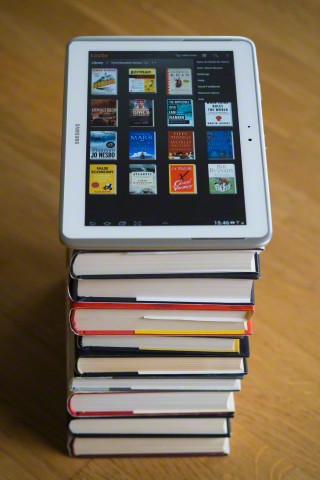
Samsung Galaxy Tab

But we’re not here to talk about the new tablet (although you can read a most thorough CNET review here).  We’re here to talk about the original Samsung Galaxy Tab series, which is now up to at least its tenth iteration … if not a higher number (they throw in variant names, with the “Galaxy Tab S” and “Galaxy Tab Pro” and so on complicating a neat and orderly numbering system).  The entire line is noted, however, first and foremost for being the first (or among the first, depending on who you ask) to embrace a full Android operating system––and as such, it became a solid, distinct, and direct competitor to both the iPad (which runs on Apple’s iOS) and the Kindle (which varies a bit from iteration to iteration, but for the most part employs a heavily modified and limited version of Android).  I think it’s worth mentioning both tablets like the iPad and dedicated e-readers like the Kindle in the same breath when it comes to the Samsung Galaxy, because the relationship between the two is hybridizing so quickly as partnership projects like the Samsung Galaxy NOOK become the new normal.

Here’s the thing with the Samsung Galaxy Tab series that gives it an edge over the Kindle and the original NOOK: it’s a fully-fledged tablet, with a far wider range of capabilities as a device than a dedicated e-reader.  You can access the Google Play store, and run a whole slew of apps that have little or nothing to do with books, and yet the reading-related apps you can download are beautifully designed and presented, so the e-reading experience is still highlighted and underscored as important to app developers.  Many people rate the average Samsung device as somewhat less responsive and intuitive than the iPad, but Apple is famously canny about using software to create closed loops around its hardware (that is, the average iPad has to be “jailbroken” before it is “hackable”––you have to actually tamper with the operating system to render it more adaptable).  Basically, Android-based operating systems like the ones the Samsung Galaxy Tablets run are way more easy to customize, tinker with, and generally geek out over.

Samsung Galaxy NOOK

And there are a lot of Samsung Galaxy Tabs out there.  There are no hard and fast numbers for me to quote to you, but it’s safe to say they’re not hurting too badly if they have the capital to launch “boutique” or specialized lines like the NOOK hybrid.  (Each iteration costs a lot of money and time and talent capital to design and maintain and run support for.)  Some recent reports do, however, indicate that sales were not quite as high as they should have been––and as the company supposedly reported them to have been––and this is a matter of great concern.  Samsung has the benefit of a large support network and a diverse portfolio to fall back on if one project or device doesn’t sell well; Barnes & Noble had no such safety net, and thus lost its ability to respond effectively to rapidly shifting market demands.

Here’s what you need to know as an author when it comes to the Samsung Galaxy Tab: it’s not going anywhere.  Oh, iterations come and go the way my love of rain comes and goes (and boy, does that one fluctuate a lot).  But the great thing about a series like this one is that Samsung will continue to make new additions as long as the market exists and as long as there is a demand for Android-based devices that aren’t locked into being dedicated e-readers like the Kindle.  Customers want variety and customizability, games and work and literature all in one device, without the need to untangle multiple cables or swap out chargers on the nearest wall outlet.  And as long as there are Android-based operating systems, the Google Play store will remain an important distribution point to keep an eye on.

Are you selling through Google Play?  I personally hope so, and if you are and would like to share your story, please (please please) drop me a line in the comment section with all of the details.

Thank you for reading!  If you have any questions, comments, suggestions, or contributions, please use the comment field below or drop us a line at selfpublishingadvice@gmail.com.  And remember to check back each Wednesday for your weekly dose of marketing musings from one indie, hybrid, and self-published author to another. ♠

KellyABOUT KELLY SCHUKNECHT: Kelly Schuknecht is the Executive Vice President of Outskirts Press. In addition to her contributions to the Outskirts Press blog at blog.outskirtspress.com, Kelly and a group of talented marketing experts offer book marketing services, support, and products to not only published Outskirts Press authors, but to all authors and professionals who are interested in marketing their books and/or careers. Learn more about Kelly on her blog, kellyschuknecht.com.

The Current State of E-Readers | An Author’s Guide (Part II)

Last week, I launched us into a new series about e-readers, and the pros and cons of using each different e-device (don’t worry, this won’t be quite the epic saga that the Beginner’s Guide to Social Media primer turned out to be!).  This week, I’ll be taking a closer look at perhaps one of the most talked-about e-readers of all time, the Kindle.  No doubt you’ve heard a lot about Amazon’s entry into the e-book sphere before, and elsewhere, in part because it was launched by a massive company still on the upswing in popularity, with the built-in infrastructure to ensure a strong debut––and in part because it remains a solid performer, especially in its newer incarnation, the Kindle Fire.

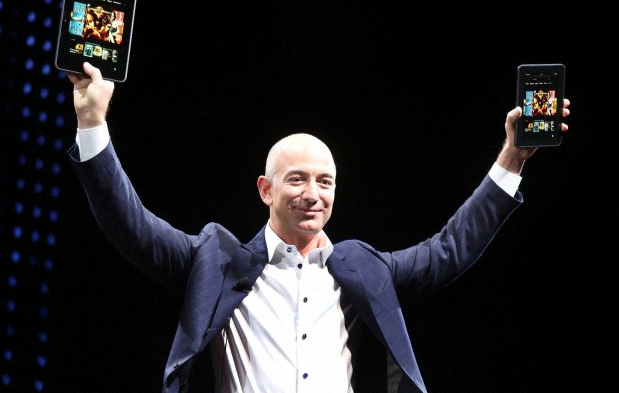
jeff bezos with the kindle
Amazon CEO Jeff Bezos with the new Kindle Fire HD

Just how many people own a Kindle?  A 2014 Forbes article reported that “roughly 43.7 million Kindle devices had been cumulatively sold till the end of 2013,” but, well, Amazon isn’t really talking, except when it’s super proud of itself, so the data Forbes was using may or may not be representative.  Even though in 2014 the Pew Research Center was marking an uptick in e-reader (specifically, Kindle) and everyone seemed, for the most part, highly optimistic about e-readers and therefore e-book distribution, some more recent data seems to indicate a plateauing of that trend … if not a slight reversal.  According to an article by Business Insider contributor James Cook, “for the first time ever the number of tablets shipped has decreased”––and Amazon’s Kindle line has been the hardest hit, with a decrease of some 69.9% in respect to shipments.  That’s a lot.  And the numbers are still so new that few tablet users are speculating yet as to why the Kindle has taken the brunt of the market change.  Is it because users have grown bored, or because Amazon hasn’t reinvented the wheel since the Kindle Fire was released two years (or two lifetimes, in today’s rapid-fire technology-hungry universe)?  But wait––what about the Kindle Paperwhite (the “Kindle 3”)?  Why does nobody seem to be getting on the Paperwhite train?  Is it because people are actively migrating away from Amazon, or from tablet computers, or from e-books?  The numbers seem to be holding mostly steady for e-books downloaded and read, so what’s the deal?

I’ll let you know as soon as I know.

Still, in the meantime, here’s what you need to know about the Kindle (Fire and Paperwhite):

They’re beautiful devices, designed and manufactured specifically to make thumbing through your digital library as tactile and responsive a practice as running a hand across a physical bookshelf––or at least, these e-readers are about as close as you can get without engaging your sense of smell.  (They do, however, make use of your fingertips and your ears as well as your eyes.  There’s some benefit to a multimodal interface, in terms of absorption of information, or so I’ve been told.)

And don’t forget that while sales may have dropped this last year (and significantly), the Kindle and Kindle Fire have out-sold almost every other dedicated e-reading device out there.  There are millions––dozens of millions––of Kindles out there already in use.  So yes, it still remains completely and absolutely worthwhile to sell your book as an e-book edition through the Kindle Store.  The total number of units sold alone should indicate this, but as the aforementioned Pew Research Center report also says, 3 in 10 American adults read an e-book last year, most of them on a tablet or dedicated e-reading device.  That’s a lot of e-books, my friends.  And Jim Tierney over at Loyalty360 reports that Amazon Prime Membership jumped by 53% in 2014––to around 40,000,000 (that’s 40 million) total adults.  And what with the advent of the Kindle Lending Library––a controversial offering, to be sure––Prime subscribers can opt to read certain select e-books for free.  That’s a lot of potential future readers.

Not much has changed when it’s come to the disadvantages of owning a Kindle, except for the fact that Amazon has taken away any grounds for complaint about the graphics, display quality, and user interface.  Their customer support system is pretty nifty, too, and users seem to like it.  No, you still can’t take the Kindle into the bathtub with you, and you probably don’t want to hurl it off the edge of a parking garage unless you actually want to watch it break, but these tablets do qualify as robust, insofar as tablets are allowed to.  Lending books to friends is possible, but still not quite intuitive.  Universities are starting to get on board with letting students use e-book editions for courses, but this still remains an underutilized possibility.  And no, it’s not an actual book you can hold in your hand and sniff for that “old-book” smell.  (But that’s what perfume is for, right?!)

I’m not about to try and sell you on buying a Kindle––or any e-reader, for that matter––but I do think it’s worth oohing and aaahing a little over the modern creature comforts technology has provided us.  An interlinked dictionary that I can access while reading?  Handy.  Highlighting and bookmarking?  Essential.  And much more difficult to “lose” when we’re speaking of a digital item.  And it’s nice, too, to have the option of reading multiple file formats on the same dedicated e-device without having to switch between apps.  PDFs?  No problem.  TXT?  DOC?  The Kindle’s got you covered.  And for now, people aren’t quite tossing them in a blender just to watch sparks fly, so I wouldn’t quite put up the crime scene tape just yet––if Amazon has proven anything, it’s proven just how much it loves to be on top!

Thank you for reading!  If you have any questions, comments, suggestions, or contributions, please use the comment field below or drop us a line at selfpublishingadvice@gmail.com.  And remember to check back each Wednesday for your weekly dose of marketing musings from one indie, hybrid, and self-published author to another. ♠

KellyABOUT KELLY SCHUKNECHT: Kelly Schuknecht is the Executive Vice President of Outskirts Press. In addition to her contributions to the Outskirts Press blog at blog.outskirtspress.com, Kelly and a group of talented marketing experts offer book marketing services, support, and products to not only published Outskirts Press authors, but to all authors and professionals who are interested in marketing their books and/or careers. Learn more about Kelly on her blog, kellyschuknecht.com.

Self-Publishing Week in Review: 8/19/14

As a self-publishing author, you may find it helpful to stay up-to-date on the trends and news related to the self-publishing industry. This will help you make informed decisions before, during and after the self-publishing process, which will lead to a greater self-publishing experience. To help you stay current on self-publishing topics, simply visit our blog every Tuesday to find out the hottest news.

Writer’s Digest Inks Deal With BookBaby on New Self-Publishing Imprint

Writer’s Digest recently announced that the Company has entered a partnership with BookBaby to launch a new self-publishing division named Blue Ash Publishing. This new venture is grounded in what Writer’s Digest does best: educating writers. As more companies such as Writer’s Digest join the self-publishing industry, authors will reap countless benefits and the industry will continue to grow and flourish.

Yacht Captain Turned Bestselling Self-Published Author Tells All

This interview with NY Times bestselling self-published author Hugh Howey shares his writing journey and advice. He discusses his views on traditional publishing, his secrets to success, the film based on his book, and more.

Kindle Direct Publishing Unveils Pre-Orders for eBooks

Amazon has finally rolled out their pre-order program for all authors who distribute through the Kindle Direct Publishing. Self-published authors will be able to start selling their title before its officially ready, giving them the ability to hype the book in advance and start capturing sales. All self-publishing authors should check out this opportunity.

If you have other big news to share, please comment below.

ABOUT KELLY SCHUKNECHT: Kelly Schuknecht is the Executive Vice President of Outskirts Press. In addition to her contributions to the Outskirts Press blog at blog.outskirtspress.com, Kelly and a group of talented marketing experts offer book marketing services, support, and products to not only published Outskirts Press authors, but to all authors and professionals who are interested in marketing their books and/or careers. Learn more about Kelly on her blog at http://kellyschuknecht.com.

Self-Publishing Week in Review: 8/12/14

As a self-publishing author, you may find it helpful to stay up-to-date on the trends and news related to the self-publishing industry. This will help you make informed decisions before, during and after the self-publishing process, which will lead to a greater self-publishing experience. To help you stay current on self-publishing topics, simply visit our blog every Tuesday to find out the hottest news.

Indie Authors Talk Editors

In this article, eight successful indie authors share their editing experiences and offer some tips and advice on the editing process. This is a must read for all self-publishing authors.

Everyone Needs an Editor

This article shares why a great story, professional book cover, awesome marketing plan, and stellar website are all a waste of time if you haven’t hired a professional editor to review your book. This is a must read for all authors.

Simon & Schuster Acquires Self-Published YA Novel

Aladdin Books, an imprint of Simon & Schuster Children’s Publishing, has acquired the book rights to Strays by Virginia Castleman, a self-published YA novel about two orphans. This self-publishing success story will inspire all independent authors, especially YA writers.

Self-Publish or Perish: Why I Made the Leap from Traditional Publishing to Indie

This NY Times Bestselling author shares why she decided to take the leap from traditional publishing to indie publishing. This is a fascinating read for all authors.

If you have other big news to share, please comment below.

ABOUT KELLY SCHUKNECHT: Kelly Schuknecht is the Executive Vice President of Outskirts Press. In addition to her contributions to the Outskirts Press blog at blog.outskirtspress.com, Kelly and a group of talented marketing experts offer book marketing services, support, and products to not only published Outskirts Press authors, but to all authors and professionals who are interested in marketing their books and/or careers. Learn more about Kelly on her blog at http://kellyschuknecht.com.

Self-Publishing Week in Review: 8/05/14

As a self-publishing author, you may find it helpful to stay up-to-date on the trends and news related to the self-publishing industry. This will help you make informed decisions before, during and after the self-publishing process, which will lead to a greater self-publishing experience. To help you stay current on self-publishing topics, simply visit our blog every Tuesday to find out the hottest news.

Self-Published Authors Make A Living — And Sometimes A Fortune (http://www.npr.org/blogs/money/2014/07/25/334484331/unknown-authors-make-a-living-self-publishing)

This article discusses how much money self-publishing authors make and how some authors are able to make a “fortune.” It also discusses Hugh Howey’s report that suggests that self-published authors make more money overall from ebooks than those signed with the big five publishing houses. It is an interesting read for all authors.

31 Percent of Daily E-Book Sales Are Now by Self-Published Authors

(http://smallbiztrends.com/2014/07/self-published-ebooks-on-amazon-study.html)

According to a report by the author’s advocacy group Author Earnings, self-published ebooks now account for 31 percent of daily ebook sales on Amazon, and self-published authors are now earning nearly 40% of all ebook royalties on the Kindle store.  This data is very encouraging to independent authors.

Surprising Self-Publishing Statistics

(http://booklife.com/books/07/28/2014/surprising-self-publishing-statistics.html)

This article also looks at the report released by the group Author Earnings as well as a 2014 survey from the founder of Smashwords. Key findings include:

  • The Big Five traditional publishers now account for only 16% of the e-books on Amazon’s bestseller lists. Self-published books now represent 31% of e-book sales on Amazon’s Kindle Store.
  • Indie authors are earning nearly 40% of the ebook dollars going to authors.
  • $2.99 and $3.99 are currently the pricing sweet spots for most ebook bestsellers.
  • Readers prefer longer ebooks. In fact, bestselling books tend to be over 100,000 words.
  • Pre-orders give authors a sales advantage.

Be sure to check out the full article for more surprising statistics!

If you have other big news to share, please comment below.

ABOUT KELLY SCHUKNECHT: Kelly Schuknecht is the Executive Vice President of Outskirts Press. In addition to her contributions to the Outskirts Press blog at blog.outskirtspress.com, Kelly and a group of talented marketing experts offer book marketing services, support, and products to not only published Outskirts Press authors, but to all authors and professionals who are interested in marketing their books and/or careers. Learn more about Kelly on her blog at http://kellyschuknecht.com.