The Pros and Cons of Self-Publishing

There are pros and cons to any endeavor. Though we’d all like to say that our solution relieves the end user from making any of the wrong decisions, that’s simply not the case. However, there is a good and bad side of each coin. Here are a few related to self publishing:

Pros

  • Freedom of expression — you write your own words. You don’t have to change what you’ve written or even edit your manuscript.
  • You control how your book looks — everything from the cover to the interior formatting is in your hands.
  • You set your own price — it can be a low or high as you would like.
  • You receive 100% of your royalties — there’s no middleman stealing your profits.

Cons

  • No one critiques your manuscript — how can you be sure your story is “worth reading”?
  • You don’t have to edit your manuscript — a messy manuscript turns into a poorly-written book that very few people (if any) will want to read.
  • You control your book’s design — this is great if you’re a designer but not so great if you have limited graphic skills.

The best route to take is to choose a reputable self-publishing company. Interview several of them until you find the one that best suits your needs. That way, you can be given much of the same guidance you’d receive going with a “traditional” publisher, but you’ll enjoy many of the same freedoms that come along with self publishing.

What other pros/cons can you think come along with self publishing territory?
Cheri Breeding ABOUT CHERI BREEDING:
Since 2005 Cheri Breeding has been working as the Director of Production for Outskirts Press. In that time, she has been an instrumental component of every aspect of the Production Department, performing the roles of an Author Representative, Book Designer, Customer Service Representative, Title Production Supervisor, Production Manager and, Director of Production. She brings all that experience and knowledge, along with an unparalleled customer-service focus, to help self-publishing authors reach high-quality book publication more efficiently, professionally, and affordably.

Your Book WILL Be Judged by Its Cover

Today’s post is by publishing industry expert, Cheri Breeding.

Readers will judge your book by its cover — and quickly. Statistics show that the average person will decide to buy your book within 8 seconds of  seeing your cover. That’s an expensive piece of real estate! It helps you get noticed and is usually directly correlated to sales success.

My book is well-written and packed with intriguing content. Doesn’t that count for something? Of course, but if no one ever sees your book’s content because of a boring cover, how much will that help your sales? Have you ever heard the old saying “a picture is worth a thousand words”? This is especially true for books. Your cover should be 10x better than the content on the inside. So, if you have AMAZING content, you must have an EXTRAORDINARY book cover.

To put it in another perspective — when you go shopping for clothes, how do you pick what to wear? Do you pick the best-looking shirt? Or, do you blindly choose a shirt off the rack irregardless of looks? If you’re like most people, you choose based on aesthetics. This example was about clothes, but books are no different. People are drawn to things they find attractive. There’s very little attraction to a Plain-Jane cover. People like to see pictures and text intertwined in a visually pleasing way. Some books can get away with text only covers, but the layout must be creative in some way to get people to read it.

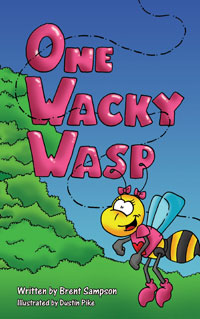
If you saw the two covers below (for children’s books), which would you choose to find out more about?

One Wacky Wasp book cover

If you’re like most people, you chose the top book. Don’t you see just how important a “pretty” cover is to your book sales?

A professionally-designed cover is important for online sales, but even more important if you plan to “sell” your book to the brick-and-mortar booksellers. A buyer will also apply the 8 second rule to your book before making the decision to purchase it. They see many books every day. If yours doesn’t stand out, they likely won’t be interested.

Getting a custom cover design is expensive! What if I can’t afford to pay for it? Maybe now is not the best time to publish your book. Continue saving and set aside enough money to do it right the first time. That way, you won’t have any regrets later. Think of your cover design as an early investment in your book promotion strategy as a lame design can affect the overall “saleability” of the book.

DISCUSSION: Did you pass on a professionally designed book cover? How do you think you think your sales have been affected?

Cheri Breeding ABOUT CHERI BREEDING:
Since 2005 Cheri Breeding has been working as the Director of Production for Outskirts Press. In that time, she has been an instrumental component of every aspect of the Production Department, performing the roles of an Author Representative, Book Designer, Customer Service Representative, Title Production Supervisor, Production Manager and, Director of Production. She brings all that experience and knowledge, along with an unparalleled customer-service focus, to help self-publishing authors reach high-quality book publication more efficiently, professionally, and affordably.


Is Your Back Cover Copy Driving Away Potential Readers?

Today’s post is by publishing industry expert, Cheri Breeding.

When I’m looking for a book to read, the first thing that catches my attention is the front cover — whether it’s good, bad, or somewhere in between. After that, I flip the book over to take a peek at what’s said on the back cover. After roughly 10-15 seconds of reading, I know whether I want to buy that book. That’s how crucial effective copy is to the success of your book.

Are you making rookie mistakes that are pushing readers in the opposite direction of your book? Here’s a quick test to be sure:

  • How much time did you put into writing the copy for your book cover? You should spend a good amount of time here. Of course, you don’t need to spend as much as you did writing the book, but you must put some serious thought into crafting the “right” back cover copy.
  • Did you include a hook? A hook is a brief (possibly 5-7 words) statement that “hooks” the reader into wanting to read more. A catchy hook is second only to a strong title (and a well-written book). It usually appears at the top of the back cover.
  • Can your reader get intimate with your book’s topic or characters in the synopsis? Your synopsis should be to the point yet interesting. Ideally, you should introduce one or two (or more) of your main characters/topics in the synopsis as well as provide a bit of background for the story.
  • Does your potential reader know what to expect from your story by reading  the synopsis? If I don’t know what I’m getting myself into with a project, I’m hesitant to get involved. The same is true for books. If you haven’t given me a “sneak peek”, I will be less likely to move forward with the purchase.
  • Are you introducing yourself in your author bio? Make sure to include an author bio that allows people to get to know you on the level you prefer. Your bio should read as if you’re a real person — BECAUSE YOU ARE!

If you find yourself stuck on any of these, it’s better to hire a professional writer to compose these pieces for you. Your publisher may be able to point you in the right direction. For example, at Outskirts Press, we have  service called Cover Scribing where one of our writers compose your back cover copy for you.

DISCUSSION: Do you have any experience with back cover copy gone bad? Share your thoughts in the comments below.

Cheri Breeding ABOUT CHERI BREEDING:
Since 2005 Cheri Breeding has been working as the Director of Production for Outskirts Press. In that time, she has been an instrumental component of every aspect of the Production Department, performing the roles of an Author Representative, Book Designer, Customer Service Representative, Title Production Supervisor, Production Manager and, Director of Production. She brings all that experience and knowledge, along with an unparalleled customer-service focus, to help self-publishing authors reach high-quality book publication more efficiently, professionally, and affordably.

Is Your Ineffective Book Title Costing You Sales?

Today’s post is by publishing industry expert, Cheri Breeding.

Did you know that a strong book title can many times translate to more sales for the author? Or that a weak (or ineffective) title can many times mean lackluster sales?

Not only do readers judge a book by its cover, but they also find books based on their title. For instance, if you’ve written a book about the battles of the Civil War, you surely want readers to find you using the term “civil war” or “civil war battles”. If your title is not reflective of the subject, you can miss out on readers. The title Love Lost, for example, would not be one I would click to if I’m looking for information about the war. Your title, while catchy and creative, just cost you a sale.

You should consider ALL of the following when choosing a book title:

  • How catchy is it (will people remember it)?
  • Is it unique/original (search bookstores for other books with the same title)?
  • Does it include the keywords/phrases you want to be found for?

Remember your title doesn’t have to stand alone. A strong subtitle can help a title that may not be descriptive enough alone. Referring to the example above, Love Lost: Short Love Stories of the Civil War is much more descriptive and would encourage a reader searching for “Civil War battles” to at least take a peek (provided you have an attention-grabbing cover).

While a subtitle is not required, you can see that many times it can make the difference by adding a few additional keywords, etc. that are related to the title.

DISCUSSION: What tips do you have for authors choosing a book title?

Cheri Breeding ABOUT CHERI BREEDING:
Since 2005 Cheri Breeding has been working as the Director of Production for Outskirts Press. In that time, she has been an instrumental component of every aspect of the Production Department, performing the roles of an Author Representative, Book Designer, Customer Service Representative, Title Production Supervisor, Production Manager and, Director of Production. She brings all that experience and knowledge, along with an unparalleled customer-service focus, to help self-publishing authors reach high-quality book publication more efficiently, professionally, and affordably.

Self-Publishing Author: There’s a Problem with Your Book

Today’s post is by publishing industry expert, Cheri Breeding.

Your book published. Your family and friends have bought it. You’re excited…until they call you to tell you there were so many grammatical errors in the book that it was difficult to finish reading. “Oh no, I should have paid for copyediting”. Now you run the risk of “looking” unprofessional in the author community.

Too often authors are faced with the decision to either save their pennies or invest in editing services. They decide to bypass the editing. Fast forward to publication and many authors wish they would have made the extra investment. Even if you have gone through your manuscript with a fine tooth comb and had friends or family look it over, you’re almost guaranteed to find mistakes at publication. As a matter of fact, when you pay for professional copyediting services, the editor normally still has a 5% margin for error. With that margin of error from fresh and professionally trained eyes, imagine the level of error from amateur and familiar eyes.

When asked what they would have done differently when self-publishing their book, most authors agree they would have invested more money into professional copyediting and customizing their book cover.

So, I’m sold on the need for copyediting service, what do I need to know about working with an editor? Here are a few tips/things to keep in mind when you hire an editor:

  • Proofread and spell-check your work before sending it to an editor.
  • Remember that Editors are human and many work with about a 5% margin of error.
  • There are different levels of editing intensity: basic, moderate, and extensive.
  • Basic copyediting typically catches about 70% of errors in a manuscript.
  • As a self-publishing author, don’t focus on what the editor didn’t find, but rather what WAS found.
  • Review your manuscript again after you receive it from the editor to check for errors they may have missed.

If you want to be a successful author, it is important that you take the publishing process very seriously. That includes investing extra money into creating a polished product.


Cheri Breeding ABOUT CHERI BREEDING:
Since 2005 Cheri Breeding has been working as the Director of Production for Outskirts Press. In that time, she has been an instrumental component of every aspect of the Production Department, performing the roles of an Author Representative, Book Designer, Customer Service Representative, Title Production Supervisor, Production Manager and, Director of Production. She brings all that experience and knowledge, along with an unparalleled customer-service focus, to help self-publishing authors reach high-quality book publication more efficiently, professionally, and affordably.


DISCUSSION: Did you have a professional edit your book? If not, do you wish you did?