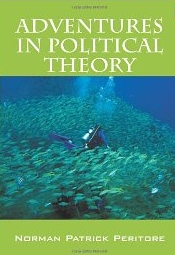
Self-Publishing Weekly Book Review: Adventures in Political Theory

Book reviews are a great way for self-publishing authors to gain exposure. After all, how can someone buy your book if they don’t know it exists? Paired with other elements of your book promotion strategy, requesting reviews is a great way to get people talking about what you’ve written.

When we read good reviews, we definitely like to share them. It gives the author a few (permanent) moments of fame and allows us to let the community know about a great book. Here’s this week’s book review by Midwest Book Review:

Adventures in Political Theory

Norman Patrick Peritore

Publisher: Outskirts Press

ISBN: 1432750194

Reviewer: Clark Isaacs

Throughout history, there have been many great thinkers who have challenged our thoughts. “Adventures in Political Theory” is Norman Patrick’s walk through the many thoughts in history and how they have shaped our history. From Socrates to the raging modern political debate, there have been many people who have changed the way people think. These leaders form the basis of our intellectual future. “Adventures in Political Theory” is worth considering for its wide reaching history. It is highly recommended.

Self-Publishing Book Review of the Week: Irises to Ashes by Charlie Hudson

Book reviews are a great way for self-publishing authors to gain exposure. After all, how can someone buy your book if they don’t know it exists? Paired with other elements of your book promotion strategy, requesting reviews is a great way to get people talking about what you’ve written.

When we read good reviews, we definitely like to share them. It gives the author a few (permanent) moments of fame and allows us to let the community know about a great book. Here’s this week’s book review by Kaye Trout at Midwest Book Review:

Irises to Ashes

Charlie Hudson

Publisher: Outskirts Press

ISBN: 9781432773892

Genre: Fiction – Family/Adventure/Dreams

Reviewed by: K. Trout for Amazon

Rating: Very Good

According  to the back cover, Irises to Ashes is

“A BOOK FOR ANYONE WHO HAS EVER STRUGGLED TO PURSUE A DREAM.” The cover also declares that “Charlie Hudson, military veteran and author, brings a different type of book in Irises to Ashes. Her comfortable writing style and touches of humor are still present in a story that explores self-discovery and the price we sometimes pay for choices that we make. See all of Charlie’s books at www.charliehunson.net.”

“Young Maggie Stewart loves the beaches of the Outer Banks, but that doesn’t take away from her desire to travel beyond the ocean’s edge. She knows that her family expects her to marry and settle down. It is an unexpected encounter with Amelia Hatcher, the village recluse, that leads to surprising opportunities that can open a path for Maggie to find a new future. Thus begins the intertwined stories of Maggie and Amelia: a fifteen year relationship between a young woman seeking to find her own way and an older woman seeking redemption for a past she has kept shrouded in secret.”

Irises to Ashes is divided into three parts: Part One – Maggie’s Beginning – Summer 1976 – Summer 1978, Part Two – Maggie’s Time – Fall 1978 – Spring 1992, and Part Three – Amelia’s Secrets – April 1992. This is not only a novel about young Maggie Stewart’s self-discovery but also about the de-mystification of Amelia Hatcher. Throughout Hudson’s novel, the page-turning tension flows from one page to the next, starting with: will she give up her virginity to Billy Ray?; how can she get to know the recluse Amelia?; how will they keep their relationship a secret; how will she work around obstinate parents; how will she get to Paris; will she succeed?; how will she deal with negative family jealousy; will she have to choose between family expectations and a successful career; and why is there no meaningful relationships? Then, you find out the secrets that led Amelia to choose the life of a recluse.

Irises To Ashes has a great beginning to pull you in, tension to keep you turning, and a satisfying conclusion to fit the title. Hudson excels at descriptive writing and character development, which bring this story to life. Can you relate to  Maggie? Might you distort the truth to get what you want? And, in some ways, Irises to Ashes is a light mystery. Will she break from family? Will she succeed? What are Amelia’s dark secrets? Other books by Charlie Hudson include: Your Room at the End, Parallel Worlds, Islands in the Sand, Orchids in the Snow, Shades of Murder,  and Parents’ Guide to Business Travel. And yes, I can highly recommend this novel.

Self-Publishing Book Review of the Week: Ice Queen by: Richard S. Lucas

Book reviews are a great way for self-publishing authors to gain exposure. After all, how can someone buy your book if they don’t know about it? Paired with other elements of your book promotion strategy, requesting reviews is a great way to get people talking about what you’ve written.

When we read good reviews, we definitely like to share them. It gives the author a few (permanent) moments of fame and allows us let the community know about a great book. Here’s this week’s book review:

Ice Queen book cover

Ice Queen

Richard S. Lucas

Publisher: Outskirts Press, Inc.

ISBN: 9781432773045

Reviewed by: Leslie Granier for Reader Views

“Ice Queen is a fictional story about archaeologists Helen and Philip Franklin. They have a great reputation, not only as hardworking and honest people, but as scientists who can prove whether specific myths and legends were based on facts or were simply made up by people for personal gain. The Franklins are hired by Thomas Coswell to find out about a woman sketched by Coswell’s grandfather shortly before he was killed on an archaeological trip. As Helen and Philip research the Ice Queen to uncover information regarding who or what she is, where she came from, and when she existed, they find themselves in danger when one of Coswell’s business competitors strives to learn what they are trying to discover in the hopes of taking any recovered artifacts for himself.

There are many good qualities about this book. First, the main characters are very likable and the chemistry between them is apparent. Understanding who a character is makes it a lot easier for the reader to relate to him or her. Second, the subject matter is interesting and timely. The interest in learning about ancient civilizations and different legends has become quite popular over the last few years. A third asset is the amount of action and adventure. The author chose to take the reader on a journey with Helen and Philip through Samoa, Peru, and other remote locations instead of concentrating too much on researching information on a computer.

I particularly enjoyed the glimpses into the ancient times. By using this method, the author provided the reader with a feeling of seeing things as they happened all those years ago instead of just reading about what people surmised had occurred. This made me feel much more involved in the story.

Ice Queen is intended for an adult audience. Men and women will both be captivated by this book. An interest in archeology is definitely not a prerequisite for reading this story. A sense of adventure and an open mind are sufficient. This is a well-written book with a plot that has been creatively crafted. It is definitely worth investing the time to read it.”

Should authors thank reviewers for reviewing their book?

What do you do when you receive a good review for your book?  Do you thank the reviewer?

Authors often ask me if this is something they should do.  Most reviewers don’t write reviews for anything in return, so they wouldn’t be surprised by not receiving anything in return.  However, if you really appreciated their review and want to take them by surprise, thank them.

I recently reviewed Blue Boy by Rakesh Satyal.  Just like the other 40 or so books I have reviewed on Amazon, I didn’t expect any thank you or acknowledgement from the author.  But to my surprise, a few days later, I received this message on my Facebook account:

Was I surprised?  Absolutely!  The personal thank you from the author made me feel a connection with him.  I’m glad I read the book and I’m glad I wrote a review.  If Satyal publishes another book someday, you can be sure I will read and review it!  That is the power of connecting with your readers.

DISCUSSION: Do you typically thank readers for reviewing your book?  If so, how do you do it?

ABOUT KELLY SCHUKNECHT:
Kelly Schuknecht works as the Director of Author Support for Outskirts Press.  In addition to her contributions to the Outskirts Press blog at blog.outskirtspress.com, Kelly and a group of talented marketing experts offer book marketing services, support, and products to not only published Outskirts Press authors, but to all authors and professionals who are interested in marketing their books and/or careers. Learn more about Kelly on her blog at http://kellyschuknecht.com.

Self-Publishing Book Review of the Week: Russia’s Prestige by Kashif Parvaiz

Book reviews are a great way for self-publishing authors to gain exposure. After all, how can someone buy your book if they don’t know about it? Paired with other elements of your book promotion strategy, requesting reviews is a great way to get people talking about what you’ve written.

When we read good reviews, we definitely like to share them. It gives the author a few (permanent) moments of fame and allows us let the community know about a great book. So, without further ado, here’s this week’s book review:

Russia's Prestige book cover

Russia’s Prestige: Historical Architecture

Kashif Parvaiz

Publisher: Outskirts Press, Inc.

ISBN 9781432766115

Reviewed by: William Phenn for Reader Views

“This is a very complete and concise volume of Russian architecture by a very talented writer. Mr. Parvaiz does more than just describe the beautiful architecture that is portrayed in the book. He goes the extra mile by giving the reader an insight into the history of the building. Beginning with Cathedral of the Dormition, to the Qolsharif Mosque, the chapters are descriptive and detailed. There is even a glossary at the end of every chapter that enlightens the reader to the terms used in that chapter.

Such amazing structures as the Catherine Palace in the Tsarskoe selo (the Tsar’s private city) are described with such detail that shows the author did his homework. He goes beyond the usual descriptions of the brick and mortar to include the reasons for its existence. It is this type of research that the author has done that makes this book stand out from the crowd of the usual architectural books.

The pictures are black and white, as would be expected in a book of architectural structures that date back as far as these do but that does not hinder the quality. The writing is top-notch and keeps the readers interest with the in-depth background and history.

The way the information is presented, with an in-depth history of the structures, makes it very interesting reading for everyone. He brought out some historical events that I had never seen or heard of in other books. It is general audience reading and full of wonderful pictures of all the old Churches and Cathedrals that are described and discussed. The cover graphics are appealing and the editing is a welcome change from most I have read recently. I enjoyed Russia’s Prestige: Historical Architecture and gave it my highest mark of an A+.”

DISCUSSION: Are you trying to obtain book reviews as part of your overall book promotion strategy?