Friday Conversations With A Self-Publishing Writer 12/05/14

CHARACTERS IV

OKAY…the wildness of the Christmas/Winter Holiday season is upon us!  What a marvelous time to observe characters!  According to the PEWS Research Project for Excellence in Journalism 2012 report, the majority of the top-selling magazines are people focused.  I call them GS’s (gossip-spreaders).  The journalists who write for them call them M&Ms (money-makers).  Whatever the label, the techniques used in developing these “people stories” are excellent tools for serious fiction and non-fiction writers.  And there are millions of readers to prove the relevance of their methods.  Among the fifteen top best-selling magazines (which include People, Better Homes and Gardens, Reader’s Digest, Good Housekeeping, Family Circle and Sports Illustrated) over 26 million readers each month “observe” their favorite “characters.”

Here are a few tips we might consider adopting when developing real or imaginary people to walk and talk in our stories.

  • Vices and Victories. These two elements in a person’s life hold great interest for readers. Recently a much admired TV personality was “exposed” in the media (followed by multiple magazine articles) for “crimes against others.” Even though the revelation broke many hearts and diminished the trustworthiness of humans on this planet, readers still want to know more and are buying the magazines (with books to follow, I’m sure) to accomplish that. THE OTHER side of that coin is the “true stories” of victorious living—about the people who have overcome disease and disabilities (Christopher Reeve/Superman) or great tragedies in their lives (Holocaust and/or natural disaster survivors).
  • Children and Pets. When Liza Minnelli talks about her Mom, Judy Garland, or Stella McCartney mentions her Dad, Paul, journalists are there to tell the story. When Sandra Bullock carries her rescued dogs down the street or Serena Williams cuddles her pet Yorkie on the tennis court sidelines, it creates “news” AND a look into their personalities. YOUR CHARACTERS should be developed at this same level. PEOPLE want to KNOW the details. Even if those details are only briefly mentioned in the novel, they allow the reader to develop their own perspective of the characters.
  • Personal and Not-So-Private Relationships. Have you noticed the multitude of YouTube and celebrity tabloids that constantly headline “Then and Now” titles? Drew Barrymore (the little girl who screamed at the top of her lungs when meeting E.T. for the first time) is a writer’s dream as they “watch” her on-film and off-film life evolve. Ben Carson is also a major example of change-of-life experiences—from belligerent child who did poorly in school to neurosurgeon, professor and now potential presidential candidate. His life intrigues readers.

Bottom Line: Writers cannot avoid the necessity to be investigative observers who keep detailed, descriptive files of the life and living examples appearing right before our eyes.  The folks who buy our books do so for many reasons (LOOK for my blog series in 2015), and certainly a main one is the element of “self-identifying.”  Of course, no two people are ever exactly alike.  However, we all share commonalities in the good, bad and ugly of our lives and seeing those things PLAY OUT in the lives of storybook characters HELPS us define and redefine who we are and where we are going.

This is a FUN part of research that brings living, breathing characters to the pages of our books!

Royalene ABOUT ROYALENE DOYLE: Royalene Doyle is a Ghostwriter with Outskirts Press, bringing more than 35 years of writing experience to authors who need “just a little assistance” with completing their writing projects. She has worked with both experienced and fledgling writers helping complete projects in multiple genres. When a writer brings the passion they have for their work and combines it with Royalene’s passion to see the finished project in print, books are published and the writer’s legacy is passed forward.

Friday Conversations With A Self-Publishing Writer 11/28/14

CHARACTERS IIIfriday post

Let’s sit the table.  This is one character development technique that I’ve recommended to every writer. Oh?  You thought I misspelled (or misused) a word in that opening sentence?  Glad you noticed it because this concept may just be the formula needed to not only develop your characters, but “keep them in their places.”  Let me explain.

Most writers I know construct the people in their stories through bullet-point outlines of each “person’s” physical, mental, emotional, and spiritual elements.  I do, too.  However, as I’m doing so, I sit each character at The Table, starting with my protagonist and antagonist at opposites ends.  When I first started doing this, the exercise felt a bit cumbersome.  Then it became FUN especially when supporting characters were seated in the side-chairs.  Not every antagonist or protagonist ally will sit to their right.

SO…just for fun…let’s play with an example.  And, since it’s the season of Thanksgiving and the Native American Tribes graciously brought the Pilgrims a sumptuous meal, I’ll offer a brief slice of one possible scenario.  The year is 1621.  The setting is a very small log-cabin and tent village where the forest has been trimmed back and a “long table” awaits.

ENTER my Protagonist, Chief Listening Bear of the small Halawi Saponi Tribe.  He wears a headdress of shiny dark-brown-and-gold turkey feathers and not much else.  His Pilgrim friend (protagonist supporter) is Father O’Malley, who greets Chief Listening Bear warmly and directs the Chief to the head of the table—the position always saved for the Pilgrim’s leader, Colonel Alfred Raleigh (maybe my Antagonist—maybe not).  A hush is felt among the gathering participants, as Colonel Raleigh raises a bushy eyebrow, then offers a half-smile and moves to the other end of the table.

Now the other “players” in this drama must find their places.  Who sits to the left and right of the main characters?  Will only men be allowed at the table?  Would the Colonel’s Lieutenant position himself next to the Chief for intimidation purposes?  Or…might the Colonel’s daughter take her seat across the table from the Chief’s son—an immediate attraction visible between them?  Yes.  This table has much plot development potential, and knowing where each character “sits” (creating their position in the protagonist/antagonist plot) will help you keep their dialogue and actions true.

History tells us that ninety Native Americans brought dinner that day with only fifty-three Pilgrims present.  This was probably the total population of both villages.  What their interactions might have been are open to interpretation (and storyline development), even though we have some documentation.  However, the concept of people looking in the eyes of the person seated across the table, and the intrusion or comfort levels felt when seated between two other people, gives the writer a great amount of material to work with.

Now, here we are, all these years later, having celebrated yet another DAY of THANKSGIVING.  What a difference a couple hundred years makes!  AND YET…might some of those same feeling be alive and well today?  Writing about them—exposing potentially harmful attitudes—might just make our next Thanksgiving Season a brighter one.

Royalene ABOUT ROYALENE DOYLE: Royalene Doyle is a Ghostwriter with Outskirts Press, bringing more than 35 years of writing experience to authors who need “just a little assistance” with completing their writing projects. She has worked with both experienced and fledgling writers helping complete projects in multiple genres. When a writer brings the passion they have for their work and combines it with Royalene’s passion to see the finished project in print, books are published and the writer’s legacy is passed forward.

Friday Conversations With A Self-Publishing Writer 11/21/14

CHARACTERS II

Many years ago my writing friend, Sara Huff, gave me a paperback book titled: Fiction is Folks by Robert Newton Peck.  The subtitle on the cover reads: “Characters are what readers remember, what editors look for, and what turn aspiring writers into published authors.”  SO TRUE!  Mr. Peck has been writing for a while, listing upwards of fifty-five novels, six books of nonfiction, thirty-five songs, three television specials and over 100 poems to his resume.  Much of his success he credits to his teacher—Miss Kelly.  “She taught first, second, third, fourth, fifth, and sixth in a tumble-down, one-room, dirt-road school in rural Vermont,” Peck tells his readers. “She believed in scholarship, manners, and soap.”  Do you already have an image in your minds?  Yes, I’m sure you do.  And creating such images—intricately detailed ones—is how Peck develops his characters.

Following Robert Peck’s example (and the pattern of many well-known and established authors) I offer the following simple concepts about character development.  They blend several philosophies about character types and have helped me see the people who walk and talk in the fiction and non-fiction stories I enjoy reading.

  • Who makes you laugh? Who makes you cry? These two seemingly opposite emotions are crucial in developing layered elements of any character type—because—laughing and crying are major pieces in everyone’s life. The personality elements that bring out these reactions in people will help you create very believable characters.
  • Who makes you feel safe? Who makes you feel afraid? Security and fear are two components that heighten a character’s makeup and set the stage for multiple possibilities within the plot—the storyline—of any book. The human DNA seeks security and fears the loss of it. Therefore, the writer must understand these facets of their characters from as many perspectives as possible.
  • What do you believe—at your core? What do you have real doubts about? These two character aspects (at least for the main group of characters) give writers miles of material for character and plot development. Dialogue develops naturally from the interplay between characters who not only hold conflicting beliefs and doubts, but who agree with each other on various levels of the same beliefs and doubts.

Although these three concepts seem ultra-simplistic, they are not.  The writer who avoids developing them will end up with paper-doll characters who barely breathe in the pages of the book.  As writers we have been given an extremely valuable gift—a legacy passed forward to us by multiple generations who may have never owned a book of their own.  Robert Peck acknowledges this in his headline statement on his Internet Homepage.  It reads: “If I possess any wisdom at all, most of it was given me by a mother, father, an aunt, and a grandmother…none of whom could read or write.”

So it is that I encourage you in your writing efforts to be the best writer you can be at any given moment in time.  Hopefully, we all continue growing in our craft.  To that end, I suggest adding another of Mr. Peck’s books to your resources library: HOW to Write Fiction Like a Pro—A Simple-to-Savvy Toolkit for Aspiring Authors.

May each and every one be blessed with exceptional inspiration this day as you develop your own writing legacy to pass forward in ALL the books you PUBLISH!

Royalene ABOUT ROYALENE DOYLE: Royalene Doyle is a Ghostwriter with Outskirts Press, bringing more than 35 years of writing experience to authors who need “just a little assistance” with completing their writing projects. She has worked with both experienced and fledgling writers helping complete projects in multiple genres. When a writer brings the passion they have for their work and combines it with Royalene’s passion to see the finished project in print, books are published and the writer’s legacy is passed forward.

Friday Conversations With A Self-Publishing Writer 11/14/14

CHARACTERSveteran

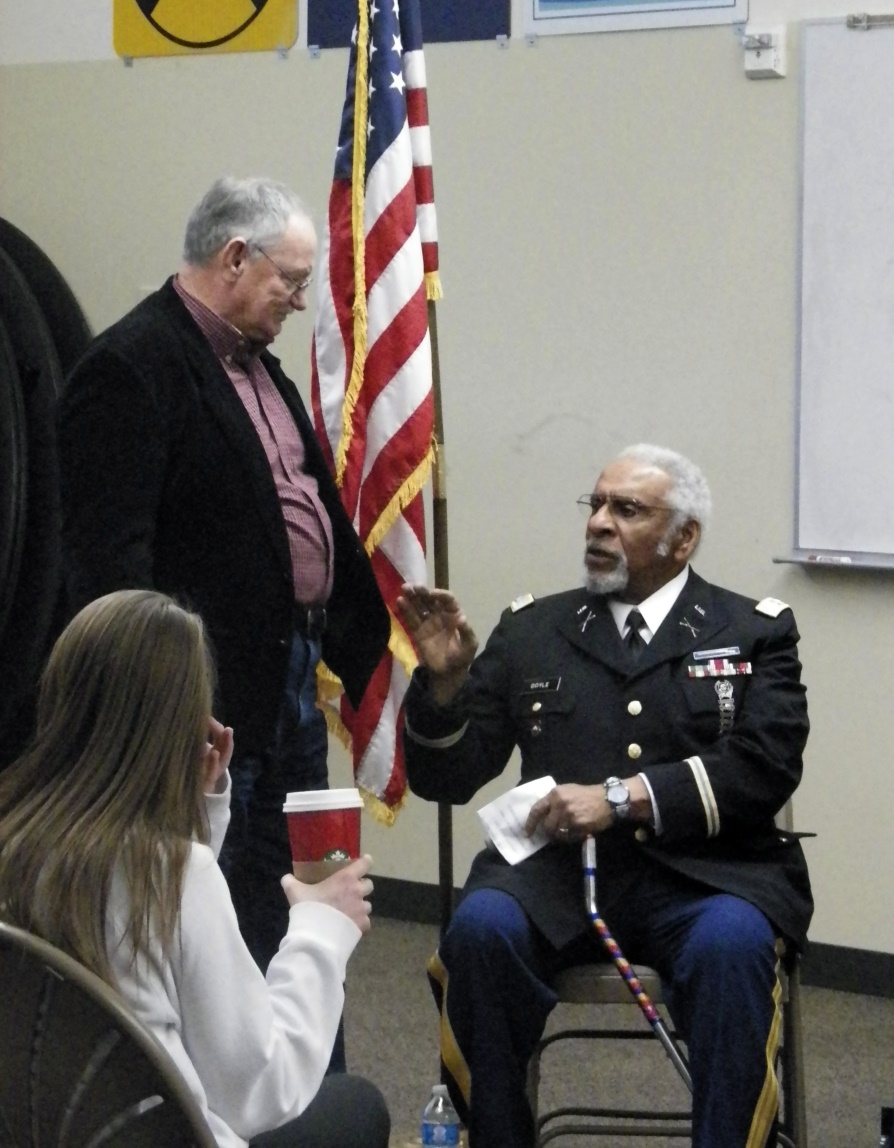
This week we paused to honor the men and women who have stepped up and accepted their position in military service for our country.  We all know someone (spouse, parent, child, neighbor) who has worn the uniforms of their Corps.  I am blessed to live with such a person, my husband, Col. Hayward Doyle, Jr. Army Retired.  His perspective on the multiple benefits of a robust and ready Military goes deep.  From the first days of training young adults are provided with invaluable structure in their lives.  This prepares them to not only defend our country and freedoms, but to continue thinking logically and strategically while developing themselves into exceptional citizens.  Col. Doyle is also sadly aware of the past and present shortcomings within the “systems.”  Thus it is that I am using the example of “characters” within any military-life-environment to introduce the concept of developing living characters in our writings.

Drill Instructors. They are given the task of “indoctrinating” recruits into the “customs and practices” of military life.  They, themselves, are examples (or should be examples) of excellence in all aspects of the practices and values honored by that Corps.  However, they are also human beings—with faults

The concept of this character-type is a good starting point for your main (protagonist) character.  The ethics, integrity and faith beliefs of this character must be as clearly defined as the rules and regulations demonstrated by a DI.

In spite of the unified structure of military units, the fact remains that each person is an individual who acts and reacts differently.  Although the pattern of Boot Camp and other types of training (character development) remains exactly the same for everyone, the DI (Drill Instructor) assesses each individual and “pushes” them in different ways in order to bring out their best efforts.

So it is with the writer.  You are developing a “unit” of characters who must work together within your storyline in order to bring about the exciting conclusion you’ve planned.  Who are they?  What were their lives like before stepping onto the pages of your story?  Who is the rebel among them?

Conflict. This element is always present in life—and military life—no matter how much education and training is involved to avoid it.  So the Military Police (MPs) became a unit to themselves.  Their main mission is to provide security support, compliance with “law and order,” and restraint (or detention) as needed.

No matter the level of conflict within your plot (minor or major), you will need one or more characters to solve or resolve the problems.  Their backgrounds should include a propensity toward discovery and investigation and a real need to bring about peace.

The next two or three blog entries will offer more ideas about character development. The ideas I’ve offered you today are (I hope) a different perspective that will jog your own skills and abilities as you create marvelous characters who will lead you into successful writing and publishing!

Royalene ABOUT ROYALENE DOYLE: Royalene Doyle is a Ghostwriter with Outskirts Press, bringing more than 35 years of writing experience to authors who need “just a little assistance” with completing their writing projects. She has worked with both experienced and fledgling writers helping complete projects in multiple genres. When a writer brings the passion they have for their work and combines it with Royalene’s passion to see the finished project in print, books are published and the writer’s legacy is passed forward.

Friday Conversations With A Self-Publishing Writer 11/07/14

CRITICAL THINKING—IV

“Knowledge is the advancing retrieval of clarity from uncertainty and confusion.” I may not have quoted that exactly (nor do I remember where I heard or read it), however, I love the concept of “advancing retrieval.”  Tis’ a bit of a paradox, which intrigues me and requires me to tap into my objectivity abilities to separate what is from what I imagine or believe.

One of my best childhood and young-adult friends (who is not a writer) was a master at stating his opinion in absolute terms. That was a trap I fell into way too many times, especially when restating his “fact” in term papers.  I could have gone the way of several of our other friends who discounted everything he ever said.  However, in some rather miraculous way, I came to appreciate his often unfathomable views and utilize them as a point of comparison with what I was discovering to be reality.  So it is that I offer you my final (for now anyway) points to consider on the topic of Critical Thinking.  Together with the previous three blogs, I hope these concepts will help you produce superb writings and reader-recognition.

    • Withhold Judgment. If a piece of information “tweaks” your ear and you immediately want to deny it—or accept and promote it—DIG DEEPER. Do the research. Go the extra investigative mile and put the puzzle pieces together. When the “fit” is natural, you’ll have your answer.
    • De-pressurize the Pressure. If editors are pushing you to complete a book or article and the words “just get it done” fall into your ear, STOP! The immediate temptation to follow that direction could produce a written work you will not be happy with and—as we know well—it remains “in print” forever—everywhere. It’s okay to remind the editor that their reputation is in play, too. If they don’t care, you may not want to work with/for them again.
    • Check and Re-Check the Facts. The journalistic rule of “two-or-more” sources is a good place to start. However, depending on your topic and the motive behind writing about it, building a chain of “evidence” that is good, better and best leads to a well-built and believable piece of writing.
    • Don’t Fear Questions. If uncertainty remains in your mind, it’s okay to include those in your writing. Readers appreciate being included in the discovery process and will buy your next book on that topic to “see” what you’ve learned that they missed.
    • Avoid Rationalization. I’ve listened to some “creative writing” instructors who insist that decisive writing is a technique that must be mastered and used in all written work. In the marketing arena everything is stated as “fact” and rationalization is a trap door used against the reader. Writers who employ this technique often fall into the consequences of poor decision-making themselves.
  • Appreciate Your Own Intuition. Hunches are those intriguing and sometimes logically-illogic threads that lead to great discoveries. Never hesitate to listen to them and follow their paths until you’re satisfied with what you find.

All of these elements of Critical Thinking serve the writer in “advancing the retrieval” of pieces to the puzzle of their writing projects—big or small.  Join the adventure! Retrieve that remnant of an idea and start advancing it!  Soon you’ll have it published and be writing the next one!

Royalene ABOUT ROYALENE DOYLE: Royalene Doyle is a Ghostwriter with Outskirts Press, bringing more than 35 years of writing experience to authors who need “just a little assistance” with completing their writing projects. She has worked with both experienced and fledgling writers helping complete projects in multiple genres. When a writer brings the passion they have for their work and combines it with Royalene’s passion to see the finished project in print, books are published and the writer’s legacy is passed forward.